| Record Information |
|---|
| Version | 2.0 |
|---|
| Created at | 2022-03-17 20:11:41 UTC |
|---|
| Updated at | 2022-03-17 20:11:41 UTC |
|---|
| NP-MRD ID | NP0046713 |
|---|
| Secondary Accession Numbers | None |
|---|
| Natural Product Identification |
|---|
| Common Name | Neuraminic-acid |
|---|
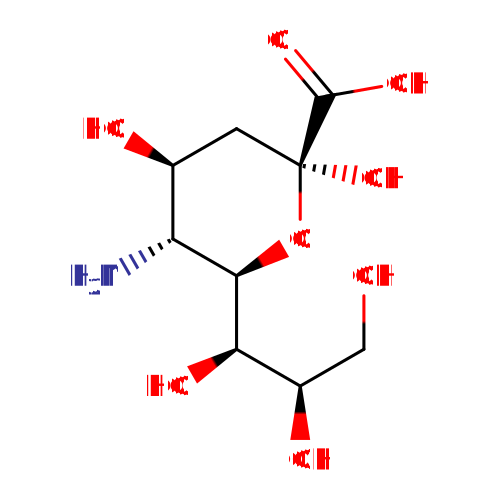
| Description | Neuraminic acid, also known as neuraminate or O-sialate, belongs to the class of organic compounds known as neuraminic acids. These are carbohydrate derivatives containing a neuraminic acid moiety. Neuraminic acid may also be visualized as the product of an aldol-condensation of pyruvic acid and D-mannosamine (2-amino-2-deoxy-mannose). Among their many biological functions, these structures are substrates for neuraminidase enzymes which cleave neuraminic acid residues. Neuraminic acid is a very strong basic compound (based on its pKa). Neuraminic acid, with regard to humans, has been linked to the inborn metabolic disorder salla disease. The hydroxyl substituents may vary considerably: Acetyl, lactyl, methyl, sulfate and phosphate groups have been found. The amino group bears either an acetyl or a glycolyl group. Neuraminic acid (5-amino-3,5-dideoxy-D-glycero-D-galacto-non-2-ulosonic acid) is an acidic amino sugar with a backbone formed by nine carbon atoms. Human flu viruses have a neuraminidase enzyme, signified in the name "H#N#", where the H refers to an isoform of hemagglutinin and N refers to an isoform of viral neuraminidase. Neuraminic acid does not occur naturally, but many of its derivatives are found widely distributed in animal tissues and in bacteria, especially in glycoproteins and gangliosides. The N- or O-substituted derivatives of neuraminic acid are collectively known as sialic acids, the predominant form in mammalian cells being N-acetylneuraminic acid. For example, N-acetylneuraminic acid, Neu5Ac, is typical in human glycoproteins. Although 9-carbon sugars do not occur naturally, neuraminic acid may be regarded as a theoretical 9-carbon ketose in which the first link of the chain (the –CH2OH at position 1) is oxidised into a carboxyl group (–C(O)OH), the hydroxyl group at position 3 is deoxidised (oxygen is removed from it), and the hydroxyl group at position 5 is substituted with an amino group (–NH2). The name "neuraminic acid" was introduced by German scientist E. Klenk in 1941, in reference to the brain lipids from which it was derived as a cleavage product. |
|---|
| Structure | N[C@@H]1[C@@H](O)C[C@](O)(O[C@H]1[C@H](O)[C@H](O)CO)C(O)=O InChI=1S/C9H17NO8/c10-5-3(12)1-9(17,8(15)16)18-7(5)6(14)4(13)2-11/h3-7,11-14,17H,1-2,10H2,(H,15,16)/t3-,4+,5+,6+,7+,9-/m0/s1 |
|---|
| Synonyms | | Value | Source |
|---|
| Neuraminate | Generator | | 5-(Acetylamino)-3,5-dideoxy-beta-L-erythro-2-nonulopyranosonate | HMDB | | 5-(Acetylamino)-3,5-dideoxy-beta-L-erythro-2-nonulopyranosonic acid | HMDB | | O-Sialate | HMDB | | O-Sialic acid | HMDB | | b-Neuraminate | HMDB | | b-Neuraminic acid | HMDB | | beta-Neuraminate | HMDB | | Β-neuraminate | HMDB | | Β-neuraminic acid | HMDB |
|
|---|
| Chemical Formula | C9H17NO8 |
|---|
| Average Mass | 267.2332 Da |
|---|
| Monoisotopic Mass | 267.09542 Da |
|---|
| IUPAC Name | (2S,4S,5R,6R)-5-amino-2,4-dihydroxy-6-[(1R,2R)-1,2,3-trihydroxypropyl]oxane-2-carboxylic acid |
|---|
| Traditional Name | β-neuraminic acid |
|---|
| CAS Registry Number | 114-04-5 |
|---|
| SMILES | N[C@@H]1[C@@H](O)C[C@](O)(O[C@H]1[C@H](O)[C@H](O)CO)C(O)=O |
|---|
| InChI Identifier | InChI=1S/C9H17NO8/c10-5-3(12)1-9(17,8(15)16)18-7(5)6(14)4(13)2-11/h3-7,11-14,17H,1-2,10H2,(H,15,16)/t3-,4+,5+,6+,7+,9-/m0/s1 |
|---|
| InChI Key | CERZMXAJYMMUDR-YOQZMRDMSA-N |
|---|
| Experimental Spectra |
|---|
|
| Not Available | | Predicted Spectra |
|---|
|
| Not Available | | Chemical Shift Submissions |
|---|
|
| Not Available | | Species |
|---|
| Species of Origin | |
|---|
| Chemical Taxonomy |
|---|
| Description | Belongs to the class of organic compounds known as neuraminic acids. These are carbohydrate derivatives containing a neuraminic acid moiety. |
|---|
| Kingdom | Organic compounds |
|---|
| Super Class | Organic oxygen compounds |
|---|
| Class | Organooxygen compounds |
|---|
| Sub Class | Carbohydrates and carbohydrate conjugates |
|---|
| Direct Parent | Neuraminic acids |
|---|
| Alternative Parents | |
|---|
| Substituents | - Neuraminic acid
- C-glucuronide
- Delta amino acid or derivatives
- C-glycosyl compound
- Glycosyl compound
- Amino saccharide
- Alpha-hydroxy acid
- Hydroxy acid
- Pyran
- Oxane
- 1,3-aminoalcohol
- 1,2-aminoalcohol
- Amino acid or derivatives
- Amino acid
- Hemiacetal
- Secondary alcohol
- Monocarboxylic acid or derivatives
- Polyol
- Organoheterocyclic compound
- Carboxylic acid derivative
- Oxacycle
- Carboxylic acid
- Primary alcohol
- Hydrocarbon derivative
- Carbonyl group
- Alcohol
- Organic oxide
- Organic nitrogen compound
- Amine
- Organopnictogen compound
- Organonitrogen compound
- Primary amine
- Primary aliphatic amine
- Aliphatic heteromonocyclic compound
|
|---|
| Molecular Framework | Aliphatic heteromonocyclic compounds |
|---|
| External Descriptors | - 5-amino-3,5-dideoxy-D-glycero-D-galacto-non-2-ulopyranosonic acid (CHEBI:49022 )
|
|---|
| Physical Properties |
|---|
| State | Not Available |
|---|
| Experimental Properties | | Property | Value | Reference |
|---|
| Melting Point | Not Available | Not Available | | Boiling Point | Not Available | Not Available | | Water Solubility | Not Available | Not Available | | LogP | Not Available | Not Available |
|
|---|
| Predicted Properties | |
|---|