| Record Information |
|---|
| Version | 2.0 |
|---|
| Created at | 2022-03-17 20:01:09 UTC |
|---|
| Updated at | 2022-03-17 20:01:09 UTC |
|---|
| NP-MRD ID | NP0046443 |
|---|
| Secondary Accession Numbers | None |
|---|
| Natural Product Identification |
|---|
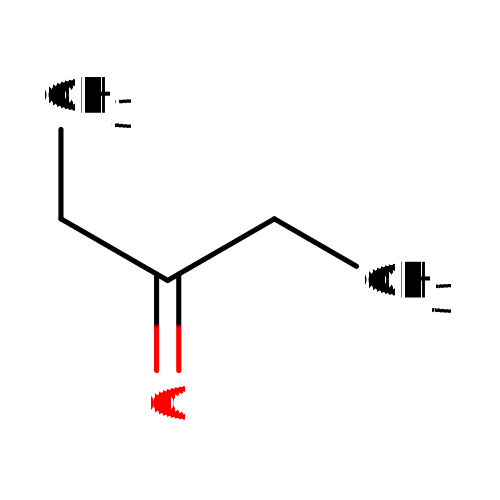
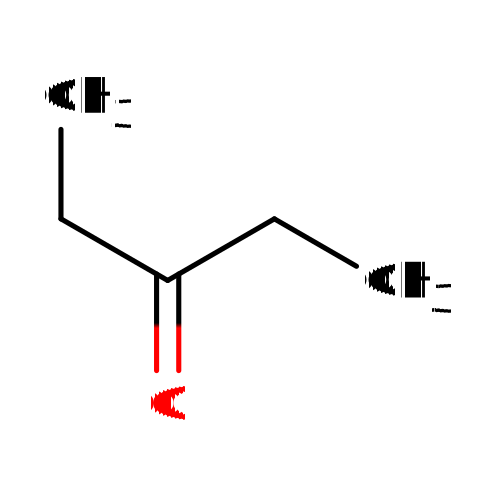
| Common Name | 3-Pentanone |
|---|
| Description | 3-Pentanone, also known as diethyl ketone or ethyl propionyl, belongs to the class of organic compounds known as ketones. These are organic compounds in which a carbonyl group is bonded to two carbon atoms R2C=O (neither R may be a hydrogen atom). Ketones that have one or more alpha-hydrogen atoms undergo keto-enol tautomerization, the tautomer being an enol. Thus, 3-pentanone is considered to be an oxygenated hydrocarbon lipid molecule. 3-Pentanone is a very hydrophobic molecule, practically insoluble (in water), and relatively neutral. 3-Pentanone is an acetone and ethereal tasting compound. Outside of the human body, 3-Pentanone has been detected, but not quantified in, several different foods, such as elliott's blueberries, lemon thymes, sweet rowanberries, towel gourds, and black raspberries. 3-Pentanone is found in Ananas comosus, Basella alba, Cichorium endivia, Medicago sativa , Myrtus communis , Opuntia ficus-indica, Oreotragus oreotragus, Perilla frutescens, Prunus avium , Zea mays and Zingiber mioga. 3-Pentanone was first documented in 2011 (PMID: 21486009). This could make 3-pentanone a potential biomarker for the consumption of these foods. |
|---|
| Structure | InChI=1S/C5H10O/c1-3-5(6)4-2/h3-4H2,1-2H3 |
|---|
| Synonyms | | Value | Source |
|---|
| Diethyl ketone | ChEBI | | Ethyl propionyl | ChEBI | | Pentan-3-one | ChEMBL | | Diethylketone | MeSH | | Diethyl ketone, 3-(14)C-labeled CPD | MeSH |
|
|---|
| Chemical Formula | C5H10O |
|---|
| Average Mass | 86.1323 Da |
|---|
| Monoisotopic Mass | 86.07316 Da |
|---|
| IUPAC Name | pentan-3-one |
|---|
| Traditional Name | 3-pentanone |
|---|
| CAS Registry Number | 96-22-0 |
|---|
| SMILES | CCC(=O)CC |
|---|
| InChI Identifier | InChI=1S/C5H10O/c1-3-5(6)4-2/h3-4H2,1-2H3 |
|---|
| InChI Key | FDPIMTJIUBPUKL-UHFFFAOYSA-N |
|---|
| Experimental Spectra |
|---|
|
| | Spectrum Type | Description | Depositor Email | Depositor Organization | Depositor | Deposition Date | View |
|---|
| 1D NMR | 1H NMR Spectrum (1D, 400 MHz, CDCl3, experimental) | Wishart Lab | Wishart Lab | David Wishart | 2021-06-20 | View Spectrum | | 1D NMR | 13C NMR Spectrum (1D, 15.09 MHz, CDCl3, experimental) | Wishart Lab | Wishart Lab | David Wishart | 2021-06-20 | View Spectrum |
| | Predicted Spectra |
|---|
|
| Not Available | | Chemical Shift Submissions |
|---|
|
| Not Available | | Species |
|---|
| Species of Origin | |
|---|
| Chemical Taxonomy |
|---|
| Description | Belongs to the class of organic compounds known as ketones. These are organic compounds in which a carbonyl group is bonded to two carbon atoms R2C=O (neither R may be a hydrogen atom). Ketones that have one or more alpha-hydrogen atoms undergo keto-enol tautomerization, the tautomer being an enol. |
|---|
| Kingdom | Organic compounds |
|---|
| Super Class | Organic oxygen compounds |
|---|
| Class | Organooxygen compounds |
|---|
| Sub Class | Carbonyl compounds |
|---|
| Direct Parent | Ketones |
|---|
| Alternative Parents | |
|---|
| Substituents | - Ketone
- Organic oxide
- Hydrocarbon derivative
- Aliphatic acyclic compound
|
|---|
| Molecular Framework | Aliphatic acyclic compounds |
|---|
| External Descriptors | |
|---|
| Physical Properties |
|---|
| State | Not Available |
|---|
| Experimental Properties | | Property | Value | Reference |
|---|
| Melting Point | Not Available | Not Available | | Boiling Point | Not Available | Not Available | | Water Solubility | Not Available | Not Available | | LogP | Not Available | Not Available |
|
|---|
| Predicted Properties | |
|---|