| Record Information |
|---|
| Version | 2.0 |
|---|
| Created at | 2022-03-17 20:00:42 UTC |
|---|
| Updated at | 2022-03-17 20:00:42 UTC |
|---|
| NP-MRD ID | NP0046416 |
|---|
| Secondary Accession Numbers | None |
|---|
| Natural Product Identification |
|---|
| Common Name | Amabiline |
|---|
| Description | Amabiline is found in Amsinckia retrorsa, Crinum kirkii, Critonia portoricensis, Cryptantha virginensis, Cynoglossum amabile, Cynoglossum amabile Stapf.et Drummond., Cynoglossum australe, Cynoglossum glochidiatum , Cynoglossum officinale, Eupatorium japonicum, Heliotropium curassavicum, Heliotropium spathulatum, Liatris punctata, Lindelofia angustifolia and Neatostema apulum. Amabiline was first documented in 2012 (PMID: 22432912). |
|---|
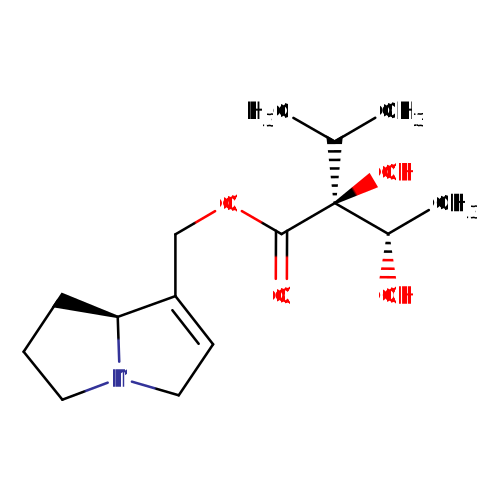
| Structure | [H][C@@]12CCCN1CC=C2COC(=O)[C@](O)(C(C)C)[C@H](C)O InChI=1S/C15H25NO4/c1-10(2)15(19,11(3)17)14(18)20-9-12-6-8-16-7-4-5-13(12)16/h6,10-11,13,17,19H,4-5,7-9H2,1-3H3/t11-,13-,15-/m0/s1 |
|---|
| Synonyms | | Value | Source |
|---|
| Butanoic acid, 2,3-dihydroxy-2-(1-methylethyl)-, (2,3,5,7a-tetrahydro-1H-pyrrolidizin-7-yl)methyl ester | ChEBI | | Butanoate, 2,3-dihydroxy-2-(1-methylethyl)-, (2,3,5,7a-tetrahydro-1H-pyrrolidizin-7-yl)methyl ester | Generator |
|
|---|
| Chemical Formula | C15H25NO4 |
|---|
| Average Mass | 283.3633 Da |
|---|
| Monoisotopic Mass | 283.17836 Da |
|---|
| IUPAC Name | (7aS)-2,3,5,7a-tetrahydro-1H-pyrrolizin-7-ylmethyl (2S)-2-hydroxy-2-[(1S)-1-hydroxyethyl]-3-methylbutanoate |
|---|
| Traditional Name | amabiline |
|---|
| CAS Registry Number | 17958-43-9 |
|---|
| SMILES | [H][C@@]12CCCN1CC=C2COC(=O)[C@](O)(C(C)C)[C@H](C)O |
|---|
| InChI Identifier | InChI=1S/C15H25NO4/c1-10(2)15(19,11(3)17)14(18)20-9-12-6-8-16-7-4-5-13(12)16/h6,10-11,13,17,19H,4-5,7-9H2,1-3H3/t11-,13-,15-/m0/s1 |
|---|
| InChI Key | DRVWTOSBCBKXOR-WHOFXGATSA-N |
|---|
| Experimental Spectra |
|---|
|
| Not Available | | Predicted Spectra |
|---|
|
| Not Available | | Chemical Shift Submissions |
|---|
|
| Not Available | | Species |
|---|
| Species of Origin | |
|---|
| Chemical Taxonomy |
|---|
| Description | Belongs to the class of organic compounds known as alkaloids and derivatives. These are naturally occurring chemical compounds that contain mostly basic nitrogen atoms. This group also includes some related compounds with neutral and even weakly acidic properties. Also some synthetic compounds of similar structure are attributed to alkaloids. In addition to carbon, hydrogen and nitrogen, alkaloids may also contain oxygen, sulfur and more rarely other elements such as chlorine, bromine, and phosphorus. |
|---|
| Kingdom | Organic compounds |
|---|
| Super Class | Alkaloids and derivatives |
|---|
| Class | Not Available |
|---|
| Sub Class | Not Available |
|---|
| Direct Parent | Alkaloids and derivatives |
|---|
| Alternative Parents | |
|---|
| Substituents | - Alkaloid or derivatives
- Pyrrolizine
- Beta-hydroxy acid
- Fatty acid ester
- Hydroxy acid
- Fatty acyl
- N-alkylpyrrolidine
- Pyrrolidine
- Tertiary alcohol
- Pyrroline
- 1,2-diol
- Amino acid or derivatives
- Carboxylic acid ester
- Tertiary aliphatic amine
- Tertiary amine
- Secondary alcohol
- Carboxylic acid derivative
- Azacycle
- Monocarboxylic acid or derivatives
- Organoheterocyclic compound
- Alcohol
- Hydrocarbon derivative
- Organic oxide
- Organic nitrogen compound
- Carbonyl group
- Organopnictogen compound
- Organic oxygen compound
- Organonitrogen compound
- Organooxygen compound
- Amine
- Aliphatic heteropolycyclic compound
|
|---|
| Molecular Framework | Aliphatic heteropolycyclic compounds |
|---|
| External Descriptors | |
|---|
| Physical Properties |
|---|
| State | Not Available |
|---|
| Experimental Properties | | Property | Value | Reference |
|---|
| Melting Point | Not Available | Not Available | | Boiling Point | Not Available | Not Available | | Water Solubility | Not Available | Not Available | | LogP | Not Available | Not Available |
|
|---|
| Predicted Properties | |
|---|