| Record Information |
|---|
| Version | 2.0 |
|---|
| Created at | 2022-03-17 19:49:10 UTC |
|---|
| Updated at | 2022-03-17 19:49:10 UTC |
|---|
| NP-MRD ID | NP0046142 |
|---|
| Secondary Accession Numbers | None |
|---|
| Natural Product Identification |
|---|
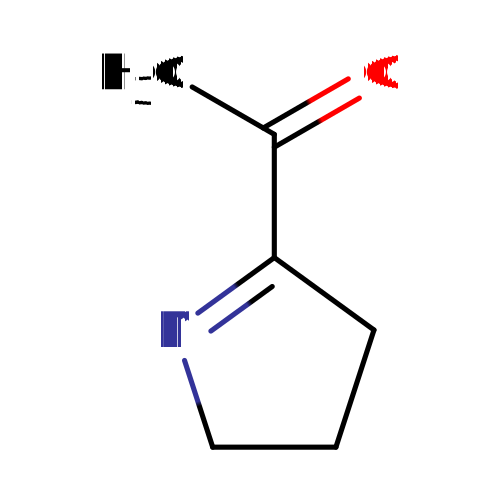
| Common Name | 5-Acetyl-3,4-dihydro-2H-pyrrole |
|---|
| Description | 5-Acetyl-3,4-dihydro-2H-pyrrole, also known as 2AP or APR, belongs to the class of organic compounds known as pyrrolines. Pyrrolines are compounds containing a pyrroline ring, which is a five-member unsaturated aliphatic ring with one nitrogen atom and four carbon atoms. It is one of the key odourants of the crust of bread and considered to be responsible for the cracker-like odour properties. A pyrroline that is 1-pyrroline in which the hydrogen at position 2 is replaced by an acetyl group. 5-Acetyl-3,4-dihydro-2H-pyrrole is a strong basic compound (based on its pKa). 5-Acetyl-3,4-dihydro-2H-pyrrole is a sweet, ham, and nut tasting compound. Outside of the human body, 5-Acetyl-3,4-dihydro-2H-pyrrole has been detected, but not quantified in, cereals and cereal products and tortilla chips. This could make 5-acetyl-3,4-dihydro-2H-pyrrole a potential biomarker for the consumption of these foods. It is an aroma and flavour compound present in jasmine rice and basmati rice. It is responsible for the 'popcorn' aroma in a large variety of cereal and food products. 5-Acetyl-3,4-dihydro-2H-pyrrole is found in Pandanus amaryllifolius. 5-Acetyl-3,4-dihydro-2H-pyrrole was first documented in 2002 (PMID: 12428963). In bread, it is primarily generated during baking but amounts are influenced by ingredient composition and fermentation conditions (PMID: 12517110) (PMID: 16356012) (PMID: 16771451) (PMID: 20497370) (PMID: 20800726) (PMID: 22404867). |
|---|
| Structure | InChI=1S/C6H9NO/c1-5(8)6-3-2-4-7-6/h2-4H2,1H3 |
|---|
| Synonyms | | Value | Source |
|---|
| 2-Acetyl-4,5-dihydro-3H-pyrrole | ChEBI | | 2AP | ChEBI | | APR | ChEBI | | 1-(3,4-Dihydro-2H-pyrrol-5-yl)ethanone | HMDB | | 1-(3,4-Dihydro-2H-pyrrol-5-yl)ethanone, 9ci | HMDB | | 1-Pyrroline, 2-acetyl | HMDB | | 2-Acetyl-1-pyrolline | HMDB | | 2-Acetyl-1-pyrroline | HMDB | | 2-Acetylpyrroline | HMDB |
|
|---|
| Chemical Formula | C6H9NO |
|---|
| Average Mass | 111.1418 Da |
|---|
| Monoisotopic Mass | 111.06841 Da |
|---|
| IUPAC Name | 1-(3,4-dihydro-2H-pyrrol-5-yl)ethan-1-one |
|---|
| Traditional Name | 2-acetyl-1-pyrroline |
|---|
| CAS Registry Number | 85213-22-5 |
|---|
| SMILES | CC(=O)C1=NCCC1 |
|---|
| InChI Identifier | InChI=1S/C6H9NO/c1-5(8)6-3-2-4-7-6/h2-4H2,1H3 |
|---|
| InChI Key | DQBQWWSFRPLIAX-UHFFFAOYSA-N |
|---|
| Experimental Spectra |
|---|
|
| Not Available | | Predicted Spectra |
|---|
|
| Not Available | | Chemical Shift Submissions |
|---|
|
| Not Available | | Species |
|---|
| Species of Origin | |
|---|
| Chemical Taxonomy |
|---|
| Description | Belongs to the class of organic compounds known as pyrrolines. Pyrrolines are compounds containing a pyrroline ring, which is a five-member unsaturated aliphatic ring with one nitrogen atom and four carbon atoms. |
|---|
| Kingdom | Organic compounds |
|---|
| Super Class | Organoheterocyclic compounds |
|---|
| Class | Pyrrolines |
|---|
| Sub Class | Not Available |
|---|
| Direct Parent | Pyrrolines |
|---|
| Alternative Parents | |
|---|
| Substituents | - Pyrroline
- Ketimine
- Ketone
- Propargyl-type 1,3-dipolar organic compound
- Organic 1,3-dipolar compound
- Azacycle
- Carbonyl group
- Organopnictogen compound
- Organooxygen compound
- Organonitrogen compound
- Organic oxygen compound
- Organic nitrogen compound
- Imine
- Hydrocarbon derivative
- Organic oxide
- Aliphatic heteromonocyclic compound
|
|---|
| Molecular Framework | Aliphatic heteromonocyclic compounds |
|---|
| External Descriptors | |
|---|
| Physical Properties |
|---|
| State | Not Available |
|---|
| Experimental Properties | | Property | Value | Reference |
|---|
| Melting Point | Not Available | Not Available | | Boiling Point | Not Available | Not Available | | Water Solubility | Not Available | Not Available | | LogP | Not Available | Not Available |
|
|---|
| Predicted Properties | |
|---|
| General References | - Costello PJ, Henschke PA: Mousy off-flavor of wine: precursors and biosynthesis of the causative N-heterocycles 2-ethyltetrahydropyridine, 2-acetyltetrahydropyridine, and 2-acetyl-1-pyrroline by Lactobacillus hilgardii DSM 20176. J Agric Food Chem. 2002 Nov 20;50(24):7079-87. doi: 10.1021/jf020341r. [PubMed:12428963 ]
- Wongpornchai S, Sriseadka T, Choonvisase S: Identification and quantitation of the rice aroma compound, 2-acetyl-1-pyrroline, in bread flowers (Vallaris glabra Ktze). J Agric Food Chem. 2003 Jan 15;51(2):457-62. doi: 10.1021/jf025856x. [PubMed:12517110 ]
- Harrison TJ, Dake GR: An expeditious, high-yielding construction of the food aroma compounds 6-acetyl-1,2,3,4-tetrahydropyridine and 2-acetyl-1-pyrroline. J Org Chem. 2005 Dec 23;70(26):10872-4. doi: 10.1021/jo051940a. [PubMed:16356012 ]
- Adams A, De Kimpe N: Chemistry of 2-acetyl-1-pyrroline, 6-acetyl-1,2,3,4-tetrahydropyridine, 2-acetyl-2-thiazoline, and 5-acetyl-2,3-dihydro-4H-thiazine: extraordinary Maillard flavor compounds. Chem Rev. 2006 Jun;106(6):2299-319. doi: 10.1021/cr040097y. [PubMed:16771451 ]
- Arikit S, Yoshihashi T, Wanchana S, Uyen TT, Huong NT, Wongpornchai S, Vanavichit A: Deficiency in the amino aldehyde dehydrogenase encoded by GmAMADH2, the homologue of rice Os2AP, enhances 2-acetyl-1-pyrroline biosynthesis in soybeans (Glycine max L.). Plant Biotechnol J. 2011 Jan;9(1):75-87. doi: 10.1111/j.1467-7652.2010.00533.x. [PubMed:20497370 ]
- Maraval I, Sen K, Agrebi A, Menut C, Morere A, Boulanger R, Gay F, Mestres C, Gunata Z: Quantification of 2-acetyl-1-pyrroline in rice by stable isotope dilution assay through headspace solid-phase microextraction coupled to gas chromatography-tandem mass spectrometry. Anal Chim Acta. 2010 Aug 24;675(2):148-55. doi: 10.1016/j.aca.2010.07.024. Epub 2010 Jul 21. [PubMed:20800726 ]
- Poonlaphdecha J, Maraval I, Roques S, Audebert A, Boulanger R, Bry X, Gunata Z: Effect of timing and duration of salt treatment during growth of a fragrant rice variety on yield and 2-acetyl-1-pyrroline, proline, and GABA Levels. J Agric Food Chem. 2012 Apr 18;60(15):3824-30. doi: 10.1021/jf205130y. Epub 2012 Apr 5. [PubMed:22404867 ]
|
|---|