| Record Information |
|---|
| Version | 2.0 |
|---|
| Created at | 2022-03-17 19:48:53 UTC |
|---|
| Updated at | 2022-03-17 19:48:53 UTC |
|---|
| NP-MRD ID | NP0046124 |
|---|
| Secondary Accession Numbers | None |
|---|
| Natural Product Identification |
|---|
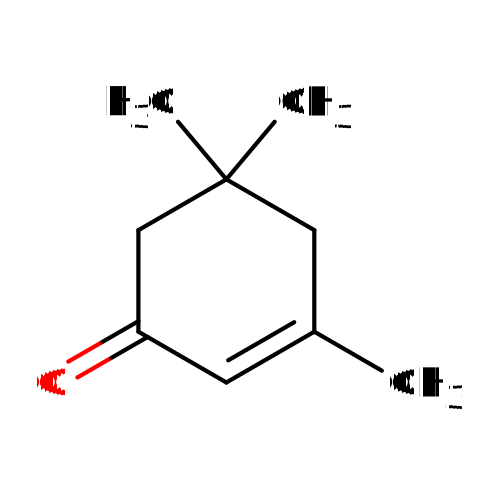
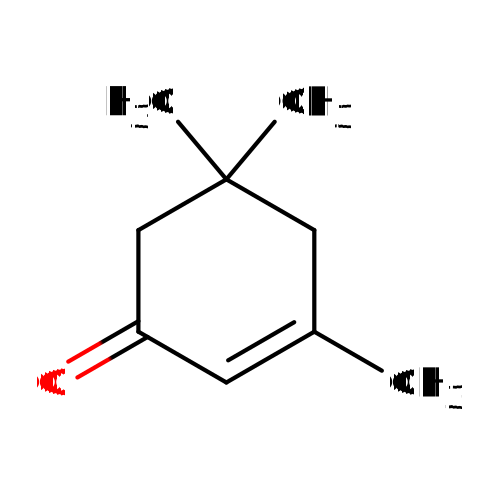
| Common Name | 3,5,5-Trimethyl-2-cyclohexen-1-one |
|---|
| Description | 3,5,5-Trimethyl-2-cyclohexen-1-one, also known as isoforone or isoacetophorone, belongs to the class of organic compounds known as cyclohexenones. Cyclohexenones are compounds containing a cylohexenone moiety, which is a six-membered aliphatic ring that carries a ketone and has one endocyclic double bond. 3,5,5-Trimethyl-2-cyclohexen-1-one is a flavouring ingredient. 3,5,5-Trimethyl-2-cyclohexen-1-one is an extremely weak basic (essentially neutral) compound (based on its pKa). 3,5,5-Trimethyl-2-cyclohexen-1-one is a sweet, camphor, and camphoraceous tasting compound. Outside of the human body, 3,5,5-Trimethyl-2-cyclohexen-1-one is found, on average, in the highest concentration within kohlrabis. 3,5,5-Trimethyl-2-cyclohexen-1-one has also been detected, but not quantified in, several different foods, such as saffrons, cherry tomato, garden tomato (var.), White mustards, and garden tomato. 3,5,5-Trimethyl-2-cyclohexen-1-one is found in Amauris echeria, Artemisia judaica, Prunus armeniaca L. (K604-19,K113-40,K33-81) , Prunus salcina Lindl. (Friar), Taxus baccata , Vaccinium macrocarpon and Vaccinium microcarpa. 3,5,5-Trimethyl-2-cyclohexen-1-one was first documented in 2013 (PMID: 23183344). This could make 3,5,5-trimethyl-2-cyclohexen-1-one a potential biomarker for the consumption of these foods (PMID: 23472460) (PMID: 23506080) (PMID: 23923622). |
|---|
| Structure | InChI=1S/C9H14O/c1-7-4-8(10)6-9(2,3)5-7/h4H,5-6H2,1-3H3 |
|---|
| Synonyms | | Value | Source |
|---|
| 1,1,3-Trimethyl-3-cyclohexene-5-one | ChEBI | | 3,5,5-Trimethyl-2-cyclohexen-1-ON | ChEBI | | Isoacetophorone | ChEBI | | Isoforone | ChEBI | | Isooctopherone | ChEBI | | Izoforon | ChEBI | | 1,1, 3-Trimethyl-3-cyclohexene-5-one | HMDB | | 1,5,5-Trimethyl-1-cyclohexen-3-one | HMDB | | 3,3,5-Trimethyl-2-cyclohexen-1-one | HMDB | | 3,5, 5-Trimethyl-2-cyclohexene-1-one | HMDB | | 3,5,5-Trimethyl-2-cyclohexene-1-one | HMDB | | 3,5,5-Trimethyl-2-cyclohexenone | HMDB | | 3,5,5-Trimethylcyclohex-2-enone | HMDB | | 3,5,5-Trimethylcyclohexen one | HMDB | | 3,5,5-Trimethylcyclohexen-2-one-1 | HMDB | | 3,5,5-Trimethylcyclohexenone | HMDB | | 3,5,5-Trimetil-2-cicloesen-1-one | HMDB | | a-Isophorone | HMDB | | alpha -Isophoron | HMDB | | alpha -Isophorone | HMDB | | alpha-Isophorone | HMDB | | DIIsophorone | HMDB | | FEMA 3553 | HMDB | | Isoforon | HMDB | | Isophoron | HMDB | | Isophorone | HMDB | | Isophorone, reag | HMDB | | Nchem.180-comp3 | HMDB |
|
|---|
| Chemical Formula | C9H14O |
|---|
| Average Mass | 138.2069 Da |
|---|
| Monoisotopic Mass | 138.10447 Da |
|---|
| IUPAC Name | 3,5,5-trimethylcyclohex-2-en-1-one |
|---|
| Traditional Name | isophorone |
|---|
| CAS Registry Number | 78-59-1 |
|---|
| SMILES | CC1=CC(=O)CC(C)(C)C1 |
|---|
| InChI Identifier | InChI=1S/C9H14O/c1-7-4-8(10)6-9(2,3)5-7/h4H,5-6H2,1-3H3 |
|---|
| InChI Key | HJOVHMDZYOCNQW-UHFFFAOYSA-N |
|---|
| Experimental Spectra |
|---|
|
| Not Available | | Predicted Spectra |
|---|
|
| Not Available | | Chemical Shift Submissions |
|---|
|
| Not Available | | Species |
|---|
| Species of Origin | |
|---|
| Chemical Taxonomy |
|---|
| Description | Belongs to the class of organic compounds known as cyclohexenones. Cyclohexenones are compounds containing a cylohexenone moiety, which is a six-membered aliphatic ring that carries a ketone and has one endocyclic double bond. |
|---|
| Kingdom | Organic compounds |
|---|
| Super Class | Organic oxygen compounds |
|---|
| Class | Organooxygen compounds |
|---|
| Sub Class | Carbonyl compounds |
|---|
| Direct Parent | Cyclohexenones |
|---|
| Alternative Parents | |
|---|
| Substituents | - Cyclohexenone
- Organic oxide
- Hydrocarbon derivative
- Aliphatic homomonocyclic compound
|
|---|
| Molecular Framework | Aliphatic homomonocyclic compounds |
|---|
| External Descriptors | |
|---|
| Physical Properties |
|---|
| State | Not Available |
|---|
| Experimental Properties | | Property | Value | Reference |
|---|
| Melting Point | Not Available | Not Available | | Boiling Point | Not Available | Not Available | | Water Solubility | Not Available | Not Available | | LogP | Not Available | Not Available |
|
|---|
| Predicted Properties | |
|---|
| General References | - Wei H, Yan X, Li X, He S, Sun C: The degradation of Isophorone by catalytic wet air oxidation on Ru/TiZrO4. J Hazard Mater. 2013 Jan 15;244-245:478-88. doi: 10.1016/j.jhazmat.2012.10.069. Epub 2012 Nov 5. [PubMed:23183344 ]
- Kiran I, Ozsen O, Celik T, Ilhan S, Gursu BY, Demirci F: Microbial transformations of isophorone by Alternaria alternata and Neurospora crassa. Nat Prod Commun. 2013 Jan;8(1):59-61. [PubMed:23472460 ]
- Zheng Z, Yu Z, Yang M, Jin F, Zhang Q, Zhou H, Wu J, Tian Y: Substituent group variations directing the molecular packing, electronic structure, and aggregation-induced emission property of isophorone derivatives. J Org Chem. 2013 Apr 5;78(7):3222-34. doi: 10.1021/jo400116j. Epub 2013 Mar 25. [PubMed:23506080 ]
- Zong S, Liu X, Cao C, Luo Y, Ren L, Zhang H: Development of semiochemical attractants for monitoring and controlling Chlorophorus caragana. Z Naturforsch C J Biosci. 2013 May-Jun;68(5-6):243-52. [PubMed:23923622 ]
|
|---|