| Record Information |
|---|
| Version | 2.0 |
|---|
| Created at | 2022-03-17 19:48:14 UTC |
|---|
| Updated at | 2022-03-17 19:48:14 UTC |
|---|
| NP-MRD ID | NP0046091 |
|---|
| Secondary Accession Numbers | None |
|---|
| Natural Product Identification |
|---|
| Common Name | 2-Decenal |
|---|
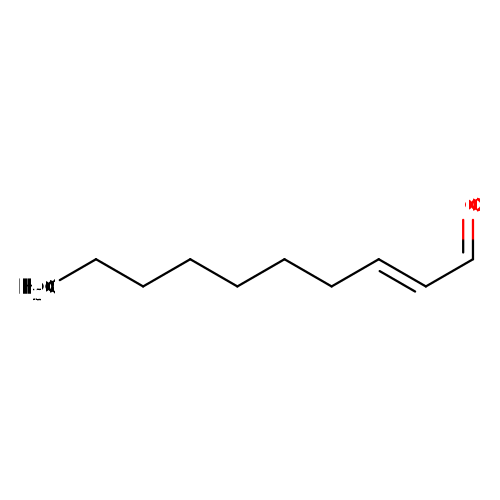
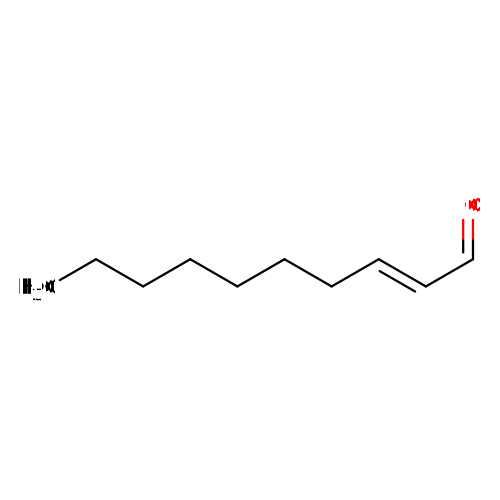
| Description | 2-Decenal, also known as (e)-2-decenal or t-2-dca, belongs to the class of organic compounds known as medium-chain aldehydes. These are an aldehyde with a chain length containing between 6 and 12 carbon atoms. Thus, 2-decenal is considered to be a fatty aldehyde lipid molecule. 2-Decenal is a very hydrophobic molecule, practically insoluble (in water), and relatively neutral. 2-Decenal is an aldehydic, fatty, and floral tasting compound. Outside of the human body, 2-Decenal has been detected, but not quantified in, several different foods, such as garden tomato, herbs and spices, soy beans, potato, and nuts. This could make 2-decenal a potential biomarker for the consumption of these foods. 2-Decenal is found in Akebia trifoliata, Anthemis aciphylla, Atractylodes macrocephala, Coriandrum sativum, Cynomorium songaricum, Daucus carota, Paeonia lactiflora, Polygonum minus, Vaccinium macrocarpon and Vaccinium vitis-idaea. 2-Decenal was first documented in 2006 (PMID: 16216463). A dec-2-enal in which the olefinic double bond has E configuration (PMID: 25619643) (PMID: 18605734) (PMID: 20164502) (PMID: 24552061) (PMID: 27656692). |
|---|
| Structure | InChI=1S/C10H18O/c1-2-3-4-5-6-7-8-9-10-11/h8-10H,2-7H2,1H3/b9-8+ |
|---|
| Synonyms | | Value | Source |
|---|
| (e)-2-Decenal | ChEBI | | t-2-DCA | ChEBI | | trans-2-Decenal | ChEBI | | trans-Dec-2-enal | ChEBI | | (2E)-Decenal | MeSH | | Decenal | MeSH | | Dec-2-enal | HMDB | | FEMA 2366 | HMDB |
|
|---|
| Chemical Formula | C10H18O |
|---|
| Average Mass | 154.2493 Da |
|---|
| Monoisotopic Mass | 154.13577 Da |
|---|
| IUPAC Name | (2E)-dec-2-enal |
|---|
| Traditional Name | 2-decenal |
|---|
| CAS Registry Number | 3913-71-1 |
|---|
| SMILES | CCCCCCC\C=C\C=O |
|---|
| InChI Identifier | InChI=1S/C10H18O/c1-2-3-4-5-6-7-8-9-10-11/h8-10H,2-7H2,1H3/b9-8+ |
|---|
| InChI Key | MMFCJPPRCYDLLZ-CMDGGOBGSA-N |
|---|
| Experimental Spectra |
|---|
|
| Not Available | | Predicted Spectra |
|---|
|
| | Spectrum Type | Description | Depositor ID | Depositor Organization | Depositor | Deposition Date | View |
|---|
| 1D NMR | 13C NMR Spectrum (1D, 25 MHz, D2O, predicted) | Wishart Lab | Wishart Lab | David Wishart | 2021-06-20 | View Spectrum | | 1D NMR | 1H NMR Spectrum (1D, 100 MHz, D2O, predicted) | Wishart Lab | Wishart Lab | David Wishart | 2021-06-20 | View Spectrum | | 1D NMR | 13C NMR Spectrum (1D, 252 MHz, D2O, predicted) | Wishart Lab | Wishart Lab | David Wishart | 2021-06-20 | View Spectrum | | 1D NMR | 1H NMR Spectrum (1D, 1000 MHz, D2O, predicted) | Wishart Lab | Wishart Lab | David Wishart | 2021-06-20 | View Spectrum | | 1D NMR | 13C NMR Spectrum (1D, 50 MHz, D2O, predicted) | Wishart Lab | Wishart Lab | David Wishart | 2021-06-20 | View Spectrum | | 1D NMR | 1H NMR Spectrum (1D, 200 MHz, D2O, predicted) | Wishart Lab | Wishart Lab | David Wishart | 2021-06-20 | View Spectrum | | 1D NMR | 13C NMR Spectrum (1D, 75 MHz, D2O, predicted) | Wishart Lab | Wishart Lab | David Wishart | 2021-06-20 | View Spectrum | | 1D NMR | 1H NMR Spectrum (1D, 300 MHz, D2O, predicted) | Wishart Lab | Wishart Lab | David Wishart | 2021-06-20 | View Spectrum | | 1D NMR | 13C NMR Spectrum (1D, 101 MHz, D2O, predicted) | Wishart Lab | Wishart Lab | David Wishart | 2021-06-20 | View Spectrum | | 1D NMR | 1H NMR Spectrum (1D, 400 MHz, D2O, predicted) | Wishart Lab | Wishart Lab | David Wishart | 2021-06-20 | View Spectrum | | 1D NMR | 13C NMR Spectrum (1D, 126 MHz, D2O, predicted) | Wishart Lab | Wishart Lab | David Wishart | 2021-06-20 | View Spectrum | | 1D NMR | 1H NMR Spectrum (1D, 500 MHz, D2O, predicted) | Wishart Lab | Wishart Lab | David Wishart | 2021-06-20 | View Spectrum | | 1D NMR | 13C NMR Spectrum (1D, 151 MHz, D2O, predicted) | Wishart Lab | Wishart Lab | David Wishart | 2021-06-20 | View Spectrum | | 1D NMR | 1H NMR Spectrum (1D, 600 MHz, D2O, predicted) | Wishart Lab | Wishart Lab | David Wishart | 2021-06-20 | View Spectrum | | 1D NMR | 13C NMR Spectrum (1D, 176 MHz, D2O, predicted) | Wishart Lab | Wishart Lab | David Wishart | 2021-06-20 | View Spectrum | | 1D NMR | 1H NMR Spectrum (1D, 700 MHz, D2O, predicted) | Wishart Lab | Wishart Lab | David Wishart | 2021-06-20 | View Spectrum | | 1D NMR | 13C NMR Spectrum (1D, 201 MHz, D2O, predicted) | Wishart Lab | Wishart Lab | David Wishart | 2021-06-20 | View Spectrum | | 1D NMR | 1H NMR Spectrum (1D, 800 MHz, D2O, predicted) | Wishart Lab | Wishart Lab | David Wishart | 2021-06-20 | View Spectrum | | 1D NMR | 13C NMR Spectrum (1D, 226 MHz, D2O, predicted) | Wishart Lab | Wishart Lab | David Wishart | 2021-06-20 | View Spectrum | | 1D NMR | 1H NMR Spectrum (1D, 900 MHz, D2O, predicted) | Wishart Lab | Wishart Lab | David Wishart | 2021-06-20 | View Spectrum |
| | Chemical Shift Submissions |
|---|
|
| Not Available | | Species |
|---|
| Species of Origin | |
|---|
| Chemical Taxonomy |
|---|
| Description | Belongs to the class of organic compounds known as medium-chain aldehydes. These are an aldehyde with a chain length containing between 6 and 12 carbon atoms. |
|---|
| Kingdom | Organic compounds |
|---|
| Super Class | Organic oxygen compounds |
|---|
| Class | Organooxygen compounds |
|---|
| Sub Class | Carbonyl compounds |
|---|
| Direct Parent | Medium-chain aldehydes |
|---|
| Alternative Parents | |
|---|
| Substituents | - Medium-chain aldehyde
- Enal
- Alpha,beta-unsaturated aldehyde
- Organic oxide
- Hydrocarbon derivative
- Aliphatic acyclic compound
|
|---|
| Molecular Framework | Aliphatic acyclic compounds |
|---|
| External Descriptors | |
|---|
| Physical Properties |
|---|
| State | Not Available |
|---|
| Experimental Properties | | Property | Value | Reference |
|---|
| Melting Point | Not Available | Not Available | | Boiling Point | Not Available | Not Available | | Water Solubility | Not Available | Not Available | | LogP | Not Available | Not Available |
|
|---|
| Predicted Properties | |
|---|
| General References | - Mesa J, Alsina C, Oppermann U, Pares X, Farres J, Porte S: Human prostaglandin reductase 1 (PGR1): Substrate specificity, inhibitor analysis and site-directed mutagenesis. Chem Biol Interact. 2015 Jun 5;234:105-13. doi: 10.1016/j.cbi.2015.01.021. Epub 2015 Jan 22. [PubMed:25619643 ]
- Dung CH, Wu SC, Yen GC: Genotoxicity and oxidative stress of the mutagenic compounds formed in fumes of heated soybean oil, sunflower oil and lard. Toxicol In Vitro. 2006 Jun;20(4):439-47. doi: 10.1016/j.tiv.2005.08.019. Epub 2005 Oct 10. [PubMed:16216463 ]
- Kim J, Seo SM, Lee SG, Shin SC, Park IK: Nematicidal activity of plant essential oils and components from coriander (Coriandrum sativum), Oriental sweetgum (Liquidambar orientalis), and valerian (Valeriana wallichii) essential oils against pine wood nematode (Bursaphelenchus xylophilus). J Agric Food Chem. 2008 Aug 27;56(16):7316-20. doi: 10.1021/jf800780f. Epub 2008 Jul 8. [PubMed:18605734 ]
- Sjaastad AK, Jorgensen RB, Svendsen K: Exposure to polycyclic aromatic hydrocarbons (PAHs), mutagenic aldehydes and particulate matter during pan frying of beefsteak. Occup Environ Med. 2010 Apr;67(4):228-32. doi: 10.1136/oem.2009.046144. Epub 2010 Feb 17. [PubMed:20164502 ]
- Chen X, Luo Q, Yuan S, Wei Z, Song H, Wang D, Wang Z: Simultaneous determination of ten taste and odor compounds in drinking water by solid-phase microextraction combined with gas chromatography-mass spectrometry. J Environ Sci (China). 2013 Nov 1;25(11):2313-23. doi: 10.1016/s1001-0742(12)60290-3. [PubMed:24552061 ]
- Sagun S, Collins E, Martin C, Nolan EJ, Horzempa J: Alarm Odor Compounds of the Brown Marmorated Stink Bug Exhibit Antibacterial Activity. J Pharmacogn Nat Prod. 2016 Aug;2(3). doi: 10.4172/2472-0992.1000119. Epub 2016 Jul 4. [PubMed:27656692 ]
|
|---|