| Record Information |
|---|
| Version | 2.0 |
|---|
| Created at | 2022-03-17 19:47:19 UTC |
|---|
| Updated at | 2022-03-17 19:47:19 UTC |
|---|
| NP-MRD ID | NP0046034 |
|---|
| Secondary Accession Numbers | None |
|---|
| Natural Product Identification |
|---|
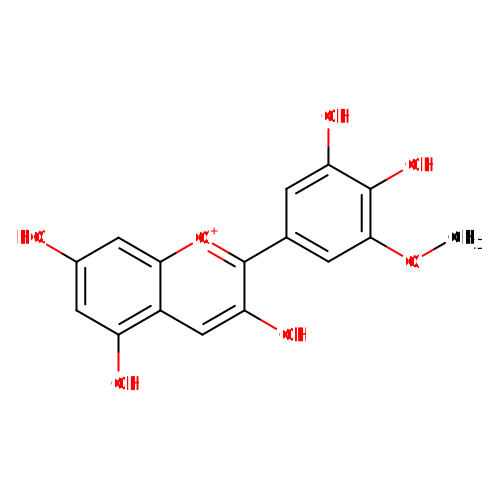
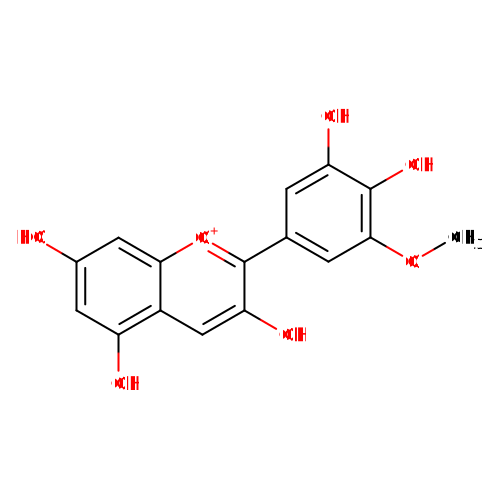
| Common Name | Petunidin |
|---|
| Description | Petunidin, also known as petunidol or Pt, belongs to the class of organic compounds known as 3'-o-methylated flavonoids. These are flavonoids with methoxy groups attached to the C3' atom of the flavonoid backbone. Thus, petunidin is considered to be a flavonoid lipid molecule. Petunidin is a very hydrophobic molecule, practically insoluble (in water), and relatively neutral. Outside of the human body, Petunidin is found, on average, in the highest concentration within a few different foods, such as bilberries, cowpea, and vaccinium (blueberry, cranberry, huckleberry) and in a lower concentration in java plums, black chokeberries, and wheats. Petunidin has also been detected, but not quantified in, several different foods, such as barley, apples, red wines, ryes, and triticales. This could make petunidin a potential biomarker for the consumption of these foods. Petunidin is found in Amonum subulatum, Apis cerana, Ginkgo biloba , Malva sylvestris , Passiflora quadrangularis , Pereskia aculeata, Solanum tuberosum subsp. Andigena , Valeriana spryginii and Vicia faba. Petunidin was first documented in 2005 (PMID: 16254886). An anthocyanidin cation that is flavylium bearing five hydroxy substituents at positions 3, 3', 4', 5 and 7 as well as a methoxy substituent at position 5' (PMID: 30612223) (PMID: 16277406) (PMID: 23993625) (PMID: 24363205) (PMID: 24483298) (PMID: 24506267). |
|---|
| Structure | COC1=C(O)C(O)=CC(=C1)C1=[O+]C2=CC(O)=CC(O)=C2C=C1O InChI=1S/C16H12O7/c1-22-14-3-7(2-11(19)15(14)21)16-12(20)6-9-10(18)4-8(17)5-13(9)23-16/h2-6H,1H3,(H4-,17,18,19,20,21)/p+1 |
|---|
| Synonyms | | Value | Source |
|---|
| 2-(3,4-Dihydroxy-5-methoxyphenyl)-3,5,7-trihydroxy-1-benzopyrylium | ChEBI | | 3,3',4',5,7-Pentahydroxy-5'-methoxyflavylium | ChEBI | | Petunidin chloride | ChEBI | | Petunidol | ChEBI | | Pt | ChEBI | | Petunidin | HMDB |
|
|---|
| Chemical Formula | C16H13O7 |
|---|
| Average Mass | 317.2702 Da |
|---|
| Monoisotopic Mass | 317.06613 Da |
|---|
| IUPAC Name | 2-(3,4-dihydroxy-5-methoxyphenyl)-3,5,7-trihydroxy-1lambda4-chromen-1-ylium |
|---|
| Traditional Name | 2-(3,4-dihydroxy-5-methoxyphenyl)-3,5,7-trihydroxy-1lambda4-chromen-1-ylium |
|---|
| CAS Registry Number | 1429-30-7 |
|---|
| SMILES | COC1=C(O)C(O)=CC(=C1)C1=[O+]C2=CC(O)=CC(O)=C2C=C1O |
|---|
| InChI Identifier | InChI=1S/C16H12O7/c1-22-14-3-7(2-11(19)15(14)21)16-12(20)6-9-10(18)4-8(17)5-13(9)23-16/h2-6H,1H3,(H4-,17,18,19,20,21)/p+1 |
|---|
| InChI Key | AFOLOMGWVXKIQL-UHFFFAOYSA-O |
|---|
| Experimental Spectra |
|---|
|
| Not Available | | Predicted Spectra |
|---|
|
| | Spectrum Type | Description | Depositor ID | Depositor Organization | Depositor | Deposition Date | View |
|---|
| 1D NMR | 13C NMR Spectrum (1D, 25 MHz, D2O, predicted) | Wishart Lab | Wishart Lab | David Wishart | 2021-06-20 | View Spectrum | | 1D NMR | 1H NMR Spectrum (1D, 100 MHz, D2O, predicted) | Wishart Lab | Wishart Lab | David Wishart | 2021-06-20 | View Spectrum | | 1D NMR | 13C NMR Spectrum (1D, 252 MHz, D2O, predicted) | Wishart Lab | Wishart Lab | David Wishart | 2021-06-20 | View Spectrum | | 1D NMR | 1H NMR Spectrum (1D, 1000 MHz, D2O, predicted) | Wishart Lab | Wishart Lab | David Wishart | 2021-06-20 | View Spectrum | | 1D NMR | 13C NMR Spectrum (1D, 50 MHz, D2O, predicted) | Wishart Lab | Wishart Lab | David Wishart | 2021-06-20 | View Spectrum | | 1D NMR | 1H NMR Spectrum (1D, 200 MHz, D2O, predicted) | Wishart Lab | Wishart Lab | David Wishart | 2021-06-20 | View Spectrum | | 1D NMR | 13C NMR Spectrum (1D, 75 MHz, D2O, predicted) | Wishart Lab | Wishart Lab | David Wishart | 2021-06-20 | View Spectrum | | 1D NMR | 1H NMR Spectrum (1D, 300 MHz, D2O, predicted) | Wishart Lab | Wishart Lab | David Wishart | 2021-06-20 | View Spectrum | | 1D NMR | 13C NMR Spectrum (1D, 101 MHz, D2O, predicted) | Wishart Lab | Wishart Lab | David Wishart | 2021-06-20 | View Spectrum | | 1D NMR | 1H NMR Spectrum (1D, 400 MHz, D2O, predicted) | Wishart Lab | Wishart Lab | David Wishart | 2021-06-20 | View Spectrum | | 1D NMR | 13C NMR Spectrum (1D, 126 MHz, D2O, predicted) | Wishart Lab | Wishart Lab | David Wishart | 2021-06-20 | View Spectrum | | 1D NMR | 1H NMR Spectrum (1D, 500 MHz, D2O, predicted) | Wishart Lab | Wishart Lab | David Wishart | 2021-06-20 | View Spectrum | | 1D NMR | 13C NMR Spectrum (1D, 151 MHz, D2O, predicted) | Wishart Lab | Wishart Lab | David Wishart | 2021-06-20 | View Spectrum | | 1D NMR | 1H NMR Spectrum (1D, 600 MHz, D2O, predicted) | Wishart Lab | Wishart Lab | David Wishart | 2021-06-20 | View Spectrum | | 1D NMR | 13C NMR Spectrum (1D, 176 MHz, D2O, predicted) | Wishart Lab | Wishart Lab | David Wishart | 2021-06-20 | View Spectrum | | 1D NMR | 1H NMR Spectrum (1D, 700 MHz, D2O, predicted) | Wishart Lab | Wishart Lab | David Wishart | 2021-06-20 | View Spectrum | | 1D NMR | 13C NMR Spectrum (1D, 201 MHz, D2O, predicted) | Wishart Lab | Wishart Lab | David Wishart | 2021-06-20 | View Spectrum | | 1D NMR | 1H NMR Spectrum (1D, 800 MHz, D2O, predicted) | Wishart Lab | Wishart Lab | David Wishart | 2021-06-20 | View Spectrum | | 1D NMR | 13C NMR Spectrum (1D, 226 MHz, D2O, predicted) | Wishart Lab | Wishart Lab | David Wishart | 2021-06-20 | View Spectrum | | 1D NMR | 1H NMR Spectrum (1D, 900 MHz, D2O, predicted) | Wishart Lab | Wishart Lab | David Wishart | 2021-06-20 | View Spectrum |
| | Chemical Shift Submissions |
|---|
|
| Not Available | | Species |
|---|
| Species of Origin | |
|---|
| Chemical Taxonomy |
|---|
| Description | Belongs to the class of organic compounds known as 3'-o-methylated flavonoids. These are flavonoids with methoxy groups attached to the C3' atom of the flavonoid backbone. |
|---|
| Kingdom | Organic compounds |
|---|
| Super Class | Phenylpropanoids and polyketides |
|---|
| Class | Flavonoids |
|---|
| Sub Class | O-methylated flavonoids |
|---|
| Direct Parent | 3'-O-methylated flavonoids |
|---|
| Alternative Parents | |
|---|
| Substituents | - 3p-methoxyflavonoid-skeleton
- 3'-hydroxyflavonoid
- 3-hydroxyflavonoid
- 4'-hydroxyflavonoid
- 5-hydroxyflavonoid
- 7-hydroxyflavonoid
- Hydroxyflavonoid
- Anthocyanidin
- Benzopyran
- Methoxyphenol
- 1-benzopyran
- Phenoxy compound
- Anisole
- Methoxybenzene
- Catechol
- Phenol ether
- 1-hydroxy-2-unsubstituted benzenoid
- 1-hydroxy-4-unsubstituted benzenoid
- Alkyl aryl ether
- Phenol
- Benzenoid
- Monocyclic benzene moiety
- Heteroaromatic compound
- Organoheterocyclic compound
- Ether
- Oxacycle
- Polyol
- Organic oxygen compound
- Organooxygen compound
- Hydrocarbon derivative
- Organic cation
- Aromatic heteropolycyclic compound
|
|---|
| Molecular Framework | Aromatic heteropolycyclic compounds |
|---|
| External Descriptors | |
|---|
| Physical Properties |
|---|
| State | Not Available |
|---|
| Experimental Properties | | Property | Value | Reference |
|---|
| Melting Point | Not Available | Not Available | | Boiling Point | Not Available | Not Available | | Water Solubility | Not Available | Not Available | | LogP | Not Available | Not Available |
|
|---|
| Predicted Properties | |
|---|
| General References | - Djoumbou-Feunang Y, Fiamoncini J, Gil-de-la-Fuente A, Greiner R, Manach C, Wishart DS: BioTransformer: a comprehensive computational tool for small molecule metabolism prediction and metabolite identification. J Cheminform. 2019 Jan 5;11(1):2. doi: 10.1186/s13321-018-0324-5. [PubMed:30612223 ]
- Garcia-Alonso M, Rimbach G, Sasai M, Nakahara M, Matsugo S, Uchida Y, Rivas-Gonzalo JC, De Pascual-Teresa S: Electron spin resonance spectroscopy studies on the free radical scavenging activity of wine anthocyanins and pyranoanthocyanins. Mol Nutr Food Res. 2005 Dec;49(12):1112-9. doi: 10.1002/mnfr.200500100. [PubMed:16254886 ]
- Lo Piero AR, Puglisi I, Rapisarda P, Petrone G: Anthocyanins accumulation and related gene expression in red orange fruit induced by low temperature storage. J Agric Food Chem. 2005 Nov 16;53(23):9083-8. doi: 10.1021/jf051609s. [PubMed:16277406 ]
- Rustioni L, Di Meo F, Guillaume M, Failla O, Trouillas P: Tuning color variation in grape anthocyanins at the molecular scale. Food Chem. 2013 Dec 15;141(4):4349-57. doi: 10.1016/j.foodchem.2013.07.006. Epub 2013 Jul 9. [PubMed:23993625 ]
- Son JE, Lee E, Jung SK, Kim JE, Oak MH, Lee KW, Lee HJ: Anthocyanidins, novel FAK inhibitors, attenuate PDGF-BB-induced aortic smooth muscle cell migration and neointima formation. Cardiovasc Res. 2014 Mar 1;101(3):503-12. doi: 10.1093/cvr/cvt337. Epub 2013 Dec 20. [PubMed:24363205 ]
- Lee S, Jung ES, Do SG, Jung GY, Song G, Song JM, Lee CH: Correlation between species-specific metabolite profiles and bioactivities of blueberries (Vaccinium spp.). J Agric Food Chem. 2014 Mar 5;62(9):2126-33. doi: 10.1021/jf405272b. Epub 2014 Feb 24. [PubMed:24483298 ]
- Oszmianski J, Kolniak-Ostek J, Wojdylo A: Characterization of phenolic compounds and antioxidant activity of Solanum scabrum and Solanum burbankii berries. J Agric Food Chem. 2014 Feb 19;62(7):1512-9. doi: 10.1021/jf4045233. Epub 2014 Feb 7. [PubMed:24506267 ]
- Kitahara K, Murai Y, Bang SW, Kitajima J, Iwashina T, Kaneko Y: Anthocyanins from the flowers of Nagai line of Japanese garden Iris (Iris ensata). Nat Prod Commun. 2014 Feb;9(2):201-4. [PubMed:24689289 ]
|
|---|