| Record Information |
|---|
| Version | 2.0 |
|---|
| Created at | 2022-03-17 19:46:48 UTC |
|---|
| Updated at | 2022-03-17 19:46:48 UTC |
|---|
| NP-MRD ID | NP0046003 |
|---|
| Secondary Accession Numbers | None |
|---|
| Natural Product Identification |
|---|
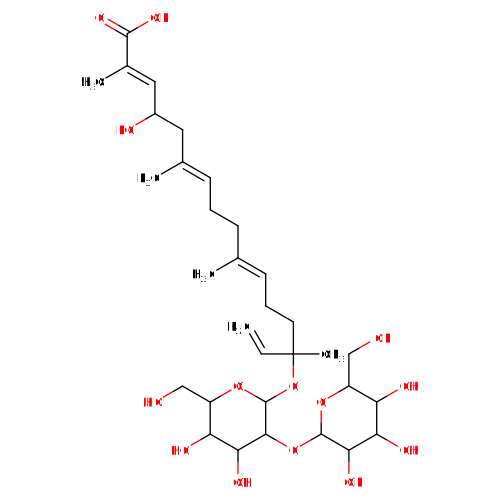
| Common Name | Capsianoside I |
|---|
| Description | Capsianoside I belongs to the class of organic compounds known as long-chain fatty acids. These are fatty acids with an aliphatic tail that contains between 13 and 21 carbon atoms. Capsianoside I is an extremely weak basic (essentially neutral) compound (based on its pKa). Outside of the human body, Capsianoside I is found, on average, in the highest concentration within a few different foods, such as yellow bell peppers, red bell peppers, and peppers and in a lower concentration in orange bell peppers and green bell peppers. Capsianoside I has also been detected, but not quantified in, herbs and spices and italian sweet red peppers. This could make capsianoside I a potential biomarker for the consumption of these foods. Paprika is known for its high vitamin C content and has been isolated from Hungarian paprika in large amounts. Traditionally, medical doctors advise ulcer patients not to consume spicy foods like pungent capsicum products, while naturopaths and herbalists have tended to use hot seasonings to relieve ulcers. Jalapeno is a stimulating spice which contains capsaicin and related compounds in its fruits and veins. Peppers are native plants of America, and the fruits (pericarps) are consumed as vegetable foods, spices, and external medicines and are also a source of vitamins A, C, and E. Hot chili pepper has been used for centuries as a condiment to aid digestion. Capsianosides are acyclic diterpene glycosides, water-soluble constituents present in the fruits of Paprika (Paprika Capsicum annuum L. Var. Grossum Bailey) and Jalapeno (Jalapeno Capsicum annuum L. Var. Annuum), that are used as vegetables and spices. Phytochemical investigations have been mainly focused on hot components of pepper species and qualitative and quantitative determinations of phenolic metabolites with antioxidant activities. Capsianoside I is found in Capsicum annuum var. fascuilatum . Capsianoside I was first documented in 2006 (PMID: 17015971). The genus Capsicum (Solanaceae) includes many species widely cultivated in Asia, Africa, and Mediterranean countries. |
|---|
| Structure | C\C(CC\C=C(/C)CC(O)\C=C(/C)C(O)=O)=C/CCC(C)(OC1OC(CO)C(O)C(O)C1OC1OC(CO)C(O)C(O)C1O)C=C InChI=1S/C32H52O14/c1-6-32(5,12-8-11-17(2)9-7-10-18(3)13-20(35)14-19(4)29(41)42)46-31-28(26(39)24(37)22(16-34)44-31)45-30-27(40)25(38)23(36)21(15-33)43-30/h6,10-11,14,20-28,30-31,33-40H,1,7-9,12-13,15-16H2,2-5H3,(H,41,42)/b17-11+,18-10+,19-14+ |
|---|
| Synonyms | | Value | Source |
|---|
| Capsianside I | HMDB | | (2E,6E,10E)-14-{[4,5-dihydroxy-6-(hydroxymethyl)-3-{[3,4,5-trihydroxy-6-(hydroxymethyl)oxan-2-yl]oxy}oxan-2-yl]oxy}-4-hydroxy-2,6,10,14-tetramethylhexadeca-2,6,10,15-tetraenoate | HMDB |
|
|---|
| Chemical Formula | C32H52O14 |
|---|
| Average Mass | 660.7469 Da |
|---|
| Monoisotopic Mass | 660.33571 Da |
|---|
| IUPAC Name | (2E,6E,10E)-14-{[4,5-dihydroxy-6-(hydroxymethyl)-3-{[3,4,5-trihydroxy-6-(hydroxymethyl)oxan-2-yl]oxy}oxan-2-yl]oxy}-4-hydroxy-2,6,10,14-tetramethylhexadeca-2,6,10,15-tetraenoic acid |
|---|
| Traditional Name | capsianoside I |
|---|
| CAS Registry Number | 121924-04-7 |
|---|
| SMILES | C\C(CC\C=C(/C)CC(O)\C=C(/C)C(O)=O)=C/CCC(C)(OC1OC(CO)C(O)C(O)C1OC1OC(CO)C(O)C(O)C1O)C=C |
|---|
| InChI Identifier | InChI=1S/C32H52O14/c1-6-32(5,12-8-11-17(2)9-7-10-18(3)13-20(35)14-19(4)29(41)42)46-31-28(26(39)24(37)22(16-34)44-31)45-30-27(40)25(38)23(36)21(15-33)43-30/h6,10-11,14,20-28,30-31,33-40H,1,7-9,12-13,15-16H2,2-5H3,(H,41,42)/b17-11+,18-10+,19-14+ |
|---|
| InChI Key | ISQUNAAALVXWGI-DFTZOVBQSA-N |
|---|
| Experimental Spectra |
|---|
|
| Not Available | | Predicted Spectra |
|---|
|
| | Spectrum Type | Description | Depositor ID | Depositor Organization | Depositor | Deposition Date | View |
|---|
| 1D NMR | 13C NMR Spectrum (1D, 25 MHz, D2O, predicted) | Wishart Lab | Wishart Lab | David Wishart | 2021-06-20 | View Spectrum | | 1D NMR | 1H NMR Spectrum (1D, 100 MHz, D2O, predicted) | Wishart Lab | Wishart Lab | David Wishart | 2021-06-20 | View Spectrum | | 1D NMR | 13C NMR Spectrum (1D, 252 MHz, D2O, predicted) | Wishart Lab | Wishart Lab | David Wishart | 2021-06-20 | View Spectrum | | 1D NMR | 1H NMR Spectrum (1D, 1000 MHz, D2O, predicted) | Wishart Lab | Wishart Lab | David Wishart | 2021-06-20 | View Spectrum | | 1D NMR | 13C NMR Spectrum (1D, 50 MHz, D2O, predicted) | Wishart Lab | Wishart Lab | David Wishart | 2021-06-20 | View Spectrum | | 1D NMR | 1H NMR Spectrum (1D, 200 MHz, D2O, predicted) | Wishart Lab | Wishart Lab | David Wishart | 2021-06-20 | View Spectrum | | 1D NMR | 13C NMR Spectrum (1D, 75 MHz, D2O, predicted) | Wishart Lab | Wishart Lab | David Wishart | 2021-06-20 | View Spectrum | | 1D NMR | 1H NMR Spectrum (1D, 300 MHz, D2O, predicted) | Wishart Lab | Wishart Lab | David Wishart | 2021-06-20 | View Spectrum | | 1D NMR | 13C NMR Spectrum (1D, 101 MHz, D2O, predicted) | Wishart Lab | Wishart Lab | David Wishart | 2021-06-20 | View Spectrum | | 1D NMR | 1H NMR Spectrum (1D, 400 MHz, D2O, predicted) | Wishart Lab | Wishart Lab | David Wishart | 2021-06-20 | View Spectrum | | 1D NMR | 13C NMR Spectrum (1D, 126 MHz, D2O, predicted) | Wishart Lab | Wishart Lab | David Wishart | 2021-06-20 | View Spectrum | | 1D NMR | 1H NMR Spectrum (1D, 500 MHz, D2O, predicted) | Wishart Lab | Wishart Lab | David Wishart | 2021-06-20 | View Spectrum | | 1D NMR | 13C NMR Spectrum (1D, 151 MHz, D2O, predicted) | Wishart Lab | Wishart Lab | David Wishart | 2021-06-20 | View Spectrum | | 1D NMR | 1H NMR Spectrum (1D, 600 MHz, D2O, predicted) | Wishart Lab | Wishart Lab | David Wishart | 2021-06-20 | View Spectrum | | 1D NMR | 13C NMR Spectrum (1D, 176 MHz, D2O, predicted) | Wishart Lab | Wishart Lab | David Wishart | 2021-06-20 | View Spectrum | | 1D NMR | 1H NMR Spectrum (1D, 700 MHz, D2O, predicted) | Wishart Lab | Wishart Lab | David Wishart | 2021-06-20 | View Spectrum | | 1D NMR | 13C NMR Spectrum (1D, 201 MHz, D2O, predicted) | Wishart Lab | Wishart Lab | David Wishart | 2021-06-20 | View Spectrum | | 1D NMR | 1H NMR Spectrum (1D, 800 MHz, D2O, predicted) | Wishart Lab | Wishart Lab | David Wishart | 2021-06-20 | View Spectrum | | 1D NMR | 13C NMR Spectrum (1D, 226 MHz, D2O, predicted) | Wishart Lab | Wishart Lab | David Wishart | 2021-06-20 | View Spectrum | | 1D NMR | 1H NMR Spectrum (1D, 900 MHz, D2O, predicted) | Wishart Lab | Wishart Lab | David Wishart | 2021-06-20 | View Spectrum |
| | Chemical Shift Submissions |
|---|
|
| Not Available | | Species |
|---|
| Species of Origin | | Species Name | Source | Reference |
|---|
| Capsicum annuum | FooDB | | | Capsicum annuum var. fascuilatum | Plant | |
|
|---|
| Chemical Taxonomy |
|---|
| Description | Belongs to the class of organic compounds known as long-chain fatty acids. These are fatty acids with an aliphatic tail that contains between 13 and 21 carbon atoms. |
|---|
| Kingdom | Organic compounds |
|---|
| Super Class | Lipids and lipid-like molecules |
|---|
| Class | Fatty Acyls |
|---|
| Sub Class | Fatty acids and conjugates |
|---|
| Direct Parent | Long-chain fatty acids |
|---|
| Alternative Parents | |
|---|
| Substituents | - Long-chain fatty acid
- Dicarboxylic acid or derivatives
- Carboxylic acid
- Carboxylic acid derivative
- Organic oxygen compound
- Organic oxide
- Hydrocarbon derivative
- Organooxygen compound
- Carbonyl group
- Aliphatic acyclic compound
|
|---|
| Molecular Framework | Aliphatic acyclic compounds |
|---|
| External Descriptors | |
|---|
| Physical Properties |
|---|
| State | Not Available |
|---|
| Experimental Properties | | Property | Value | Reference |
|---|
| Melting Point | Not Available | Not Available | | Boiling Point | Not Available | Not Available | | Water Solubility | Not Available | Not Available | | LogP | Not Available | Not Available |
|
|---|
| Predicted Properties | |
|---|