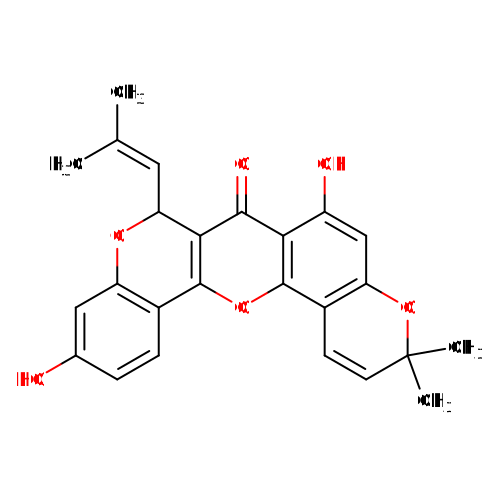
| Record Information |
|---|
| Version | 2.0 |
|---|
| Created at | 2022-03-17 19:46:27 UTC |
|---|
| Updated at | 2022-03-17 19:46:27 UTC |
|---|
| NP-MRD ID | NP0045982 |
|---|
| Secondary Accession Numbers | None |
|---|
| Natural Product Identification |
|---|
| Common Name | Cyclomorusin |
|---|
| Description | Cyclomorusin belongs to the class of organic compounds known as pyranoflavonoids. Pyranoflavonoids are compounds containing a pyran ring fused to a 2-phenyl-1,4-benzopyran skeleton. Thus, cyclomorusin is considered to be a flavonoid lipid molecule. Cyclomorusin is a very hydrophobic molecule, practically insoluble (in water), and relatively neutral. Outside of the human body, Cyclomorusin has been detected, but not quantified in, breadfruits and fruits. This could make cyclomorusin a potential biomarker for the consumption of these foods. Cyclomorusin is found in Artocarpus elasticus , Artocarpus heterophyllus, Morus alba , Morus australis and Sorocea bonplandii. Cyclomorusin was first documented in 1982 (PMID: 17396934). An extended flavonoid that is cyclomulberrin in which the hydroxy group at position 10 has undergone oxidative cyclisation to position 3 of the 3-methylbut-2-en-1-yl substituent, with migration of the double bond into conjugation with the aromatic ring (PMID: 21434689) (PMID: 12648543) (PMID: 12662107) (PMID: 15884809) (PMID: 15885940) (PMID: 17405024). |
|---|
| Structure | CC(C)=CC1OC2=C(C=CC(O)=C2)C2=C1C(=O)C1=C(O2)C2=C(OC(C)(C)C=C2)C=C1O InChI=1S/C25H22O6/c1-12(2)9-19-21-22(28)20-16(27)11-18-15(7-8-25(3,4)31-18)23(20)30-24(21)14-6-5-13(26)10-17(14)29-19/h5-11,19,26-27H,1-4H3 |
|---|
| Synonyms | | Value | Source |
|---|
| 6,11-Dihydroxy-3,3-dimethyl-8-(2-methyl-1-propenyl)-3H,7H,8H-bis[1]benzopyrano[4,3-b:6',5'-e]pyran-7-one | HMDB | | 6,11-Dihydroxy-3,3-dimethyl-8-(2-methyl-1-propenyl)-3H,7H,8H-bis[1]benzopyrano[4,3-b:6',5'-e]pyran-7-one, 9ci | HMDB | | Cyclomorusin a | HMDB | | Cyclomulberrochromene | HMDB |
|
|---|
| Chemical Formula | C25H22O6 |
|---|
| Average Mass | 418.4386 Da |
|---|
| Monoisotopic Mass | 418.14164 Da |
|---|
| IUPAC Name | 11,19-dihydroxy-7,7-dimethyl-15-(2-methylprop-1-en-1-yl)-2,8,16-trioxapentacyclo[12.8.0.0³,¹².0⁴,⁹.0¹⁷,²²]docosa-1(14),3(12),4(9),5,10,17(22),18,20-octaen-13-one |
|---|
| Traditional Name | cyclomorusin |
|---|
| CAS Registry Number | 62596-34-3 |
|---|
| SMILES | CC(C)=CC1OC2=C(C=CC(O)=C2)C2=C1C(=O)C1=C(O2)C2=C(OC(C)(C)C=C2)C=C1O |
|---|
| InChI Identifier | InChI=1S/C25H22O6/c1-12(2)9-19-21-22(28)20-16(27)11-18-15(7-8-25(3,4)31-18)23(20)30-24(21)14-6-5-13(26)10-17(14)29-19/h5-11,19,26-27H,1-4H3 |
|---|
| InChI Key | GDQXJMLXEYSICD-UHFFFAOYSA-N |
|---|
| Experimental Spectra |
|---|
|
| Not Available | | Predicted Spectra |
|---|
|
| | Spectrum Type | Description | Depositor ID | Depositor Organization | Depositor | Deposition Date | View |
|---|
| 1D NMR | 13C NMR Spectrum (1D, 25 MHz, D2O, predicted) | Wishart Lab | Wishart Lab | David Wishart | 2021-06-20 | View Spectrum | | 1D NMR | 1H NMR Spectrum (1D, 100 MHz, D2O, predicted) | Wishart Lab | Wishart Lab | David Wishart | 2021-06-20 | View Spectrum | | 1D NMR | 13C NMR Spectrum (1D, 252 MHz, D2O, predicted) | Wishart Lab | Wishart Lab | David Wishart | 2021-06-20 | View Spectrum | | 1D NMR | 1H NMR Spectrum (1D, 1000 MHz, D2O, predicted) | Wishart Lab | Wishart Lab | David Wishart | 2021-06-20 | View Spectrum | | 1D NMR | 13C NMR Spectrum (1D, 50 MHz, D2O, predicted) | Wishart Lab | Wishart Lab | David Wishart | 2021-06-20 | View Spectrum | | 1D NMR | 1H NMR Spectrum (1D, 200 MHz, D2O, predicted) | Wishart Lab | Wishart Lab | David Wishart | 2021-06-20 | View Spectrum | | 1D NMR | 13C NMR Spectrum (1D, 75 MHz, D2O, predicted) | Wishart Lab | Wishart Lab | David Wishart | 2021-06-20 | View Spectrum | | 1D NMR | 1H NMR Spectrum (1D, 300 MHz, D2O, predicted) | Wishart Lab | Wishart Lab | David Wishart | 2021-06-20 | View Spectrum | | 1D NMR | 13C NMR Spectrum (1D, 101 MHz, D2O, predicted) | Wishart Lab | Wishart Lab | David Wishart | 2021-06-20 | View Spectrum | | 1D NMR | 1H NMR Spectrum (1D, 400 MHz, D2O, predicted) | Wishart Lab | Wishart Lab | David Wishart | 2021-06-20 | View Spectrum | | 1D NMR | 13C NMR Spectrum (1D, 126 MHz, D2O, predicted) | Wishart Lab | Wishart Lab | David Wishart | 2021-06-20 | View Spectrum | | 1D NMR | 1H NMR Spectrum (1D, 500 MHz, D2O, predicted) | Wishart Lab | Wishart Lab | David Wishart | 2021-06-20 | View Spectrum | | 1D NMR | 13C NMR Spectrum (1D, 151 MHz, D2O, predicted) | Wishart Lab | Wishart Lab | David Wishart | 2021-06-20 | View Spectrum | | 1D NMR | 1H NMR Spectrum (1D, 600 MHz, D2O, predicted) | Wishart Lab | Wishart Lab | David Wishart | 2021-06-20 | View Spectrum | | 1D NMR | 13C NMR Spectrum (1D, 176 MHz, D2O, predicted) | Wishart Lab | Wishart Lab | David Wishart | 2021-06-20 | View Spectrum | | 1D NMR | 1H NMR Spectrum (1D, 700 MHz, D2O, predicted) | Wishart Lab | Wishart Lab | David Wishart | 2021-06-20 | View Spectrum | | 1D NMR | 13C NMR Spectrum (1D, 201 MHz, D2O, predicted) | Wishart Lab | Wishart Lab | David Wishart | 2021-06-20 | View Spectrum | | 1D NMR | 1H NMR Spectrum (1D, 800 MHz, D2O, predicted) | Wishart Lab | Wishart Lab | David Wishart | 2021-06-20 | View Spectrum | | 1D NMR | 13C NMR Spectrum (1D, 226 MHz, D2O, predicted) | Wishart Lab | Wishart Lab | David Wishart | 2021-06-20 | View Spectrum | | 1D NMR | 1H NMR Spectrum (1D, 900 MHz, D2O, predicted) | Wishart Lab | Wishart Lab | David Wishart | 2021-06-20 | View Spectrum |
| | Chemical Shift Submissions |
|---|
|
| Not Available | | Species |
|---|
| Species of Origin | |
|---|
| Chemical Taxonomy |
|---|
| Description | Belongs to the class of organic compounds known as pyranoflavonoids. Pyranoflavonoids are compounds containing a pyran ring fused to a 2-phenyl-1,4-benzopyran skeleton. |
|---|
| Kingdom | Organic compounds |
|---|
| Super Class | Phenylpropanoids and polyketides |
|---|
| Class | Flavonoids |
|---|
| Sub Class | Pyranoflavonoids |
|---|
| Direct Parent | Pyranoflavonoids |
|---|
| Alternative Parents | |
|---|
| Substituents | - Pyranoflavonoid
- Pyranochromene
- 2,2-dimethyl-1-benzopyran
- Chromone
- Benzopyran
- 1-benzopyran
- 1-hydroxy-2-unsubstituted benzenoid
- Alkyl aryl ether
- Pyranone
- Pyran
- Benzenoid
- Heteroaromatic compound
- Vinylogous acid
- Ether
- Oxacycle
- Organoheterocyclic compound
- Organic oxygen compound
- Hydrocarbon derivative
- Organooxygen compound
- Organic oxide
- Aromatic heteropolycyclic compound
|
|---|
| Molecular Framework | Aromatic heteropolycyclic compounds |
|---|
| External Descriptors | |
|---|
| Physical Properties |
|---|
| State | Not Available |
|---|
| Experimental Properties | | Property | Value | Reference |
|---|
| Melting Point | Not Available | Not Available | | Boiling Point | Not Available | Not Available | | Water Solubility | Not Available | Not Available | | LogP | Not Available | Not Available |
|
|---|
| Predicted Properties | |
|---|
| General References | - Kim JY, Lee WS, Kim YS, Curtis-Long MJ, Lee BW, Ryu YB, Park KH: Isolation of cholinesterase-inhibiting flavonoids from Morus lhou. J Agric Food Chem. 2011 May 11;59(9):4589-96. doi: 10.1021/jf200423g. Epub 2011 Apr 5. [PubMed:21434689 ]
- Du J, He ZD, Jiang RW, Ye WC, Xu HX, But PP: Antiviral flavonoids from the root bark of Morus alba L. Phytochemistry. 2003 Apr;62(8):1235-8. doi: 10.1016/s0031-9422(02)00753-7. [PubMed:12648543 ]
- Chan SC, Ko HH, Lin CN: New prenylflavonoids from Artocarpus communis. J Nat Prod. 2003 Mar;66(3):427-30. doi: 10.1021/np020487k. [PubMed:12662107 ]
- Wei BL, Weng JR, Chiu PH, Hung CF, Wang JP, Lin CN: Antiinflammatory flavonoids from Artocarpus heterophyllus and Artocarpus communis. J Agric Food Chem. 2005 May 18;53(10):3867-71. doi: 10.1021/jf047873n. [PubMed:15884809 ]
- Singab AN, El-Beshbishy HA, Yonekawa M, Nomura T, Fukai T: Hypoglycemic effect of Egyptian Morus alba root bark extract: effect on diabetes and lipid peroxidation of streptozotocin-induced diabetic rats. J Ethnopharmacol. 2005 Sep 14;100(3):333-8. doi: 10.1016/j.jep.2005.03.013. [PubMed:15885940 ]
- Nomura T, Fukai T, Matsumoto J, Ohmori T: Constituents of the cultivated mulberry tree. Planta Med. 1982 Sep;46(1):28-32. doi: 10.1055/s-2007-970012. [PubMed:17396934 ]
- Nomura T, Fukai T, Shimada T, Chen IS: [Components of Root Bark of Morus australis.]. Planta Med. 1983 Oct;49(10):90-4. doi: 10.1055/s-2007-969822. [PubMed:17405024 ]
- Wang L, Wang HQ, Chen RY: [Studies on chemical constituents from bark of Morus nigra]. Zhongguo Zhong Yao Za Zhi. 2007 Dec;32(23):2497-9. [PubMed:18330242 ]
- Ryu YB, Ha TJ, Curtis-Long MJ, Ryu HW, Gal SW, Park KH: Inhibitory effects on mushroom tyrosinase by flavones from the stem barks of Morus lhou (S.) Koidz. J Enzyme Inhib Med Chem. 2008 Dec;23(6):922-30. doi: 10.1080/14756360701810207. [PubMed:18608767 ]
- Xu YL, Li XE, Zou YX, Chen JJ: [Studies on chemical constituents from twigs of Morus atropurpurea]. Zhongguo Zhong Yao Za Zhi. 2008 Nov;33(21):2499-502. [PubMed:19149258 ]
- Abd El-Mawla AM, Mohamed KM, Mostafa AM: Induction of Biologically Active Flavonoids in Cell Cultures of Morus nigra and Testing their Hypoglycemic Efficacy. Sci Pharm. 2011 Oct-Dec;79(4):951-61. doi: 10.3797/scipharm.1101-15. Epub 2011 Oct 3. [PubMed:22145117 ]
- Zheng RR, Ya J, Wang WJ, Yang HB, Zhang QW, Zhang XQ, Ye WC: [Chemical studies on roots of Ficus hirta]. Zhongguo Zhong Yao Za Zhi. 2013 Nov;38(21):3696-701. [PubMed:24494557 ]
- Jung JW, Ko WM, Park JH, Seo KH, Oh EJ, Lee DY, Lee DS, Kim YC, Lim DW, Han D, Baek NI: Isoprenylated flavonoids from the root bark of Morus alba and their hepatoprotective and neuroprotective activities. Arch Pharm Res. 2015 Nov;38(11):2066-75. doi: 10.1007/s12272-015-0613-8. Epub 2015 May 16. [PubMed:25981820 ]
- Liou SS, Shieh WL, Cheng TH, Won SJ, Lin CN: Gamma-pyrone compounds as potential anti-cancer drugs. J Pharm Pharmacol. 1993 Sep;45(9):791-4. doi: 10.1111/j.2042-7158.1993.tb05686.x. [PubMed:7903365 ]
|
|---|