| Record Information |
|---|
| Version | 2.0 |
|---|
| Created at | 2022-03-17 19:45:50 UTC |
|---|
| Updated at | 2022-03-17 19:45:51 UTC |
|---|
| NP-MRD ID | NP0045947 |
|---|
| Secondary Accession Numbers | None |
|---|
| Natural Product Identification |
|---|
| Common Name | Scutellarein |
|---|
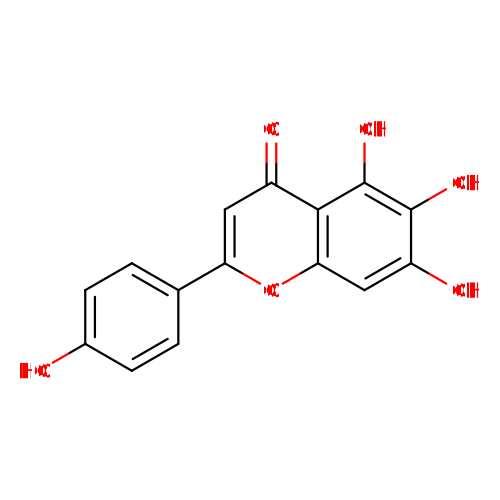
| Description | 5,6,7-Trihydroxy-2-(4-hydroxyphenyl)-4H-chromen-4-one, also known as 6-hydroxyapigenin or isocarthamidin, belongs to the class of organic compounds known as flavones. These are flavonoids with a structure based on the backbone of 2-phenylchromen-4-one (2-phenyl-1-benzopyran-4-one). Thus, 5,6,7-trihydroxy-2-(4-hydroxyphenyl)-4H-chromen-4-one is considered to be a flavonoid lipid molecule. 5,6,7-Trihydroxy-2-(4-hydroxyphenyl)-4H-chromen-4-one is a very hydrophobic molecule, practically insoluble (in water), and relatively neutral. Outside of the human body, 5,6,7-trihydroxy-2-(4-hydroxyphenyl)-4H-chromen-4-one has been detected, but not quantified in, winter savories. This could make 5,6,7-trihydroxy-2-(4-hydroxyphenyl)-4H-chromen-4-one a potential biomarker for the consumption of these foods. Scutellarein is found in Achillea alpina, Ageratum conyzoides, Artemisia anomala, Artemisia douglasiana, Asphodeline globifera, Baptisia calycosa, Carthamus tinctorius, Caryopteris tangutica, Centaurea clementei, Centaurea jacea, Citrus sinensis, Clerodendron fragrans, Clerodendron phlomoides, Clerodendron serratum , Clerodendrum indicum, Clerodendrum phlomidis , Dicoma capensis, Digitalis grandiflora, Dittrichia graveolens, Duranta erecta, Duranta plumieri , Duranta repens, Erigeron breviscapus, Garcinia andamanica, Lippia origanoides, Lycopus asper, Millingtonia hortensis , Origanum majorana , Oroxylum indicum , Persicaria hydropiper, Polygonum viscosum, Plantago major, Polygonum hydropiper L. , Pulicaria dysenterica , Salvia officinalis , Scoparia dulcis , Scutellaria alpina, Scutellaria baicalensis, Scutellaria barbata , Scutellaria galericulata, Scutellaria immaculata, Scutellaria indica, Scutellaria lateriflora, Scutellaria rivularis , Scutellaria scandens, Scutellaria spp., Scutettaria baicalensis, Striga passargei and Volkameria inermis. Scutellarein was first documented in 2000 (PMID: 10724177). Flavone substituted with hydroxy groups at C-4', -5, -6 and -7. |
|---|
| Structure | OC1=CC=C(C=C1)C1=CC(=O)C2=C(O1)C=C(O)C(O)=C2O InChI=1S/C15H10O6/c16-8-3-1-7(2-4-8)11-5-9(17)13-12(21-11)6-10(18)14(19)15(13)20/h1-6,16,18-20H |
|---|
| Synonyms | | Value | Source |
|---|
| 4',5,6,7-Tetrahydroxyflavanone | ChEBI | | 5,6,7,4'-Tetrahydroxyflavone | ChEBI | | 5,6,7-Trihydroxy-2-(4-hydroxyphenyl)-4H-1-benzopyran-4-one | ChEBI | | 6-Hydroxyapigenin | ChEBI | | Isocarthamidin | ChEBI | | 4',5,6,7-Tetrahydroxy-flavanone | MeSH | | 6-Hydroxy-apigenin | MeSH |
|
|---|
| Chemical Formula | C15H10O6 |
|---|
| Average Mass | 286.2363 Da |
|---|
| Monoisotopic Mass | 286.04774 Da |
|---|
| IUPAC Name | 5,6,7-trihydroxy-2-(4-hydroxyphenyl)-4H-chromen-4-one |
|---|
| Traditional Name | scutellarein |
|---|
| CAS Registry Number | 529-53-3 |
|---|
| SMILES | OC1=CC=C(C=C1)C1=CC(=O)C2=C(O1)C=C(O)C(O)=C2O |
|---|
| InChI Identifier | InChI=1S/C15H10O6/c16-8-3-1-7(2-4-8)11-5-9(17)13-12(21-11)6-10(18)14(19)15(13)20/h1-6,16,18-20H |
|---|
| InChI Key | JVXZRQGOGOXCEC-UHFFFAOYSA-N |
|---|
| Experimental Spectra |
|---|
|
| Not Available | | Predicted Spectra |
|---|
|
| | Spectrum Type | Description | Depositor ID | Depositor Organization | Depositor | Deposition Date | View |
|---|
| 1D NMR | 13C NMR Spectrum (1D, 25 MHz, D2O, predicted) | Wishart Lab | Wishart Lab | David Wishart | 2021-06-20 | View Spectrum | | 1D NMR | 1H NMR Spectrum (1D, 100 MHz, D2O, predicted) | Wishart Lab | Wishart Lab | David Wishart | 2021-06-20 | View Spectrum | | 1D NMR | 13C NMR Spectrum (1D, 252 MHz, D2O, predicted) | Wishart Lab | Wishart Lab | David Wishart | 2021-06-20 | View Spectrum | | 1D NMR | 1H NMR Spectrum (1D, 1000 MHz, D2O, predicted) | Wishart Lab | Wishart Lab | David Wishart | 2021-06-20 | View Spectrum | | 1D NMR | 13C NMR Spectrum (1D, 50 MHz, D2O, predicted) | Wishart Lab | Wishart Lab | David Wishart | 2021-06-20 | View Spectrum | | 1D NMR | 1H NMR Spectrum (1D, 200 MHz, D2O, predicted) | Wishart Lab | Wishart Lab | David Wishart | 2021-06-20 | View Spectrum | | 1D NMR | 13C NMR Spectrum (1D, 75 MHz, D2O, predicted) | Wishart Lab | Wishart Lab | David Wishart | 2021-06-20 | View Spectrum | | 1D NMR | 1H NMR Spectrum (1D, 300 MHz, D2O, predicted) | Wishart Lab | Wishart Lab | David Wishart | 2021-06-20 | View Spectrum | | 1D NMR | 13C NMR Spectrum (1D, 101 MHz, D2O, predicted) | Wishart Lab | Wishart Lab | David Wishart | 2021-06-20 | View Spectrum | | 1D NMR | 1H NMR Spectrum (1D, 400 MHz, D2O, predicted) | Wishart Lab | Wishart Lab | David Wishart | 2021-06-20 | View Spectrum | | 1D NMR | 13C NMR Spectrum (1D, 126 MHz, D2O, predicted) | Wishart Lab | Wishart Lab | David Wishart | 2021-06-20 | View Spectrum | | 1D NMR | 1H NMR Spectrum (1D, 500 MHz, D2O, predicted) | Wishart Lab | Wishart Lab | David Wishart | 2021-06-20 | View Spectrum | | 1D NMR | 13C NMR Spectrum (1D, 151 MHz, D2O, predicted) | Wishart Lab | Wishart Lab | David Wishart | 2021-06-20 | View Spectrum | | 1D NMR | 1H NMR Spectrum (1D, 600 MHz, D2O, predicted) | Wishart Lab | Wishart Lab | David Wishart | 2021-06-20 | View Spectrum | | 1D NMR | 13C NMR Spectrum (1D, 176 MHz, D2O, predicted) | Wishart Lab | Wishart Lab | David Wishart | 2021-06-20 | View Spectrum | | 1D NMR | 1H NMR Spectrum (1D, 700 MHz, D2O, predicted) | Wishart Lab | Wishart Lab | David Wishart | 2021-06-20 | View Spectrum | | 1D NMR | 13C NMR Spectrum (1D, 201 MHz, D2O, predicted) | Wishart Lab | Wishart Lab | David Wishart | 2021-06-20 | View Spectrum | | 1D NMR | 1H NMR Spectrum (1D, 800 MHz, D2O, predicted) | Wishart Lab | Wishart Lab | David Wishart | 2021-06-20 | View Spectrum | | 1D NMR | 13C NMR Spectrum (1D, 226 MHz, D2O, predicted) | Wishart Lab | Wishart Lab | David Wishart | 2021-06-20 | View Spectrum | | 1D NMR | 1H NMR Spectrum (1D, 900 MHz, D2O, predicted) | Wishart Lab | Wishart Lab | David Wishart | 2021-06-20 | View Spectrum |
| | Chemical Shift Submissions |
|---|
|
| Not Available | | Species |
|---|
| Species of Origin | |
|---|
| Chemical Taxonomy |
|---|
| Description | Belongs to the class of organic compounds known as flavones. These are flavonoids with a structure based on the backbone of 2-phenylchromen-4-one (2-phenyl-1-benzopyran-4-one). |
|---|
| Kingdom | Organic compounds |
|---|
| Super Class | Phenylpropanoids and polyketides |
|---|
| Class | Flavonoids |
|---|
| Sub Class | Flavones |
|---|
| Direct Parent | Flavones |
|---|
| Alternative Parents | |
|---|
| Substituents | - 4'-hydroxyflavonoid
- 5-hydroxyflavonoid
- 6-hydroxyflavonoid
- 7-hydroxyflavonoid
- Flavone
- Hydroxyflavonoid
- Chromone
- Benzopyran
- 1-benzopyran
- 1-hydroxy-4-unsubstituted benzenoid
- 1-hydroxy-2-unsubstituted benzenoid
- Phenol
- Pyranone
- Monocyclic benzene moiety
- Pyran
- Benzenoid
- Heteroaromatic compound
- Vinylogous acid
- Polyol
- Organoheterocyclic compound
- Oxacycle
- Organic oxygen compound
- Organooxygen compound
- Hydrocarbon derivative
- Organic oxide
- Aromatic heteropolycyclic compound
|
|---|
| Molecular Framework | Aromatic heteropolycyclic compounds |
|---|
| External Descriptors | |
|---|
| Physical Properties |
|---|
| State | Not Available |
|---|
| Experimental Properties | | Property | Value | Reference |
|---|
| Melting Point | Not Available | Not Available | | Boiling Point | Not Available | Not Available | | Water Solubility | Not Available | Not Available | | LogP | Not Available | Not Available |
|
|---|
| Predicted Properties | |
|---|