| Record Information |
|---|
| Version | 2.0 |
|---|
| Created at | 2022-03-17 19:44:42 UTC |
|---|
| Updated at | 2022-03-17 19:44:42 UTC |
|---|
| NP-MRD ID | NP0045876 |
|---|
| Secondary Accession Numbers | None |
|---|
| Natural Product Identification |
|---|
| Common Name | Cuscohygrine |
|---|
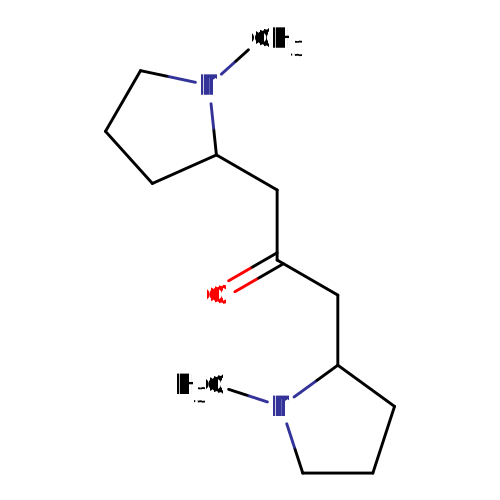
| Description | Cuscohygrine, also known as bellaradine, belongs to the class of organic compounds known as alkaloids and derivatives. These are naturally occurring chemical compounds that contain mostly basic nitrogen atoms. This group also includes some related compounds with neutral and even weakly acidic properties. Also some synthetic compounds of similar structure are attributed to alkaloids. In addition to carbon, hydrogen and nitrogen, alkaloids may also contain oxygen, sulfur and more rarely other elements such as chlorine, bromine, and phosphorus. Cuscohygrine usually comes with other, more potent alkaloids like atropine or cocaine. Cuscohygrine is a very strong basic compound (based on its pKa). Cuscohygrine is a pyrrolidine alkaloid found in coca. Outside of the human body, Cuscohygrine has been detected, but not quantified in, fruits and potato. This could make cuscohygrine a potential biomarker for the consumption of these foods. It is easily soluble in water and forms an optically inactive crystalline hydrate C13H24N2O·3H2O, which melts at 40-41 °C. ; Cuscohygrine is an oil, which can be distilled without decomposition only in vacuum. Cuscohygrine is found in Anisodus tanguticus, Apis cerana, Argyreia mollis, Atropa baetica, Atropa belladonna , Brugmansia suaveolens, Brugmansia candida, Calystegia sepium , Convolvulus arvensis, Convolvulus erinaceus, Cyphomandra betacea , Cyphomandra betaceae, Datura ceratocaula , Datura inoxia, Datura spp., Datura stramonium , Duboisia myoporoides, Erythroxylon coca , Erythroxylon novogranatense, Erythroxylum argentinum, Erythroxylum cataractarum, Erythroxylum coca , Erythroxylum monogynum, Erythroxylum novogranatense, Hyoscyamus albus , Hyoscyamus boveanus, Hyoscyamus desertorum, Hyoscyamus muticus , Hyoscyamus niger , Mandragora autumnale, Mandragora autumnalis , Mandragora autunnale, Mandragora officinarum L. , Mandragora vernalis, Physalis alkekengi , Physalis minima, Physalis peruviana , Physalis solanacea, Salpichora origanifolia, Scopolia carniolica, Scopolia spp., Solandra grandiflora and Withania somnifera . It can be extracted from plants of the family Solanaceae as well, including Atropa belladonna (deadly nightshade), Datura inoxia and Datura stramonium (jimson weed). |
|---|
| Structure | InChI=1S/C13H24N2O/c1-14-7-3-5-11(14)9-13(16)10-12-6-4-8-15(12)2/h11-12H,3-10H2,1-2H3 |
|---|
| Synonyms | | Value | Source |
|---|
| Cuskhygrine | Kegg | | 1,3-Bis(1-methyl-2-pyrrolidinyl)-2-propanone, 9ci | HMDB | | Bellaradine | HMDB | | Hellaradine | HMDB | | Meso-cuscohygrine | HMDB |
|
|---|
| Chemical Formula | C13H24N2O |
|---|
| Average Mass | 224.3425 Da |
|---|
| Monoisotopic Mass | 224.18886 Da |
|---|
| IUPAC Name | 1,3-bis(1-methylpyrrolidin-2-yl)propan-2-one |
|---|
| Traditional Name | cuscohygrine |
|---|
| CAS Registry Number | 454-14-8 |
|---|
| SMILES | CN1CCCC1CC(=O)CC1CCCN1C |
|---|
| InChI Identifier | InChI=1S/C13H24N2O/c1-14-7-3-5-11(14)9-13(16)10-12-6-4-8-15(12)2/h11-12H,3-10H2,1-2H3 |
|---|
| InChI Key | ZEBIACKKLGVLFZ-UHFFFAOYSA-N |
|---|
| Experimental Spectra |
|---|
|
| Not Available | | Predicted Spectra |
|---|
|
| | Spectrum Type | Description | Depositor ID | Depositor Organization | Depositor | Deposition Date | View |
|---|
| 1D NMR | 13C NMR Spectrum (1D, 25 MHz, D2O, predicted) | Wishart Lab | Wishart Lab | David Wishart | 2021-06-20 | View Spectrum | | 1D NMR | 1H NMR Spectrum (1D, 100 MHz, D2O, predicted) | Wishart Lab | Wishart Lab | David Wishart | 2021-06-20 | View Spectrum | | 1D NMR | 13C NMR Spectrum (1D, 252 MHz, D2O, predicted) | Wishart Lab | Wishart Lab | David Wishart | 2021-06-20 | View Spectrum | | 1D NMR | 1H NMR Spectrum (1D, 1000 MHz, D2O, predicted) | Wishart Lab | Wishart Lab | David Wishart | 2021-06-20 | View Spectrum | | 1D NMR | 13C NMR Spectrum (1D, 50 MHz, D2O, predicted) | Wishart Lab | Wishart Lab | David Wishart | 2021-06-20 | View Spectrum | | 1D NMR | 1H NMR Spectrum (1D, 200 MHz, D2O, predicted) | Wishart Lab | Wishart Lab | David Wishart | 2021-06-20 | View Spectrum | | 1D NMR | 13C NMR Spectrum (1D, 75 MHz, D2O, predicted) | Wishart Lab | Wishart Lab | David Wishart | 2021-06-20 | View Spectrum | | 1D NMR | 1H NMR Spectrum (1D, 300 MHz, D2O, predicted) | Wishart Lab | Wishart Lab | David Wishart | 2021-06-20 | View Spectrum | | 1D NMR | 13C NMR Spectrum (1D, 101 MHz, D2O, predicted) | Wishart Lab | Wishart Lab | David Wishart | 2021-06-20 | View Spectrum | | 1D NMR | 1H NMR Spectrum (1D, 400 MHz, D2O, predicted) | Wishart Lab | Wishart Lab | David Wishart | 2021-06-20 | View Spectrum | | 1D NMR | 13C NMR Spectrum (1D, 126 MHz, D2O, predicted) | Wishart Lab | Wishart Lab | David Wishart | 2021-06-20 | View Spectrum | | 1D NMR | 1H NMR Spectrum (1D, 500 MHz, D2O, predicted) | Wishart Lab | Wishart Lab | David Wishart | 2021-06-20 | View Spectrum | | 1D NMR | 13C NMR Spectrum (1D, 151 MHz, D2O, predicted) | Wishart Lab | Wishart Lab | David Wishart | 2021-06-20 | View Spectrum | | 1D NMR | 1H NMR Spectrum (1D, 600 MHz, D2O, predicted) | Wishart Lab | Wishart Lab | David Wishart | 2021-06-20 | View Spectrum | | 1D NMR | 13C NMR Spectrum (1D, 176 MHz, D2O, predicted) | Wishart Lab | Wishart Lab | David Wishart | 2021-06-20 | View Spectrum | | 1D NMR | 1H NMR Spectrum (1D, 700 MHz, D2O, predicted) | Wishart Lab | Wishart Lab | David Wishart | 2021-06-20 | View Spectrum | | 1D NMR | 13C NMR Spectrum (1D, 201 MHz, D2O, predicted) | Wishart Lab | Wishart Lab | David Wishart | 2021-06-20 | View Spectrum | | 1D NMR | 1H NMR Spectrum (1D, 800 MHz, D2O, predicted) | Wishart Lab | Wishart Lab | David Wishart | 2021-06-20 | View Spectrum | | 1D NMR | 13C NMR Spectrum (1D, 226 MHz, D2O, predicted) | Wishart Lab | Wishart Lab | David Wishart | 2021-06-20 | View Spectrum | | 1D NMR | 1H NMR Spectrum (1D, 900 MHz, D2O, predicted) | Wishart Lab | Wishart Lab | David Wishart | 2021-06-20 | View Spectrum |
| | Chemical Shift Submissions |
|---|
|
| Not Available | | Species |
|---|
| Species of Origin | |
|---|
| Chemical Taxonomy |
|---|
| Description | Belongs to the class of organic compounds known as alkaloids and derivatives. These are naturally occurring chemical compounds that contain mostly basic nitrogen atoms. This group also includes some related compounds with neutral and even weakly acidic properties. Also some synthetic compounds of similar structure are attributed to alkaloids. In addition to carbon, hydrogen and nitrogen, alkaloids may also contain oxygen, sulfur and more rarely other elements such as chlorine, bromine, and phosphorus. |
|---|
| Kingdom | Organic compounds |
|---|
| Super Class | Alkaloids and derivatives |
|---|
| Class | Not Available |
|---|
| Sub Class | Not Available |
|---|
| Direct Parent | Alkaloids and derivatives |
|---|
| Alternative Parents | |
|---|
| Substituents | - Alkaloid or derivatives
- Beta-aminoketone
- N-alkylpyrrolidine
- Pyrrolidine
- Ketone
- Tertiary amine
- Tertiary aliphatic amine
- Organoheterocyclic compound
- Azacycle
- Organopnictogen compound
- Organic nitrogen compound
- Amine
- Organic oxygen compound
- Organooxygen compound
- Organonitrogen compound
- Carbonyl group
- Organic oxide
- Hydrocarbon derivative
- Aliphatic heteromonocyclic compound
|
|---|
| Molecular Framework | Aliphatic heteromonocyclic compounds |
|---|
| External Descriptors | - Pyrrolidine alkaloids (C06521 )
|
|---|
| Physical Properties |
|---|
| State | Not Available |
|---|
| Experimental Properties | | Property | Value | Reference |
|---|
| Melting Point | Not Available | Not Available | | Boiling Point | Not Available | Not Available | | Water Solubility | Not Available | Not Available | | LogP | Not Available | Not Available |
|
|---|
| Predicted Properties | |
|---|