| Record Information |
|---|
| Version | 2.0 |
|---|
| Created at | 2022-03-17 19:19:41 UTC |
|---|
| Updated at | 2022-03-17 19:19:41 UTC |
|---|
| NP-MRD ID | NP0045421 |
|---|
| Secondary Accession Numbers | None |
|---|
| Natural Product Identification |
|---|
| Common Name | Gossypol |
|---|
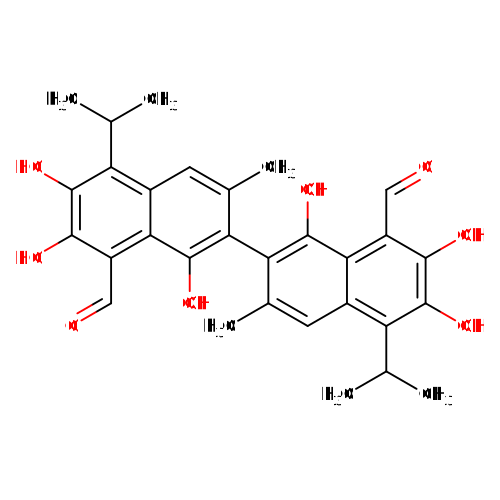
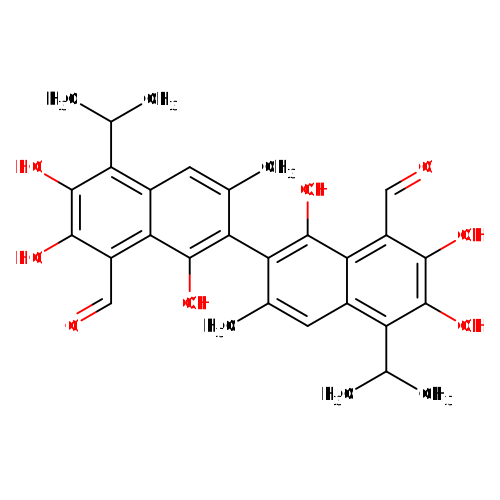
| Description | (-)-Gossypol, also known as pogosin or racemic-gossypol, belongs to the class of organic compounds known as sesquiterpenoids. These are terpenes with three consecutive isoprene units. Thus, (-)-gossypol is considered to be an isoprenoid lipid molecule. It is also an inhibitor of calcineurin and protein kinases C, and has been shown to bind calmodulin (-)-Gossypol is a very hydrophobic molecule, practically insoluble (in water), and relatively neutral. Outside of the human body, (-)-Gossypol is found, on average, in the highest concentration within cottonseeds and sunflowers (-)-Gossypol has also been detected, but not quantified in, okra and soy beans. This could make (-)-gossypol a potential biomarker for the consumption of these foods (-)-Gossypol is a potentially toxic compound. Symptoms of gossypol poisoning include fatigue, muscle weakness, and at its most extreme, paralysis. Gossypol is found in Calycopteris floribunda , Gossypium arboreum, Gossypium barbadense , Gossypium herbaceum , Gossypium hirsutum , Gossypium mexicanum, Gossypium sp. , Helianthus annuus, Hibiscus rosa-sinensis, Hibiscus sabdariffa, Hibiscus trionum, Kerria japonica, Montezuma speciosissima, Sida rhombifolia , Talipariti tiliaceum, Thespesia danis, Thespesia grandiflora, Thespesia populnea , Verticillium albo-atrum and Zanthoxylum chalybeum. Gossypol was first documented in 1998 (PMID: 9824647). Gossypol may cause apoptosis via the regulation of Bax and Bcl-2 proteins (PMID: 18645028) (PMID: 20081872). |
|---|
| Structure | CC(C)C1=C2C=C(C)C(=C(O)C2=C(C=O)C(O)=C1O)C1=C(O)C2=C(C=O)C(O)=C(O)C(C(C)C)=C2C=C1C InChI=1S/C30H30O8/c1-11(2)19-15-7-13(5)21(27(35)23(15)17(9-31)25(33)29(19)37)22-14(6)8-16-20(12(3)4)30(38)26(34)18(10-32)24(16)28(22)36/h7-12,33-38H,1-6H3 |
|---|
| Synonyms | | Value | Source |
|---|
| (+)-Gossypol | HMDB | | (+-)-Gossypol | HMDB | | (+/-)-gossypol | HMDB | | (R)-(-)-Gossypol | HMDB | | (R)-Gossypol | HMDB | | Dipotassium salt, gossypol | HMDB | | Gossypol | HMDB | | Gossypol dipotassium salt | HMDB | | Gossypol from cotton seeds | HMDB | | Gossypol sodium salt | HMDB | | Gossypol, (+)-isomer | HMDB | | Gossypol, (+-)-isomer | HMDB | | Gossypol, (-)-isomer | HMDB | | Pogosin | HMDB | | Racemic-gossypol | HMDB | | Sodium salt, gossypol | HMDB | | Tash 1 | HMDB |
|
|---|
| Chemical Formula | C30H30O8 |
|---|
| Average Mass | 518.5544 Da |
|---|
| Monoisotopic Mass | 518.19407 Da |
|---|
| IUPAC Name | 7-[8-formyl-1,6,7-trihydroxy-3-methyl-5-(propan-2-yl)naphthalen-2-yl]-2,3,8-trihydroxy-6-methyl-4-(propan-2-yl)naphthalene-1-carbaldehyde |
|---|
| Traditional Name | (-)-gossypol |
|---|
| CAS Registry Number | 303-45-7 |
|---|
| SMILES | CC(C)C1=C2C=C(C)C(=C(O)C2=C(C=O)C(O)=C1O)C1=C(O)C2=C(C=O)C(O)=C(O)C(C(C)C)=C2C=C1C |
|---|
| InChI Identifier | InChI=1S/C30H30O8/c1-11(2)19-15-7-13(5)21(27(35)23(15)17(9-31)25(33)29(19)37)22-14(6)8-16-20(12(3)4)30(38)26(34)18(10-32)24(16)28(22)36/h7-12,33-38H,1-6H3 |
|---|
| InChI Key | QBKSWRVVCFFDOT-UHFFFAOYSA-N |
|---|
| Experimental Spectra |
|---|
|
| Not Available | | Predicted Spectra |
|---|
|
| | Spectrum Type | Description | Depositor ID | Depositor Organization | Depositor | Deposition Date | View |
|---|
| 1D NMR | 13C NMR Spectrum (1D, 25 MHz, D2O, predicted) | Wishart Lab | Wishart Lab | David Wishart | 2021-06-20 | View Spectrum | | 1D NMR | 1H NMR Spectrum (1D, 100 MHz, D2O, predicted) | Wishart Lab | Wishart Lab | David Wishart | 2021-06-20 | View Spectrum | | 1D NMR | 13C NMR Spectrum (1D, 252 MHz, D2O, predicted) | Wishart Lab | Wishart Lab | David Wishart | 2021-06-20 | View Spectrum | | 1D NMR | 1H NMR Spectrum (1D, 1000 MHz, D2O, predicted) | Wishart Lab | Wishart Lab | David Wishart | 2021-06-20 | View Spectrum | | 1D NMR | 13C NMR Spectrum (1D, 50 MHz, D2O, predicted) | Wishart Lab | Wishart Lab | David Wishart | 2021-06-20 | View Spectrum | | 1D NMR | 1H NMR Spectrum (1D, 200 MHz, D2O, predicted) | Wishart Lab | Wishart Lab | David Wishart | 2021-06-20 | View Spectrum | | 1D NMR | 13C NMR Spectrum (1D, 75 MHz, D2O, predicted) | Wishart Lab | Wishart Lab | David Wishart | 2021-06-20 | View Spectrum | | 1D NMR | 1H NMR Spectrum (1D, 300 MHz, D2O, predicted) | Wishart Lab | Wishart Lab | David Wishart | 2021-06-20 | View Spectrum | | 1D NMR | 13C NMR Spectrum (1D, 101 MHz, D2O, predicted) | Wishart Lab | Wishart Lab | David Wishart | 2021-06-20 | View Spectrum | | 1D NMR | 1H NMR Spectrum (1D, 400 MHz, D2O, predicted) | Wishart Lab | Wishart Lab | David Wishart | 2021-06-20 | View Spectrum | | 1D NMR | 13C NMR Spectrum (1D, 126 MHz, D2O, predicted) | Wishart Lab | Wishart Lab | David Wishart | 2021-06-20 | View Spectrum | | 1D NMR | 1H NMR Spectrum (1D, 500 MHz, D2O, predicted) | Wishart Lab | Wishart Lab | David Wishart | 2021-06-20 | View Spectrum | | 1D NMR | 13C NMR Spectrum (1D, 151 MHz, D2O, predicted) | Wishart Lab | Wishart Lab | David Wishart | 2021-06-20 | View Spectrum | | 1D NMR | 1H NMR Spectrum (1D, 600 MHz, D2O, predicted) | Wishart Lab | Wishart Lab | David Wishart | 2021-06-20 | View Spectrum | | 1D NMR | 13C NMR Spectrum (1D, 176 MHz, D2O, predicted) | Wishart Lab | Wishart Lab | David Wishart | 2021-06-20 | View Spectrum | | 1D NMR | 1H NMR Spectrum (1D, 700 MHz, D2O, predicted) | Wishart Lab | Wishart Lab | David Wishart | 2021-06-20 | View Spectrum | | 1D NMR | 13C NMR Spectrum (1D, 201 MHz, D2O, predicted) | Wishart Lab | Wishart Lab | David Wishart | 2021-06-20 | View Spectrum | | 1D NMR | 1H NMR Spectrum (1D, 800 MHz, D2O, predicted) | Wishart Lab | Wishart Lab | David Wishart | 2021-06-20 | View Spectrum | | 1D NMR | 13C NMR Spectrum (1D, 226 MHz, D2O, predicted) | Wishart Lab | Wishart Lab | David Wishart | 2021-06-20 | View Spectrum | | 1D NMR | 1H NMR Spectrum (1D, 900 MHz, D2O, predicted) | Wishart Lab | Wishart Lab | David Wishart | 2021-06-20 | View Spectrum |
| | Chemical Shift Submissions |
|---|
|
| Not Available | | Species |
|---|
| Species of Origin | |
|---|
| Chemical Taxonomy |
|---|
| Description | Belongs to the class of organic compounds known as sesquiterpenoids. These are terpenes with three consecutive isoprene units. |
|---|
| Kingdom | Organic compounds |
|---|
| Super Class | Lipids and lipid-like molecules |
|---|
| Class | Prenol lipids |
|---|
| Sub Class | Sesquiterpenoids |
|---|
| Direct Parent | Sesquiterpenoids |
|---|
| Alternative Parents | |
|---|
| Substituents | - Cadinane sesquiterpenoid
- Sesquiterpenoid
- 2-naphthol
- 1-naphthol
- Naphthalene
- Aryl-aldehyde
- 1-hydroxy-4-unsubstituted benzenoid
- Benzenoid
- Vinylogous acid
- Polyol
- Organic oxygen compound
- Organooxygen compound
- Aldehyde
- Hydrocarbon derivative
- Organic oxide
- Aromatic homopolycyclic compound
|
|---|
| Molecular Framework | Aromatic homopolycyclic compounds |
|---|
| External Descriptors | |
|---|
| Physical Properties |
|---|
| State | Not Available |
|---|
| Experimental Properties | | Property | Value | Reference |
|---|
| Melting Point | Not Available | Not Available | | Boiling Point | Not Available | Not Available | | Water Solubility | Not Available | Not Available | | LogP | Not Available | Not Available |
|
|---|
| Predicted Properties | |
|---|
| General References | - Meng Y, Tang W, Dai Y, Wu X, Liu M, Ji Q, Ji M, Pienta K, Lawrence T, Xu L: Natural BH3 mimetic (-)-gossypol chemosensitizes human prostate cancer via Bcl-xL inhibition accompanied by increase of Puma and Noxa. Mol Cancer Ther. 2008 Jul;7(7):2192-202. doi: 10.1158/1535-7163.MCT-08-0333. [PubMed:18645028 ]
- Zhang XQ, Huang XF, Mu SJ, An QX, Xia AJ, Chen R, Wu DC: Inhibition of proliferation of prostate cancer cell line, PC-3, in vitro and in vivo using (-)-gossypol. Asian J Androl. 2010 May;12(3):390-9. doi: 10.1038/aja.2009.87. Epub 2010 Jan 18. [PubMed:20081872 ]
- Zhang Y, Kulp SK, Sugimoto Y, Brueggemeier RW, Lin YC: The (-)-enantiomer of gossypol inhibits proliferation of stromal cells derived from human breast adipose tissues by enhancing transforming growth factor beta1 production. Int J Oncol. 1998 Dec;13(6):1291-7. doi: 10.3892/ijo.13.6.1291. [PubMed:9824647 ]
|
|---|