| Record Information |
|---|
| Version | 2.0 |
|---|
| Created at | 2022-03-10 18:59:41 UTC |
|---|
| Updated at | 2022-03-10 22:19:39 UTC |
|---|
| NP-MRD ID | NP0045200 |
|---|
| Secondary Accession Numbers | None |
|---|
| Natural Product Identification |
|---|
| Common Name | Cannflavin B |
|---|
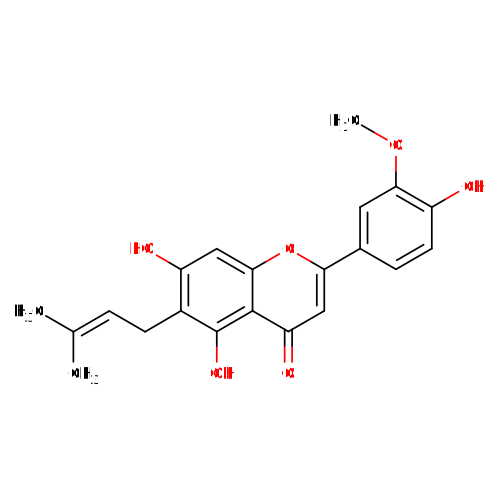
| Description | Cannflavin B belongs to the class of organic compounds known as 6-prenylated flavones. These are flavones that feature a C5-isoprenoid substituent at the 6-position. There are three known cannflavins including cannflavin A, B and C. Cannflavins are unique to Cannabis sativa (PMID: 3754224 ). Cannflavin B was identified in Cannabis in 1985 (PMID: 3859295 ; PMID: 3754224 ). Chemically, cannflavins are prenylflavonoids and are unrelated to THC and other cannabinoids. Cannflavin B is biosynthesized via the prenylation of chrysoeriol (PMID: 31151063 ). Specifically, an aromatic prenyltransferase (CsPT3) catalyzes the regiospecific addition of dimethylallyl diphosphate (DMAPP) to the methylated flavone, chrysoeriol to produce Cannflavin A. Chrysoeriol is produced through the conversion of luteolin via the O-methyltransferase (CsOMT21) (PMID: 31151063 ). Cannflavin B is a very hydrophobic molecule, practically insoluble in water, and relatively neutral. Cannflavins exhibit anti-inflammatory activity that is thirty times that of aspirin (PMID: 31151063 ). It has been found that cannflavin B is an inhibitor of prostaglandin E2 production which appears to help explain its strong anti-inflammatory properties (PMID: 3859295 ; PMID: 3754224 ). Cannflavins were the first flavonoids identified to have direct inhibitory activity of two important pro-inflammatory mediators: Arachidonate 5-lipoxygenase (5-LOX) and prostaglandin E synthase (mPGES-1). |
|---|
| Structure | COC1=C(O)C=CC(=C1)C1=CC(=O)C2=C(O)C(CC=C(C)C)=C(O)C=C2O1 InChI=1S/C21H20O6/c1-11(2)4-6-13-15(23)9-19-20(21(13)25)16(24)10-17(27-19)12-5-7-14(22)18(8-12)26-3/h4-5,7-10,22-23,25H,6H2,1-3H3 |
|---|
| Synonyms | | Value | Source |
|---|
| Cannflavin | MeSH | | Cannflavin a | MeSH | | 6-Prenylchrysoeriol | PhytoBank | | Canniflavone | PhytoBank | | Canniflavone 1 | PhytoBank |
|
|---|
| Chemical Formula | C21H20O6 |
|---|
| Average Mass | 368.3850 Da |
|---|
| Monoisotopic Mass | 368.12599 Da |
|---|
| IUPAC Name | 5,7-dihydroxy-2-(4-hydroxy-3-methoxyphenyl)-6-(3-methylbut-2-en-1-yl)-4H-chromen-4-one |
|---|
| Traditional Name | cannflavin B |
|---|
| CAS Registry Number | Not Available |
|---|
| SMILES | COC1=C(O)C=CC(=C1)C1=CC(=O)C2=C(O)C(CC=C(C)C)=C(O)C=C2O1 |
|---|
| InChI Identifier | InChI=1S/C21H20O6/c1-11(2)4-6-13-15(23)9-19-20(21(13)25)16(24)10-17(27-19)12-5-7-14(22)18(8-12)26-3/h4-5,7-10,22-23,25H,6H2,1-3H3 |
|---|
| InChI Key | IXCUTZUASDSIJO-UHFFFAOYSA-N |
|---|
| Experimental Spectra |
|---|
|
| Not Available | | Predicted Spectra |
|---|
|
| | Spectrum Type | Description | Depositor ID | Depositor Organization | Depositor | Deposition Date | View |
|---|
| 1D NMR | 13C NMR Spectrum (1D, 25 MHz, D2O, predicted) | Wishart Lab | Wishart Lab | David Wishart | 2021-06-20 | View Spectrum | | 1D NMR | 1H NMR Spectrum (1D, 100 MHz, D2O, predicted) | Wishart Lab | Wishart Lab | David Wishart | 2021-06-20 | View Spectrum | | 1D NMR | 13C NMR Spectrum (1D, 252 MHz, D2O, predicted) | Wishart Lab | Wishart Lab | David Wishart | 2021-06-20 | View Spectrum | | 1D NMR | 1H NMR Spectrum (1D, 1000 MHz, D2O, predicted) | Wishart Lab | Wishart Lab | David Wishart | 2021-06-20 | View Spectrum | | 1D NMR | 13C NMR Spectrum (1D, 50 MHz, D2O, predicted) | Wishart Lab | Wishart Lab | David Wishart | 2021-06-20 | View Spectrum | | 1D NMR | 1H NMR Spectrum (1D, 200 MHz, D2O, predicted) | Wishart Lab | Wishart Lab | David Wishart | 2021-06-20 | View Spectrum | | 1D NMR | 13C NMR Spectrum (1D, 75 MHz, D2O, predicted) | Wishart Lab | Wishart Lab | David Wishart | 2021-06-20 | View Spectrum | | 1D NMR | 1H NMR Spectrum (1D, 300 MHz, D2O, predicted) | Wishart Lab | Wishart Lab | David Wishart | 2021-06-20 | View Spectrum | | 1D NMR | 13C NMR Spectrum (1D, 101 MHz, D2O, predicted) | Wishart Lab | Wishart Lab | David Wishart | 2021-06-20 | View Spectrum | | 1D NMR | 1H NMR Spectrum (1D, 400 MHz, D2O, predicted) | Wishart Lab | Wishart Lab | David Wishart | 2021-06-20 | View Spectrum | | 1D NMR | 13C NMR Spectrum (1D, 126 MHz, D2O, predicted) | Wishart Lab | Wishart Lab | David Wishart | 2021-06-20 | View Spectrum | | 1D NMR | 1H NMR Spectrum (1D, 500 MHz, D2O, predicted) | Wishart Lab | Wishart Lab | David Wishart | 2021-06-20 | View Spectrum | | 1D NMR | 13C NMR Spectrum (1D, 151 MHz, D2O, predicted) | Wishart Lab | Wishart Lab | David Wishart | 2021-06-20 | View Spectrum | | 1D NMR | 1H NMR Spectrum (1D, 600 MHz, D2O, predicted) | Wishart Lab | Wishart Lab | David Wishart | 2021-06-20 | View Spectrum | | 1D NMR | 13C NMR Spectrum (1D, 176 MHz, D2O, predicted) | Wishart Lab | Wishart Lab | David Wishart | 2021-06-20 | View Spectrum | | 1D NMR | 1H NMR Spectrum (1D, 700 MHz, D2O, predicted) | Wishart Lab | Wishart Lab | David Wishart | 2021-06-20 | View Spectrum | | 1D NMR | 13C NMR Spectrum (1D, 201 MHz, D2O, predicted) | Wishart Lab | Wishart Lab | David Wishart | 2021-06-20 | View Spectrum | | 1D NMR | 1H NMR Spectrum (1D, 800 MHz, D2O, predicted) | Wishart Lab | Wishart Lab | David Wishart | 2021-06-20 | View Spectrum | | 1D NMR | 13C NMR Spectrum (1D, 226 MHz, D2O, predicted) | Wishart Lab | Wishart Lab | David Wishart | 2021-06-20 | View Spectrum | | 1D NMR | 1H NMR Spectrum (1D, 900 MHz, D2O, predicted) | Wishart Lab | Wishart Lab | David Wishart | 2021-06-20 | View Spectrum |
| | Chemical Shift Submissions |
|---|
|
| Not Available | | Species |
|---|
| Species of Origin | |
|---|
| Chemical Taxonomy |
|---|
| Description | Belongs to the class of organic compounds known as 6-prenylated flavones. These are flavones that features a C5-isoprenoid substituent at the 6-position. |
|---|
| Kingdom | Organic compounds |
|---|
| Super Class | Phenylpropanoids and polyketides |
|---|
| Class | Flavonoids |
|---|
| Sub Class | Flavones |
|---|
| Direct Parent | 6-prenylated flavones |
|---|
| Alternative Parents | |
|---|
| Substituents | - 6-prenylated flavone
- 3p-methoxyflavonoid-skeleton
- 4'-hydroxyflavonoid
- 5-hydroxyflavonoid
- 7-hydroxyflavonoid
- Hydroxyflavonoid
- Chromone
- Benzopyran
- Methoxyphenol
- 1-benzopyran
- Phenoxy compound
- Anisole
- Methoxybenzene
- Phenol ether
- 1-hydroxy-4-unsubstituted benzenoid
- 1-hydroxy-2-unsubstituted benzenoid
- Alkyl aryl ether
- Phenol
- Pyranone
- Monocyclic benzene moiety
- Benzenoid
- Pyran
- Vinylogous acid
- Heteroaromatic compound
- Organoheterocyclic compound
- Ether
- Oxacycle
- Hydrocarbon derivative
- Organooxygen compound
- Organic oxide
- Organic oxygen compound
- Aromatic heteropolycyclic compound
|
|---|
| Molecular Framework | Aromatic heteropolycyclic compounds |
|---|
| External Descriptors | |
|---|
| Physical Properties |
|---|
| State | Not Available |
|---|
| Experimental Properties | | Property | Value | Reference |
|---|
| Melting Point | Not Available | Not Available | | Boiling Point | Not Available | Not Available | | Water Solubility | Not Available | Not Available | | LogP | Not Available | Not Available |
|
|---|
| Predicted Properties | |
|---|