| Record Information |
|---|
| Version | 2.0 |
|---|
| Created at | 2022-03-10 18:59:38 UTC |
|---|
| Updated at | 2022-03-10 22:20:22 UTC |
|---|
| NP-MRD ID | NP0045198 |
|---|
| Secondary Accession Numbers | None |
|---|
| Natural Product Identification |
|---|
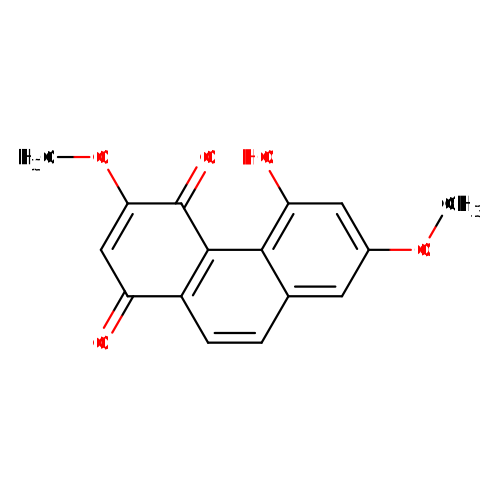
| Common Name | Denbinobin (5-hydroxy-3,7-dimethoxy-1,4-phenanthrenequinone) |
|---|
| Description | Denbinobin belongs to the class of organic compounds known as phenanthrols. Phenanthrols are compounds containing or comprised of a phenanthrene group (or its hydrogenated derivative) to which a hydroxyl group is attached. Denbinobin is also a member of the class of compounds known as phenanthrenequinones. Denbinobin is a non-cannabinoid of particular interest in Cannabis sativa, due to its interesting pharmacological activities (PMID: 18840408 ). Denbinobin has shown anti-cancer activities on several cell-lines (PMID: 15918186 ; PMID: 22089965 ; PMID: 15864744 ), As well as being able to inhibit the replication of HIV-1through an NF-kappaB-dependent pathway (PMID: 18840408 ). Interestingly, denbinobin is a typical secondary metabolite from orchidaceous plants, such as Dendrobium nobilum (Noble dendrobium) but it has also been identified in the flowers and leaves of some Cannabis strains (PMID: 28799497 ). |
|---|
| Structure | COC1=CC2=CC=C3C(=O)C=C(OC)C(=O)C3=C2C(O)=C1 InChI=1S/C16H12O5/c1-20-9-5-8-3-4-10-11(17)7-13(21-2)16(19)15(10)14(8)12(18)6-9/h3-7,18H,1-2H3 |
|---|
| Synonyms | | Value | Source |
|---|
| 5-Hydroxy-3,7-dimethoxy-1,4-phenanthraquinone | MeSH |
|
|---|
| Chemical Formula | C16H12O5 |
|---|
| Average Mass | 284.2670 Da |
|---|
| Monoisotopic Mass | 284.06847 Da |
|---|
| IUPAC Name | 5-hydroxy-3,7-dimethoxy-1,4-dihydrophenanthrene-1,4-dione |
|---|
| Traditional Name | 5-hydroxy-3,7-dimethoxyphenanthrene-1,4-dione |
|---|
| CAS Registry Number | Not Available |
|---|
| SMILES | COC1=CC2=CC=C3C(=O)C=C(OC)C(=O)C3=C2C(O)=C1 |
|---|
| InChI Identifier | InChI=1S/C16H12O5/c1-20-9-5-8-3-4-10-11(17)7-13(21-2)16(19)15(10)14(8)12(18)6-9/h3-7,18H,1-2H3 |
|---|
| InChI Key | KYOONHCJRPIMJE-UHFFFAOYSA-N |
|---|
| Experimental Spectra |
|---|
|
| Not Available | | Predicted Spectra |
|---|
|
| | Spectrum Type | Description | Depositor ID | Depositor Organization | Depositor | Deposition Date | View |
|---|
| 1D NMR | 13C NMR Spectrum (1D, 25 MHz, D2O, predicted) | Wishart Lab | Wishart Lab | David Wishart | 2021-06-20 | View Spectrum | | 1D NMR | 1H NMR Spectrum (1D, 100 MHz, D2O, predicted) | Wishart Lab | Wishart Lab | David Wishart | 2021-06-20 | View Spectrum | | 1D NMR | 13C NMR Spectrum (1D, 252 MHz, D2O, predicted) | Wishart Lab | Wishart Lab | David Wishart | 2021-06-20 | View Spectrum | | 1D NMR | 1H NMR Spectrum (1D, 1000 MHz, D2O, predicted) | Wishart Lab | Wishart Lab | David Wishart | 2021-06-20 | View Spectrum | | 1D NMR | 13C NMR Spectrum (1D, 50 MHz, D2O, predicted) | Wishart Lab | Wishart Lab | David Wishart | 2021-06-20 | View Spectrum | | 1D NMR | 1H NMR Spectrum (1D, 200 MHz, D2O, predicted) | Wishart Lab | Wishart Lab | David Wishart | 2021-06-20 | View Spectrum | | 1D NMR | 13C NMR Spectrum (1D, 75 MHz, D2O, predicted) | Wishart Lab | Wishart Lab | David Wishart | 2021-06-20 | View Spectrum | | 1D NMR | 1H NMR Spectrum (1D, 300 MHz, D2O, predicted) | Wishart Lab | Wishart Lab | David Wishart | 2021-06-20 | View Spectrum | | 1D NMR | 13C NMR Spectrum (1D, 101 MHz, D2O, predicted) | Wishart Lab | Wishart Lab | David Wishart | 2021-06-20 | View Spectrum | | 1D NMR | 1H NMR Spectrum (1D, 400 MHz, D2O, predicted) | Wishart Lab | Wishart Lab | David Wishart | 2021-06-20 | View Spectrum | | 1D NMR | 13C NMR Spectrum (1D, 126 MHz, D2O, predicted) | Wishart Lab | Wishart Lab | David Wishart | 2021-06-20 | View Spectrum | | 1D NMR | 1H NMR Spectrum (1D, 500 MHz, D2O, predicted) | Wishart Lab | Wishart Lab | David Wishart | 2021-06-20 | View Spectrum | | 1D NMR | 13C NMR Spectrum (1D, 151 MHz, D2O, predicted) | Wishart Lab | Wishart Lab | David Wishart | 2021-06-20 | View Spectrum | | 1D NMR | 1H NMR Spectrum (1D, 600 MHz, D2O, predicted) | Wishart Lab | Wishart Lab | David Wishart | 2021-06-20 | View Spectrum | | 1D NMR | 13C NMR Spectrum (1D, 176 MHz, D2O, predicted) | Wishart Lab | Wishart Lab | David Wishart | 2021-06-20 | View Spectrum | | 1D NMR | 1H NMR Spectrum (1D, 700 MHz, D2O, predicted) | Wishart Lab | Wishart Lab | David Wishart | 2021-06-20 | View Spectrum | | 1D NMR | 13C NMR Spectrum (1D, 201 MHz, D2O, predicted) | Wishart Lab | Wishart Lab | David Wishart | 2021-06-20 | View Spectrum | | 1D NMR | 1H NMR Spectrum (1D, 800 MHz, D2O, predicted) | Wishart Lab | Wishart Lab | David Wishart | 2021-06-20 | View Spectrum | | 1D NMR | 13C NMR Spectrum (1D, 226 MHz, D2O, predicted) | Wishart Lab | Wishart Lab | David Wishart | 2021-06-20 | View Spectrum | | 1D NMR | 1H NMR Spectrum (1D, 900 MHz, D2O, predicted) | Wishart Lab | Wishart Lab | David Wishart | 2021-06-20 | View Spectrum |
| | Chemical Shift Submissions |
|---|
|
| Not Available | | Species |
|---|
| Species of Origin | |
|---|
| Chemical Taxonomy |
|---|
| Description | Belongs to the class of organic compounds known as phenanthrols. Phenanthrols are compounds containing a phenanthrene (or its hydrogenated derivative) to which a hydroxyl group is attached. |
|---|
| Kingdom | Organic compounds |
|---|
| Super Class | Benzenoids |
|---|
| Class | Phenanthrenes and derivatives |
|---|
| Sub Class | Phenanthrols |
|---|
| Direct Parent | Phenanthrols |
|---|
| Alternative Parents | |
|---|
| Substituents | - Phenanthrol
- Hydrophenanthrene
- Naphthoquinone
- 1-naphthol
- Naphthalene
- Anisole
- Aryl ketone
- Quinone
- 1-hydroxy-4-unsubstituted benzenoid
- 1-hydroxy-2-unsubstituted benzenoid
- Alkyl aryl ether
- Vinylogous ester
- Ketone
- Ether
- Organic oxygen compound
- Hydrocarbon derivative
- Organic oxide
- Organooxygen compound
- Aromatic homopolycyclic compound
|
|---|
| Molecular Framework | Aromatic homopolycyclic compounds |
|---|
| External Descriptors | Not Available |
|---|
| Physical Properties |
|---|
| State | Not Available |
|---|
| Experimental Properties | | Property | Value | Reference |
|---|
| Melting Point | Not Available | Not Available | | Boiling Point | Not Available | Not Available | | Water Solubility | Not Available | Not Available | | LogP | Not Available | Not Available |
|
|---|
| Predicted Properties | |
|---|
| General References | - Sanchez-Duffhues G, Calzado MA, de Vinuesa AG, Caballero FJ, Ech-Chahad A, Appendino G, Krohn K, Fiebich BL, Munoz E: Denbinobin, a naturally occurring 1,4-phenanthrenequinone, inhibits HIV-1 replication through an NF-kappaB-dependent pathway. Biochem Pharmacol. 2008 Nov 15;76(10):1240-50. doi: 10.1016/j.bcp.2008.09.006. Epub 2008 Sep 18. [PubMed:18840408 ]
- Yang KC, Uen YH, Suk FM, Liang YC, Wang YJ, Ho YS, Li IH, Lin SY: Molecular mechanisms of denbinobin-induced anti-tumorigenesis effect in colon cancer cells. World J Gastroenterol. 2005 May 28;11(20):3040-5. doi: 10.3748/wjg.v11.i20.3040. [PubMed:15918186 ]
- Song JI, Kang YJ, Yong HY, Kim YC, Moon A: Denbinobin, a phenanthrene from dendrobium nobile, inhibits invasion and induces apoptosis in SNU-484 human gastric cancer cells. Oncol Rep. 2012 Mar;27(3):813-8. doi: 10.3892/or.2011.1551. Epub 2011 Nov 15. [PubMed:22089965 ]
- Huang YC, Guh JH, Teng CM: Denbinobin-mediated anticancer effect in human K562 leukemia cells: role in tubulin polymerization and Bcr-Abl activity. J Biomed Sci. 2005;12(1):113-21. doi: 10.1007/s11373-004-8171-y. [PubMed:15864744 ]
|
|---|