| Record Information |
|---|
| Version | 2.0 |
|---|
| Created at | 2022-03-10 18:59:26 UTC |
|---|
| Updated at | 2022-03-10 22:20:49 UTC |
|---|
| NP-MRD ID | NP0045186 |
|---|
| Secondary Accession Numbers | None |
|---|
| Natural Product Identification |
|---|
| Common Name | gamma-Caryophyllene |
|---|
| Description | Iso-caryophyllene also called cis-beta-caryophyllene (E-BCP) is a cis-double-bond isomer of trans-beta-caryophyllene. Caryophyllene has three isomers, cis-beta-caryophyllene, trans-beta-caryophyllene and alpha-caryophyllene (also called alpha humulene). All three isomers are found together in plants. Iso-caryophyllene belongs to the class of organic compounds known as sesquiterpenoids. It is formally classified as a polycyclic hydrocarbon although it is biochemically a bicyclic sesquiterpenoid as it is synthesized via multiple isoprene units. Sesquiterpenoids are terpenes that contain 15 carbon atoms and are comprised of three isoprene units. The biosynthesis of sesquiterpenes is known to occur mainly through the mevalonic acid pathway (MVA), in the cytosol. However, recent studies have found evidence of pathway crosstalk with the methyl-erythritol-phosphate (MEP) pathway in the cytosol. Farnesyl diphosphate (FPP) is a key intermediate in the biosynthesis of cyclic sesquiterpenes. FPP undergoes several cyclization reactions to yield a diverse number of cyclic arrangements. Thus, isocaryophyllene is considered to be an isoprenoid lipid molecule. Iso-caryophyllene is a neutral, hydrophobic molecule, that is practically insoluble in water. It has a woody, spicy odor and can be used as a perfuming agent and a food additive (PMID: 27696789 ). Iso-caryophyllene is a naturally occurring sesquiterpenoid found in allspice, anise, basil, cinnamon, lime, black pepper, sage, spearmint, cloves, rosemary and hops and is widespread in plants (Jasminum, Origanum, and Pimpinella species). It is also one of more than 140 terpenoids that are found in cannabis plants (PMID:6991645 ) And the combination of these terpenoids produces the skunky, fruity odor characteristic of C. Savita. Iso-caryophyllene is also called a phytocannabinoid and is able to bind to the CB2 (cannabinoid) receptor (PMID: 27696789 ). Binding to CB2 results in the activation of Galphai/o protein, which leads to decline of cAMP production and in consequence inhibition of adenylyl cyclase. In addition, ligand‚Äêcoupled CB2 activate Ggammabeta proteins and stimulate both mitogen‚Äêactivated protein kinase (MAPK) and phosphoinositide 3‚Äêkinase (PI3K) signaling pathways (PMID: 27696789 ). Iso-caryophyllene is thought to possess anti-cancer and anti-angiogenic activities through induction of apoptosis (2) repression of cell cycle, and (3) inhibition of angiogenesis and metastasis (PMID: 27696789 ) |
|---|
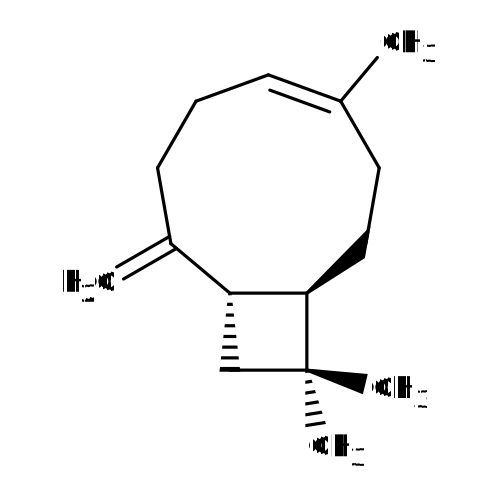
| Structure | [H][C@]12CC(C)(C)[C@]1([H])CC\C(C)=C/CCC2=C InChI=1S/C15H24/c1-11-6-5-7-12(2)13-10-15(3,4)14(13)9-8-11/h6,13-14H,2,5,7-10H2,1,3-4H3/b11-6-/t13-,14-/m1/s1 |
|---|
| Synonyms | | Value | Source |
|---|
| Gamma-Caryophyllene | HMDB | | g-Caryophyllene | HMDB | | Γ-caryophyllene | HMDB | | Caryophyllene, (r*,4Z,9S*)-(+-)-isomer | HMDB | | Caryophyllene | HMDB | | Caryophyllene, (R-(r*,4E,9S))-isomer | HMDB | | Caryophyllene, (R-(r*,4Z,9S*))-isomer | HMDB | | Caryophyllene, (S-(r*,4E,9S*))-isomer | HMDB | | Caryophyllene, (S-(r*,4Z,9S*))-isomer | HMDB |
|
|---|
| Chemical Formula | C15H24 |
|---|
| Average Mass | 204.3570 Da |
|---|
| Monoisotopic Mass | 204.18780 Da |
|---|
| IUPAC Name | (1R,4Z,9S)-4,11,11-trimethyl-8-methylidenebicyclo[7.2.0]undec-4-ene |
|---|
| Traditional Name | isocaryophyllene |
|---|
| CAS Registry Number | 118-65-0 |
|---|
| SMILES | [H][C@]12CC(C)(C)[C@]1([H])CC\C(C)=C/CCC2=C |
|---|
| InChI Identifier | InChI=1S/C15H24/c1-11-6-5-7-12(2)13-10-15(3,4)14(13)9-8-11/h6,13-14H,2,5,7-10H2,1,3-4H3/b11-6-/t13-,14-/m1/s1 |
|---|
| InChI Key | NPNUFJAVOOONJE-FLFDDASRSA-N |
|---|
| Experimental Spectra |
|---|
|
| Not Available | | Predicted Spectra |
|---|
|
| | Spectrum Type | Description | Depositor ID | Depositor Organization | Depositor | Deposition Date | View |
|---|
| 1D NMR | 13C NMR Spectrum (1D, 25 MHz, D2O, predicted) | Wishart Lab | Wishart Lab | David Wishart | 2021-06-20 | View Spectrum | | 1D NMR | 1H NMR Spectrum (1D, 100 MHz, D2O, predicted) | Wishart Lab | Wishart Lab | David Wishart | 2021-06-20 | View Spectrum | | 1D NMR | 13C NMR Spectrum (1D, 252 MHz, D2O, predicted) | Wishart Lab | Wishart Lab | David Wishart | 2021-06-20 | View Spectrum | | 1D NMR | 1H NMR Spectrum (1D, 1000 MHz, D2O, predicted) | Wishart Lab | Wishart Lab | David Wishart | 2021-06-20 | View Spectrum | | 1D NMR | 13C NMR Spectrum (1D, 50 MHz, D2O, predicted) | Wishart Lab | Wishart Lab | David Wishart | 2021-06-20 | View Spectrum | | 1D NMR | 1H NMR Spectrum (1D, 200 MHz, D2O, predicted) | Wishart Lab | Wishart Lab | David Wishart | 2021-06-20 | View Spectrum | | 1D NMR | 13C NMR Spectrum (1D, 75 MHz, D2O, predicted) | Wishart Lab | Wishart Lab | David Wishart | 2021-06-20 | View Spectrum | | 1D NMR | 1H NMR Spectrum (1D, 300 MHz, D2O, predicted) | Wishart Lab | Wishart Lab | David Wishart | 2021-06-20 | View Spectrum | | 1D NMR | 13C NMR Spectrum (1D, 101 MHz, D2O, predicted) | Wishart Lab | Wishart Lab | David Wishart | 2021-06-20 | View Spectrum | | 1D NMR | 1H NMR Spectrum (1D, 400 MHz, D2O, predicted) | Wishart Lab | Wishart Lab | David Wishart | 2021-06-20 | View Spectrum | | 1D NMR | 13C NMR Spectrum (1D, 126 MHz, D2O, predicted) | Wishart Lab | Wishart Lab | David Wishart | 2021-06-20 | View Spectrum | | 1D NMR | 1H NMR Spectrum (1D, 500 MHz, D2O, predicted) | Wishart Lab | Wishart Lab | David Wishart | 2021-06-20 | View Spectrum | | 1D NMR | 13C NMR Spectrum (1D, 151 MHz, D2O, predicted) | Wishart Lab | Wishart Lab | David Wishart | 2021-06-20 | View Spectrum | | 1D NMR | 1H NMR Spectrum (1D, 600 MHz, D2O, predicted) | Wishart Lab | Wishart Lab | David Wishart | 2021-06-20 | View Spectrum | | 1D NMR | 13C NMR Spectrum (1D, 176 MHz, D2O, predicted) | Wishart Lab | Wishart Lab | David Wishart | 2021-06-20 | View Spectrum | | 1D NMR | 1H NMR Spectrum (1D, 700 MHz, D2O, predicted) | Wishart Lab | Wishart Lab | David Wishart | 2021-06-20 | View Spectrum | | 1D NMR | 13C NMR Spectrum (1D, 201 MHz, D2O, predicted) | Wishart Lab | Wishart Lab | David Wishart | 2021-06-20 | View Spectrum | | 1D NMR | 1H NMR Spectrum (1D, 800 MHz, D2O, predicted) | Wishart Lab | Wishart Lab | David Wishart | 2021-06-20 | View Spectrum | | 1D NMR | 13C NMR Spectrum (1D, 226 MHz, D2O, predicted) | Wishart Lab | Wishart Lab | David Wishart | 2021-06-20 | View Spectrum | | 1D NMR | 1H NMR Spectrum (1D, 900 MHz, D2O, predicted) | Wishart Lab | Wishart Lab | David Wishart | 2021-06-20 | View Spectrum |
| | Chemical Shift Submissions |
|---|
|
| Not Available | | Species |
|---|
| Species of Origin | |
|---|
| Chemical Taxonomy |
|---|
| Description | Belongs to the class of organic compounds known as sesquiterpenoids. These are terpenes with three consecutive isoprene units. |
|---|
| Kingdom | Organic compounds |
|---|
| Super Class | Lipids and lipid-like molecules |
|---|
| Class | Prenol lipids |
|---|
| Sub Class | Sesquiterpenoids |
|---|
| Direct Parent | Sesquiterpenoids |
|---|
| Alternative Parents | |
|---|
| Substituents | - Caryophyllane sesquiterpenoid
- Sesquiterpenoid
- Branched unsaturated hydrocarbon
- Polycyclic hydrocarbon
- Cyclic olefin
- Unsaturated aliphatic hydrocarbon
- Unsaturated hydrocarbon
- Olefin
- Hydrocarbon
- Aliphatic homopolycyclic compound
|
|---|
| Molecular Framework | Aliphatic homopolycyclic compounds |
|---|
| External Descriptors | |
|---|
| Physical Properties |
|---|
| State | Not Available |
|---|
| Experimental Properties | | Property | Value | Reference |
|---|
| Melting Point | Not Available | Not Available | | Boiling Point | Not Available | Not Available | | Water Solubility | Not Available | Not Available | | LogP | Not Available | Not Available |
|
|---|
| Predicted Properties | |
|---|
| General References | - Fidyt K, Fiedorowicz A, Strzadala L, Szumny A: beta-caryophyllene and beta-caryophyllene oxide-natural compounds of anticancer and analgesic properties. Cancer Med. 2016 Oct;5(10):3007-3017. doi: 10.1002/cam4.816. Epub 2016 Sep 30. [PubMed:27696789 ]
- Jelen HH, Mirocha CJ, Wasowicz E, Kaminski E: Production of volatile sesquiterpenes by Fusarium sambucinum strains with different abilities to synthesize trichothecenes. Appl Environ Microbiol. 1995 Nov;61(11):3815-20. doi: 10.1128/aem.61.11.3815-3820.1995. [PubMed:8526491 ]
- Demirci B, Baser KH, Ozek T, Demirci F: Betulenols from Betula species. Planta Med. 2000 Jun;66(5):490-3. doi: 10.1055/s-2000-8591. [PubMed:10909279 ]
- Hernandez T, Canales M, Avila JG, Garcia AM, Martinez A, Caballero J, de Vivar AR, Lira R: Composition and antibacterial activity of essential oil of Lantana achyranthifolia Desf. (Verbenaceae). J Ethnopharmacol. 2005 Jan 15;96(3):551-4. doi: 10.1016/j.jep.2004.09.044. [PubMed:15619577 ]
- Ricci D, Fraternale D, Giamperi L, Bucchini A, Epifano F, Burini G, Curini M: Chemical composition, antimicrobial and antioxidant activity of the essential oil of Teucrium marum (Lamiaceae). J Ethnopharmacol. 2005 Apr 8;98(1-2):195-200. doi: 10.1016/j.jep.2005.01.022. [PubMed:15763383 ]
- Sabulal B, Dan M, J AJ, Kurup R, Pradeep NS, Valsamma RK, George V: Caryophyllene-rich rhizome oil of Zingiber nimmonii from South India: Chemical characterization and antimicrobial activity. Phytochemistry. 2006 Nov;67(22):2469-73. doi: 10.1016/j.phytochem.2006.08.003. Epub 2006 Sep 14. [PubMed:16973189 ]
- Legault J, Pichette A: Potentiating effect of beta-caryophyllene on anticancer activity of alpha-humulene, isocaryophyllene and paclitaxel. J Pharm Pharmacol. 2007 Dec;59(12):1643-7. doi: 10.1211/jpp.59.12.0005. [PubMed:18053325 ]
- Ashitani T, Borg-Karlson AK, Fujita K, Nagahama S: Reaction mechanism of direct episulfidation of caryophyllene and humulene. Nat Prod Res. 2008 Apr 15;22(6):495-8. doi: 10.1080/14786410701591903. [PubMed:18415856 ]
- Sousa EO, Silva NF, Rodrigues FF, Campos AR, Lima SG, Costa JG: Chemical composition and resistance-modifying effect of the essential oil of Lantana camara Linn. Pharmacogn Mag. 2010 Apr;6(22):79-82. doi: 10.4103/0973-1296.62890. Epub 2010 May 5. [PubMed:20668570 ]
|
|---|