| Record Information |
|---|
| Version | 2.0 |
|---|
| Created at | 2022-03-10 18:58:58 UTC |
|---|
| Updated at | 2022-03-10 22:21:43 UTC |
|---|
| NP-MRD ID | NP0045159 |
|---|
| Secondary Accession Numbers | None |
|---|
| Natural Product Identification |
|---|
| Common Name | Methyl anthranilate |
|---|
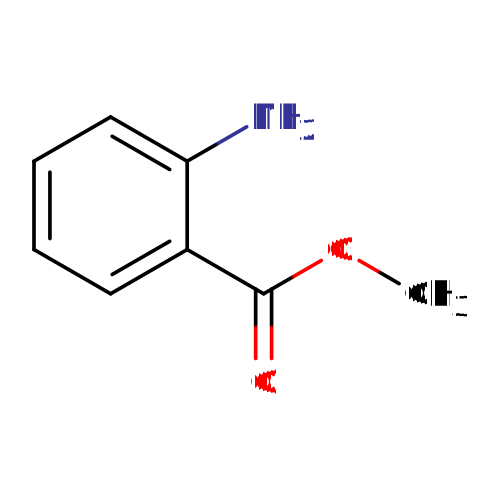
| Description | Methyl anthranilate or Methyl 2-aminobenzoate, also known as 2-carbomethoxyaniline, belongs to the class of organic compounds known as benzoic acid esters. These are ester derivatives of benzoic acid. Methyl anthranilate is a moderately basic compound (based on its pKa). It has a fruity grape smell, and one of its key uses is as a flavoring agent. Methyl 2-aminobenzoate is a bitter, flower, and fruity tasting compound. Methyl 2-aminobenzoate has been detected, but not quantified, in several different foods, such as tea, fruits, limes. Methyl anthranilate is known to occur naturally in the Concord grapes and other Vitis labrusca grapes and hybrids thereof. It has also been detected in bergamot, black locust, champak, gardenia, jasmine, lemon, mandarin orange, neroli, oranges, rue oil, strawberry, tuberose, wisteria, galangal, and ylang ylang. It is also a primary component of the essential apple flavor, along with ethyl acetate and ethyl butyrate. Methyl anthranilate is used extensively in modern perfumery. Methyl anthranilate has been reported to be a volatile component in cannabis samples (PMID: 26657499 ). |
|---|
| Structure | InChI=1S/C8H9NO2/c1-11-8(10)6-4-2-3-5-7(6)9/h2-5H,9H2,1H3 |
|---|
| Synonyms | | Value | Source |
|---|
| 2-(Methoxycarbonyl)aniline | ChEBI | | 2-Aminobenzoic acid methyl ester | ChEBI | | 2-Carbomethoxyaniline | ChEBI | | Anthranilic acid methyl ester | ChEBI | | Methyl O-aminobenzoate | ChEBI | | O-Aminobenzoic acid methyl ester | ChEBI | | O-Carbomethoxyaniline | ChEBI | | O-Methyl anthranilate | ChEBI | | 2-Aminobenzoate methyl ester | Generator | | Anthranilate methyl ester | Generator | | Methyl O-aminobenzoic acid | Generator | | O-Aminobenzoate methyl ester | Generator | | O-Methyl anthranilic acid | Generator | | Methyl 2-aminobenzoic acid | Generator | | Carbomethoxyaniline | HMDB | | FEMA 2682 | HMDB | | Methyl ester OF O-aminobenzoic acid | HMDB | | O-Amino methyl benzoate | HMDB | | Methyl anthranilic acid | Generator |
|
|---|
| Chemical Formula | C8H9NO2 |
|---|
| Average Mass | 151.1626 Da |
|---|
| Monoisotopic Mass | 151.06333 Da |
|---|
| IUPAC Name | methyl 2-aminobenzoate |
|---|
| Traditional Name | methyl anthranilate |
|---|
| CAS Registry Number | 134-20-3 |
|---|
| SMILES | COC(=O)C1=CC=CC=C1N |
|---|
| InChI Identifier | InChI=1S/C8H9NO2/c1-11-8(10)6-4-2-3-5-7(6)9/h2-5H,9H2,1H3 |
|---|
| InChI Key | VAMXMNNIEUEQDV-UHFFFAOYSA-N |
|---|
| Experimental Spectra |
|---|
|
| Not Available | | Predicted Spectra |
|---|
|
| | Spectrum Type | Description | Depositor ID | Depositor Organization | Depositor | Deposition Date | View |
|---|
| 1D NMR | 13C NMR Spectrum (1D, 25 MHz, D2O, predicted) | Wishart Lab | Wishart Lab | David Wishart | 2021-06-20 | View Spectrum | | 1D NMR | 1H NMR Spectrum (1D, 100 MHz, D2O, predicted) | Wishart Lab | Wishart Lab | David Wishart | 2021-06-20 | View Spectrum | | 1D NMR | 13C NMR Spectrum (1D, 252 MHz, D2O, predicted) | Wishart Lab | Wishart Lab | David Wishart | 2021-06-20 | View Spectrum | | 1D NMR | 1H NMR Spectrum (1D, 1000 MHz, D2O, predicted) | Wishart Lab | Wishart Lab | David Wishart | 2021-06-20 | View Spectrum | | 1D NMR | 13C NMR Spectrum (1D, 50 MHz, D2O, predicted) | Wishart Lab | Wishart Lab | David Wishart | 2021-06-20 | View Spectrum | | 1D NMR | 1H NMR Spectrum (1D, 200 MHz, D2O, predicted) | Wishart Lab | Wishart Lab | David Wishart | 2021-06-20 | View Spectrum | | 1D NMR | 13C NMR Spectrum (1D, 75 MHz, D2O, predicted) | Wishart Lab | Wishart Lab | David Wishart | 2021-06-20 | View Spectrum | | 1D NMR | 1H NMR Spectrum (1D, 300 MHz, D2O, predicted) | Wishart Lab | Wishart Lab | David Wishart | 2021-06-20 | View Spectrum | | 1D NMR | 13C NMR Spectrum (1D, 101 MHz, D2O, predicted) | Wishart Lab | Wishart Lab | David Wishart | 2021-06-20 | View Spectrum | | 1D NMR | 1H NMR Spectrum (1D, 400 MHz, D2O, predicted) | Wishart Lab | Wishart Lab | David Wishart | 2021-06-20 | View Spectrum | | 1D NMR | 13C NMR Spectrum (1D, 126 MHz, D2O, predicted) | Wishart Lab | Wishart Lab | David Wishart | 2021-06-20 | View Spectrum | | 1D NMR | 1H NMR Spectrum (1D, 500 MHz, D2O, predicted) | Wishart Lab | Wishart Lab | David Wishart | 2021-06-20 | View Spectrum | | 1D NMR | 13C NMR Spectrum (1D, 151 MHz, D2O, predicted) | Wishart Lab | Wishart Lab | David Wishart | 2021-06-20 | View Spectrum | | 1D NMR | 1H NMR Spectrum (1D, 600 MHz, D2O, predicted) | Wishart Lab | Wishart Lab | David Wishart | 2021-06-20 | View Spectrum | | 1D NMR | 13C NMR Spectrum (1D, 176 MHz, D2O, predicted) | Wishart Lab | Wishart Lab | David Wishart | 2021-06-20 | View Spectrum | | 1D NMR | 1H NMR Spectrum (1D, 700 MHz, D2O, predicted) | Wishart Lab | Wishart Lab | David Wishart | 2021-06-20 | View Spectrum | | 1D NMR | 13C NMR Spectrum (1D, 201 MHz, D2O, predicted) | Wishart Lab | Wishart Lab | David Wishart | 2021-06-20 | View Spectrum | | 1D NMR | 1H NMR Spectrum (1D, 800 MHz, D2O, predicted) | Wishart Lab | Wishart Lab | David Wishart | 2021-06-20 | View Spectrum | | 1D NMR | 13C NMR Spectrum (1D, 226 MHz, D2O, predicted) | Wishart Lab | Wishart Lab | David Wishart | 2021-06-20 | View Spectrum | | 1D NMR | 1H NMR Spectrum (1D, 900 MHz, D2O, predicted) | Wishart Lab | Wishart Lab | David Wishart | 2021-06-20 | View Spectrum |
| | Chemical Shift Submissions |
|---|
|
| Not Available | | Species |
|---|
| Species of Origin | |
|---|
| Chemical Taxonomy |
|---|
| Description | Belongs to the class of organic compounds known as benzoic acid esters. These are ester derivatives of benzoic acid. |
|---|
| Kingdom | Organic compounds |
|---|
| Super Class | Benzenoids |
|---|
| Class | Benzene and substituted derivatives |
|---|
| Sub Class | Benzoic acids and derivatives |
|---|
| Direct Parent | Benzoic acid esters |
|---|
| Alternative Parents | |
|---|
| Substituents | - Aminobenzoic acid or derivatives
- Benzoate ester
- Benzoyl
- Aniline or substituted anilines
- Vinylogous amide
- Methyl ester
- Amino acid or derivatives
- Carboxylic acid ester
- Carboxylic acid derivative
- Monocarboxylic acid or derivatives
- Amine
- Organonitrogen compound
- Organooxygen compound
- Primary amine
- Hydrocarbon derivative
- Organic oxide
- Organopnictogen compound
- Organic oxygen compound
- Organic nitrogen compound
- Aromatic homomonocyclic compound
|
|---|
| Molecular Framework | Aromatic homomonocyclic compounds |
|---|
| External Descriptors | |
|---|
| Physical Properties |
|---|
| State | Not Available |
|---|
| Experimental Properties | | Property | Value | Reference |
|---|
| Melting Point | Not Available | Not Available | | Boiling Point | Not Available | Not Available | | Water Solubility | Not Available | Not Available | | LogP | Not Available | Not Available |
|
|---|
| Predicted Properties | |
|---|
| General References | - Pankiw T: Reducing honey bee defensive responses and social wasp colonization with methyl anthranilate. J Med Entomol. 2009 Jul;46(4):782-8. doi: 10.1603/033.046.0408. [PubMed:19645280 ]
- Kollner TG, Lenk C, Zhao N, Seidl-Adams I, Gershenzon J, Chen F, Degenhardt J: Herbivore-induced SABATH methyltransferases of maize that methylate anthranilic acid using s-adenosyl-L-methionine. Plant Physiol. 2010 Aug;153(4):1795-807. doi: 10.1104/pp.110.158360. Epub 2010 Jun 2. [PubMed:20519632 ]
- Robacker DC, Massa MJ, Sacchetti P, Bartelt RJ: A novel attractant for Anastrepha ludens (Diptera: Tephritidae) from a Concord grape product. J Econ Entomol. 2011 Aug;104(4):1195-203. doi: 10.1603/ec10220. [PubMed:21882683 ]
- Mann RS, Ali JG, Hermann SL, Tiwari S, Pelz-Stelinski KS, Alborn HT, Stelinski LL: Induced release of a plant-defense volatile 'deceptively' attracts insect vectors to plants infected with a bacterial pathogen. PLoS Pathog. 2012;8(3):e1002610. doi: 10.1371/journal.ppat.1002610. Epub 2012 Mar 22. [PubMed:22457628 ]
- Esther A, Tilcher R, Jacob J: Assessing the effects of three potential chemical repellents to prevent bird damage to corn seeds and seedlings. Pest Manag Sci. 2013 Mar;69(3):425-30. doi: 10.1002/ps.3288. Epub 2012 Apr 12. [PubMed:22499556 ]
|
|---|