| Record Information |
|---|
| Version | 2.0 |
|---|
| Created at | 2022-03-10 18:58:34 UTC |
|---|
| Updated at | 2022-03-10 22:20:26 UTC |
|---|
| NP-MRD ID | NP0045135 |
|---|
| Secondary Accession Numbers | None |
|---|
| Natural Product Identification |
|---|
| Common Name | Diacetone alcohol |
|---|
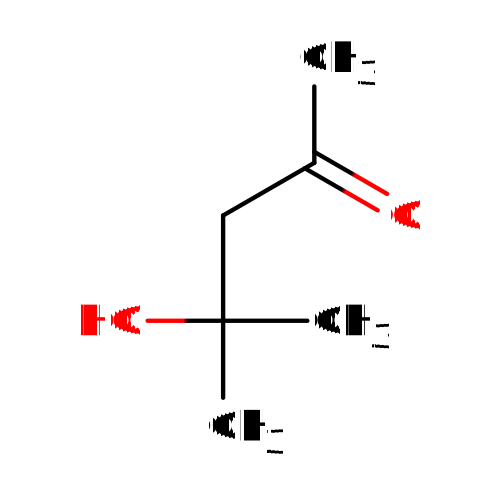
| Description | Diacetone alcohol, sometimes referred to as DAA, belongs to the class of organic compounds known as beta-hydroxy ketones. These are ketones containing a hydroxyl group attached to the beta-carbon atom, relative to the C=O group. Diacetone alcohol is an organic compound with the chemical formula CH3C(O)CH2C(OH)(CH3)2. Diacetone alcohol is a very hydrophobic molecule, practically insoluble in water, and relatively neutral. It is a colorless liquid, used as a solvent and a common synthetic intermediate used for the preparation of other compounds. Diacetone alcohol is found in the highest concentration in cow milk but it has also been detected, not quantified, in several different foods, such as fruits, mung beans, papaya, and soybeans Diacetone alcohol has also been detected as a volatile component in cannabis plant samples (PMID: 26657499 ). Diacetone alcohol is commercially used in cellulose ester lacquers, particularly of the brushing type, where it produces brilliant gloss and a hard film and where its lack of odor is desirable. It is used in lacquer thinners, dopes, wood stains, wood preservatives and printing pastes, in coating compositions for paper and textiles, permanent markers, in making artificial silk and leather, in imitation gold leaf, in celluloid cements, as a preservative for animal tissue, in metal cleaning compounds, in the manufacture of photographic film, and in hydraulic brake fluids, where it is usually mixed with an equal volume of castor oil. |
|---|
| Structure | InChI=1S/C6H12O2/c1-5(7)4-6(2,3)8/h8H,4H2,1-3H3 |
|---|
| Synonyms | | Value | Source |
|---|
| 2-Methyl-2-pentanol-4-one | ChEBI | | 4-Hydroxy-2-keto-4-methylpentane | ChEBI | | 4-Hydroxy-4-methyl-2-pentanone | ChEBI | | 4-Hydroxy-4-methylpentan-2-one | ChEBI | | Acetonyldimethylcarbinol | ChEBI | | Diacetonalkohol | ChEBI | | Diacetone-alcool | ChEBI | | Diacetonyl alcohol | ChEBI | | Dimethyl acetonyl carbinol | ChEBI | | (CH3)2C(OH)CH2C(O)CH3 | HMDB | | 2-Hydroxy-2-methyl-4-pentanone | HMDB | | 2-Methyl-3-pentanol-4-one | HMDB | | 4-Hydroxy-4-methyl pentan-2-one | HMDB | | 4-Hydroxy-4-methyl-pentan-2-ON | HMDB | | 4-Hydroxy-4-methylpentanone | HMDB | | 4-Hydroxy-4-methylpentanone-2 | HMDB | | 4-Idrossi-4-metil-pentan-2-one | HMDB | | 4-Methyl-2-pentanon-4-ol | HMDB | | 4-Methyl-4-hydroxy-2-pentanone | HMDB | | Diacetonalcohol | HMDB | | Diacetonalcool | HMDB | | Diacetone | HMDB | | Diacetonealcool | HMDB | | Diketone alcohol | HMDB | | Hydroxy-4-methyl-2-pentanone | HMDB | | Pyranton | HMDB | | Pyranton a | HMDB | | Pyraton | HMDB | | Tyranton | HMDB | | Diacetone alcohol | MeSH |
|
|---|
| Chemical Formula | C6H12O2 |
|---|
| Average Mass | 116.1583 Da |
|---|
| Monoisotopic Mass | 116.08373 Da |
|---|
| IUPAC Name | 4-hydroxy-4-methylpentan-2-one |
|---|
| Traditional Name | diacetone alcohol |
|---|
| CAS Registry Number | 123-42-2 |
|---|
| SMILES | CC(=O)CC(C)(C)O |
|---|
| InChI Identifier | InChI=1S/C6H12O2/c1-5(7)4-6(2,3)8/h8H,4H2,1-3H3 |
|---|
| InChI Key | SWXVUIWOUIDPGS-UHFFFAOYSA-N |
|---|
| Experimental Spectra |
|---|
|
| Not Available | | Predicted Spectra |
|---|
|
| | Spectrum Type | Description | Depositor ID | Depositor Organization | Depositor | Deposition Date | View |
|---|
| 1D NMR | 13C NMR Spectrum (1D, 25 MHz, D2O, predicted) | Wishart Lab | Wishart Lab | David Wishart | 2021-06-20 | View Spectrum | | 1D NMR | 1H NMR Spectrum (1D, 100 MHz, D2O, predicted) | Wishart Lab | Wishart Lab | David Wishart | 2021-06-20 | View Spectrum | | 1D NMR | 13C NMR Spectrum (1D, 252 MHz, D2O, predicted) | Wishart Lab | Wishart Lab | David Wishart | 2021-06-20 | View Spectrum | | 1D NMR | 1H NMR Spectrum (1D, 1000 MHz, D2O, predicted) | Wishart Lab | Wishart Lab | David Wishart | 2021-06-20 | View Spectrum | | 1D NMR | 13C NMR Spectrum (1D, 50 MHz, D2O, predicted) | Wishart Lab | Wishart Lab | David Wishart | 2021-06-20 | View Spectrum | | 1D NMR | 1H NMR Spectrum (1D, 200 MHz, D2O, predicted) | Wishart Lab | Wishart Lab | David Wishart | 2021-06-20 | View Spectrum | | 1D NMR | 13C NMR Spectrum (1D, 75 MHz, D2O, predicted) | Wishart Lab | Wishart Lab | David Wishart | 2021-06-20 | View Spectrum | | 1D NMR | 1H NMR Spectrum (1D, 300 MHz, D2O, predicted) | Wishart Lab | Wishart Lab | David Wishart | 2021-06-20 | View Spectrum | | 1D NMR | 13C NMR Spectrum (1D, 101 MHz, D2O, predicted) | Wishart Lab | Wishart Lab | David Wishart | 2021-06-20 | View Spectrum | | 1D NMR | 1H NMR Spectrum (1D, 400 MHz, D2O, predicted) | Wishart Lab | Wishart Lab | David Wishart | 2021-06-20 | View Spectrum | | 1D NMR | 13C NMR Spectrum (1D, 126 MHz, D2O, predicted) | Wishart Lab | Wishart Lab | David Wishart | 2021-06-20 | View Spectrum | | 1D NMR | 1H NMR Spectrum (1D, 500 MHz, D2O, predicted) | Wishart Lab | Wishart Lab | David Wishart | 2021-06-20 | View Spectrum | | 1D NMR | 13C NMR Spectrum (1D, 151 MHz, D2O, predicted) | Wishart Lab | Wishart Lab | David Wishart | 2021-06-20 | View Spectrum | | 1D NMR | 1H NMR Spectrum (1D, 600 MHz, D2O, predicted) | Wishart Lab | Wishart Lab | David Wishart | 2021-06-20 | View Spectrum | | 1D NMR | 13C NMR Spectrum (1D, 176 MHz, D2O, predicted) | Wishart Lab | Wishart Lab | David Wishart | 2021-06-20 | View Spectrum | | 1D NMR | 1H NMR Spectrum (1D, 700 MHz, D2O, predicted) | Wishart Lab | Wishart Lab | David Wishart | 2021-06-20 | View Spectrum | | 1D NMR | 13C NMR Spectrum (1D, 201 MHz, D2O, predicted) | Wishart Lab | Wishart Lab | David Wishart | 2021-06-20 | View Spectrum | | 1D NMR | 1H NMR Spectrum (1D, 800 MHz, D2O, predicted) | Wishart Lab | Wishart Lab | David Wishart | 2021-06-20 | View Spectrum | | 1D NMR | 13C NMR Spectrum (1D, 226 MHz, D2O, predicted) | Wishart Lab | Wishart Lab | David Wishart | 2021-06-20 | View Spectrum | | 1D NMR | 1H NMR Spectrum (1D, 900 MHz, D2O, predicted) | Wishart Lab | Wishart Lab | David Wishart | 2021-06-20 | View Spectrum |
| | Chemical Shift Submissions |
|---|
|
| Not Available | | Species |
|---|
| Species of Origin | |
|---|
| Chemical Taxonomy |
|---|
| Description | Belongs to the class of organic compounds known as beta-hydroxy ketones. These are ketones containing a hydroxyl group attached to the beta-carbon atom, relative to the C=O group. |
|---|
| Kingdom | Organic compounds |
|---|
| Super Class | Organic oxygen compounds |
|---|
| Class | Organooxygen compounds |
|---|
| Sub Class | Carbonyl compounds |
|---|
| Direct Parent | Beta-hydroxy ketones |
|---|
| Alternative Parents | |
|---|
| Substituents | - Beta-hydroxy ketone
- Tertiary alcohol
- Organic oxide
- Hydrocarbon derivative
- Alcohol
- Aliphatic acyclic compound
|
|---|
| Molecular Framework | Aliphatic acyclic compounds |
|---|
| External Descriptors | |
|---|
| Physical Properties |
|---|
| State | Not Available |
|---|
| Experimental Properties | | Property | Value | Reference |
|---|
| Melting Point | Not Available | Not Available | | Boiling Point | Not Available | Not Available | | Water Solubility | Not Available | Not Available | | LogP | Not Available | Not Available |
|
|---|
| Predicted Properties | |
|---|