| Record Information |
|---|
| Version | 2.0 |
|---|
| Created at | 2022-03-10 18:53:11 UTC |
|---|
| Updated at | 2022-03-10 22:18:48 UTC |
|---|
| NP-MRD ID | NP0045040 |
|---|
| Secondary Accession Numbers | None |
|---|
| Natural Product Identification |
|---|
| Common Name | Cannabichromenic acid |
|---|
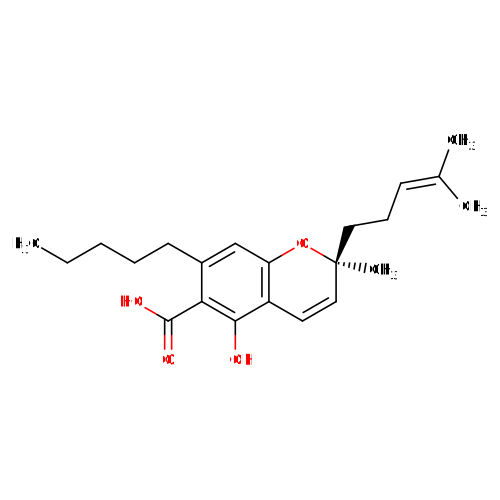
| Description | Cannabichromenic acid (CBCA) is a biosynthetic derivative of cannabigerolic acid (CBGA). It is a non-psychoactive component of cannabis and is one of the more than 100 cannabinoids found in Cannabis sativa plants. As its precursor, cannabigerolic acid, CBCA is a phytocannabinoid that belongs to the class of organic compounds known as hydroxybenzoic acid derivatives. Cannabichromenic acid is characterized by the presence of a chromene moiety in the center of the structure. This chromene arrangement results from the cyclization of the isoprenoid sidechain on to the hydroxyl group in position four of cannabigerolic acid, yielding a pyrane type ring. Cannabichromenic acid is a molecule of mixed biosynthetic origin, in which its aromatic moiety (derived from olivetolic acid) occurs through the polyketide biosynthetic pathway while the prenylated sidechain derives from the MEP pathway of the terpenoids (DOI: 10.1016/B978-0-12-800756-3.00002-8). As such, cannabichromenic acid can be considered a polyketide, a monoterpenoid and a resorcinol, due to the meta arrangement of its two hydroxyl groups on the benzene ring. CBC is not active at the  cannabinoid-1 (CB1) and cannabinoid-2 (CB2) receptors, but is an agonist of  transient receptor potential ankyrin 1 TRPA1 and less potently, an agonist of  transient receptor potential cation channel, subfamily V, member 3 and 4 (TRPV3;  TRPV4;  PMID 28120231 ). |
|---|
| Structure | CCCCCC1=CC2=C(C=C[C@](C)(CCC=C(C)C)O2)C(O)=C1C(O)=O InChI=1S/C22H30O4/c1-5-6-7-10-16-14-18-17(20(23)19(16)21(24)25)11-13-22(4,26-18)12-8-9-15(2)3/h9,11,13-14,23H,5-8,10,12H2,1-4H3,(H,24,25)/t22-/m0/s1 |
|---|
| Synonyms | | Value | Source |
|---|
| 5-Hydroxy-2-methyl-2-(4-methylpent-3-enyl)-7-pentylchromene-6-carboxylate | Generator |
|
|---|
| Chemical Formula | C22H30O4 |
|---|
| Average Mass | 358.4780 Da |
|---|
| Monoisotopic Mass | 358.21441 Da |
|---|
| IUPAC Name | (2S)-5-hydroxy-2-methyl-2-(4-methylpent-3-en-1-yl)-7-pentyl-2H-chromene-6-carboxylic acid |
|---|
| Traditional Name | (2S)-5-hydroxy-2-methyl-2-(4-methylpent-3-en-1-yl)-7-pentylchromene-6-carboxylic acid |
|---|
| CAS Registry Number | 20408-52-0 |
|---|
| SMILES | CCCCCC1=CC2=C(C=C[C@](C)(CCC=C(C)C)O2)C(O)=C1C(O)=O |
|---|
| InChI Identifier | InChI=1S/C22H30O4/c1-5-6-7-10-16-14-18-17(20(23)19(16)21(24)25)11-13-22(4,26-18)12-8-9-15(2)3/h9,11,13-14,23H,5-8,10,12H2,1-4H3,(H,24,25)/t22-/m0/s1 |
|---|
| InChI Key | HRHJHXJQMNWQTF-QFIPXVFZSA-N |
|---|
| Experimental Spectra |
|---|
|
| Not Available | | Predicted Spectra |
|---|
|
| | Spectrum Type | Description | Depositor ID | Depositor Organization | Depositor | Deposition Date | View |
|---|
| 1D NMR | 13C NMR Spectrum (1D, 25 MHz, D2O, predicted) | Wishart Lab | Wishart Lab | David Wishart | 2021-06-20 | View Spectrum | | 1D NMR | 1H NMR Spectrum (1D, 100 MHz, D2O, predicted) | Wishart Lab | Wishart Lab | David Wishart | 2021-06-20 | View Spectrum | | 1D NMR | 13C NMR Spectrum (1D, 252 MHz, D2O, predicted) | Wishart Lab | Wishart Lab | David Wishart | 2021-06-20 | View Spectrum | | 1D NMR | 1H NMR Spectrum (1D, 1000 MHz, D2O, predicted) | Wishart Lab | Wishart Lab | David Wishart | 2021-06-20 | View Spectrum | | 1D NMR | 13C NMR Spectrum (1D, 50 MHz, D2O, predicted) | Wishart Lab | Wishart Lab | David Wishart | 2021-06-20 | View Spectrum | | 1D NMR | 1H NMR Spectrum (1D, 200 MHz, D2O, predicted) | Wishart Lab | Wishart Lab | David Wishart | 2021-06-20 | View Spectrum | | 1D NMR | 13C NMR Spectrum (1D, 75 MHz, D2O, predicted) | Wishart Lab | Wishart Lab | David Wishart | 2021-06-20 | View Spectrum | | 1D NMR | 1H NMR Spectrum (1D, 300 MHz, D2O, predicted) | Wishart Lab | Wishart Lab | David Wishart | 2021-06-20 | View Spectrum | | 1D NMR | 13C NMR Spectrum (1D, 101 MHz, D2O, predicted) | Wishart Lab | Wishart Lab | David Wishart | 2021-06-20 | View Spectrum | | 1D NMR | 1H NMR Spectrum (1D, 400 MHz, D2O, predicted) | Wishart Lab | Wishart Lab | David Wishart | 2021-06-20 | View Spectrum | | 1D NMR | 13C NMR Spectrum (1D, 126 MHz, D2O, predicted) | Wishart Lab | Wishart Lab | David Wishart | 2021-06-20 | View Spectrum | | 1D NMR | 1H NMR Spectrum (1D, 500 MHz, D2O, predicted) | Wishart Lab | Wishart Lab | David Wishart | 2021-06-20 | View Spectrum | | 1D NMR | 13C NMR Spectrum (1D, 151 MHz, D2O, predicted) | Wishart Lab | Wishart Lab | David Wishart | 2021-06-20 | View Spectrum | | 1D NMR | 1H NMR Spectrum (1D, 600 MHz, D2O, predicted) | Wishart Lab | Wishart Lab | David Wishart | 2021-06-20 | View Spectrum | | 1D NMR | 13C NMR Spectrum (1D, 176 MHz, D2O, predicted) | Wishart Lab | Wishart Lab | David Wishart | 2021-06-20 | View Spectrum | | 1D NMR | 1H NMR Spectrum (1D, 700 MHz, D2O, predicted) | Wishart Lab | Wishart Lab | David Wishart | 2021-06-20 | View Spectrum | | 1D NMR | 13C NMR Spectrum (1D, 201 MHz, D2O, predicted) | Wishart Lab | Wishart Lab | David Wishart | 2021-06-20 | View Spectrum | | 1D NMR | 1H NMR Spectrum (1D, 800 MHz, D2O, predicted) | Wishart Lab | Wishart Lab | David Wishart | 2021-06-20 | View Spectrum | | 1D NMR | 13C NMR Spectrum (1D, 226 MHz, D2O, predicted) | Wishart Lab | Wishart Lab | David Wishart | 2021-06-20 | View Spectrum | | 1D NMR | 1H NMR Spectrum (1D, 900 MHz, D2O, predicted) | Wishart Lab | Wishart Lab | David Wishart | 2021-06-20 | View Spectrum |
| | Chemical Shift Submissions |
|---|
|
| Not Available | | Species |
|---|
| Species of Origin | |
|---|
| Chemical Taxonomy |
|---|
| Description | Belongs to the class of organic compounds known as salicylic acid and derivatives. Salicylic acid and derivatives are compounds containing a 2-hydroxybenzoic acid moiety or a derivative thereof. |
|---|
| Kingdom | Organic compounds |
|---|
| Super Class | Benzenoids |
|---|
| Class | Benzene and substituted derivatives |
|---|
| Sub Class | Benzoic acids and derivatives |
|---|
| Direct Parent | Salicylic acid and derivatives |
|---|
| Alternative Parents | |
|---|
| Substituents | - Benzopyran
- Salicylic acid or derivatives
- 1-benzopyran
- 1-hydroxy-4-unsubstituted benzenoid
- Alkyl aryl ether
- Phenol
- Vinylogous acid
- Carboxylic acid derivative
- Carboxylic acid
- Ether
- Oxacycle
- Organoheterocyclic compound
- Organic oxide
- Organooxygen compound
- Hydrocarbon derivative
- Organic oxygen compound
- Aromatic heteropolycyclic compound
|
|---|
| Molecular Framework | Aromatic heteropolycyclic compounds |
|---|
| External Descriptors | Not Available |
|---|
| Physical Properties |
|---|
| State | Not Available |
|---|
| Experimental Properties | | Property | Value | Reference |
|---|
| Melting Point | Not Available | Not Available | | Boiling Point | Not Available | Not Available | | Water Solubility | Not Available | Not Available | | LogP | Not Available | Not Available |
|
|---|
| Predicted Properties | |
|---|