| Record Information |
|---|
| Version | 2.0 |
|---|
| Created at | 2022-03-10 18:53:06 UTC |
|---|
| Updated at | 2022-12-14 16:27:40 UTC |
|---|
| NP-MRD ID | NP0045035 |
|---|
| Secondary Accession Numbers | None |
|---|
| Natural Product Identification |
|---|
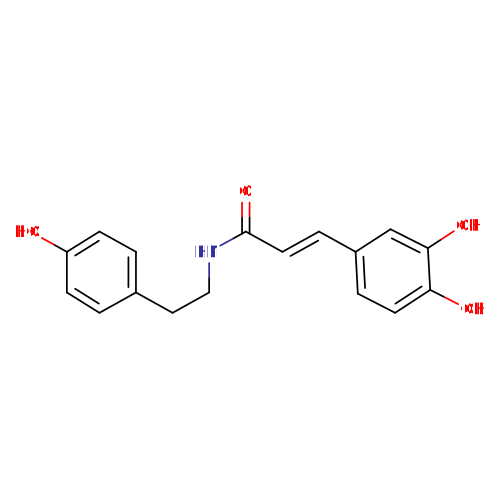
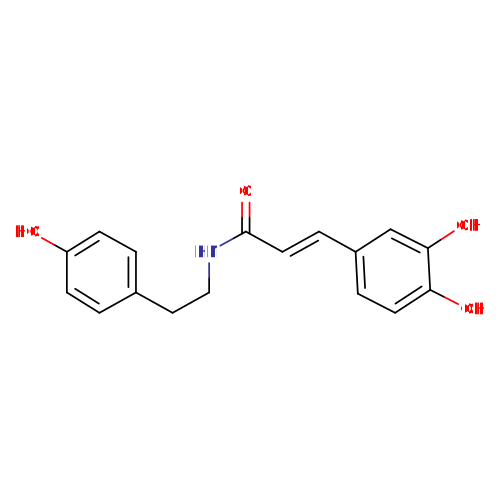
| Common Name | N-trans-Caffeoyltyramine |
|---|
| Description | N-trans-Caffeoyltyramine also known as trans-N-Caffeoyltyramine or TNC, belongs to the class of organic compounds known as hydroxycinnamic acids and derivatives. Hydroxycinnamic acids and derivatives are compounds containing a cinnamic acid (or a derivative thereof) where the benzene ring is hydroxylated. N-trans-Caffeoyltyramine is also classified as a phenylpropanoid amide. Phenylpropanoids consist of a six-carbon, aromatic phenyl group and a three-carbon propene tail of coumaric acid, which is the central intermediate in phenylpropanoid biosynthesis. A phenylpropanoid amide has an amide group incorporated into its propanoid chain. There are two known isomers of N-Caffeoyltyramine, N-trans-Caffeoyltyramine and N-cis-Caffeoyltyramine. N-trans-Caffeoyltyramine is a largely neutral molecule that is somewhat insoluble in water. N-trans-caffeoyltyramine is one of the major phenylpropanoid amides that have been identified in the cannabis plant (PMID:6991645 ) N-trans-Caffeoyltyramine has also been found in the plant Tribulus terrestris (also known as Bindi or puncture vine, a fruit-producing Mediterranean plant that's covered with spines) (PMID: 26239676 ). N-trans-Caffeoyltyramine is also known to be found in Lycium chinense root bark (which produces goji berry or wolfberry) (PMID: 12214850 ). N-trans-Caffeoyltyramine has both arginase inhibitory properties and a strong antioxidant capacity (DOI: 10.1055/S-0042-119400). These properties may make it useful for the design and development of new drugs for the treatment of endothelial dysfunction associated with cardiovascular diseases. N-Caffeoyltyramine has exhibited anti-cancer activities and appears to inhibit the epidermal growth factor receptor (EGFR) and its protein tyrosine kinase activity. In addition, N-Caffeoyltyramine appears to activate caspase 3 activity (PMID: 14643446 ). N-trans-caffeoyltyramine, in particular, has been found to have strong anti-oxidant properties (PMID: 12214850 ; PMID: 28715870 ), And potent anti-fungal activities (PMID: 15266117 ). More recently N-trans-caffeoyltyramine has been identified to be a potent HNF4α agonist (PMID: 35087037 ). It has been found to promote weight loss by inducing an increase in mitochondrial mass and function, including fatty acid oxidation. It also promotes the reversal of hepatic steatosis through a mechanism involving the stimulation of lipophagy by dihydroceramides (PMID: 34117215 ). This has made TNC a strong candidate as a NAFLD (non-alcoholic fatty liver disease) therapeutic. |
|---|
| Structure | OC1=CC=C(CCNC(=O)\C=C\C2=CC=C(O)C(O)=C2)C=C1 InChI=1S/C17H17NO4/c19-14-5-1-12(2-6-14)9-10-18-17(22)8-4-13-3-7-15(20)16(21)11-13/h1-8,11,19-21H,9-10H2,(H,18,22)/b8-4+ |
|---|
| Synonyms | | Value | Source |
|---|
| trans-N-Caffeoyltyramine | HMDB | | (2E)-3-(3,4-Dihydroxyphenyl)-N-[2-(4-hydroxyphenyl)ethyl]prop-2-enimidate | Generator | | N-Caffeoyltyramine | MeSH |
|
|---|
| Chemical Formula | C17H17NO4 |
|---|
| Average Mass | 299.3212 Da |
|---|
| Monoisotopic Mass | 299.11576 Da |
|---|
| IUPAC Name | (E,2E)-3-(3,4-dihydroxyphenyl)-N-[2-(4-hydroxyphenyl)ethyl]prop-2-enimidic acid |
|---|
| Traditional Name | (E,2E)-3-(3,4-dihydroxyphenyl)-N-[2-(4-hydroxyphenyl)ethyl]prop-2-enimidic acid |
|---|
| CAS Registry Number | 219773-48-5 |
|---|
| SMILES | OC1=CC=C(CCNC(=O)\C=C\C2=CC=C(O)C(O)=C2)C=C1 |
|---|
| InChI Identifier | InChI=1S/C17H17NO4/c19-14-5-1-12(2-6-14)9-10-18-17(22)8-4-13-3-7-15(20)16(21)11-13/h1-8,11,19-21H,9-10H2,(H,18,22)/b8-4+ |
|---|
| InChI Key | VSHUQLRHTJOKTA-XBXARRHUSA-N |
|---|
| Experimental Spectra |
|---|
|
| Not Available | | Predicted Spectra |
|---|
|
| | Spectrum Type | Description | Depositor ID | Depositor Organization | Depositor | Deposition Date | View |
|---|
| 1D NMR | 13C NMR Spectrum (1D, 25 MHz, D2O, predicted) | Wishart Lab | Wishart Lab | David Wishart | 2021-06-20 | View Spectrum | | 1D NMR | 1H NMR Spectrum (1D, 100 MHz, D2O, predicted) | Wishart Lab | Wishart Lab | David Wishart | 2021-06-20 | View Spectrum | | 1D NMR | 13C NMR Spectrum (1D, 252 MHz, D2O, predicted) | Wishart Lab | Wishart Lab | David Wishart | 2021-06-20 | View Spectrum | | 1D NMR | 1H NMR Spectrum (1D, 1000 MHz, D2O, predicted) | Wishart Lab | Wishart Lab | David Wishart | 2021-06-20 | View Spectrum | | 1D NMR | 13C NMR Spectrum (1D, 50 MHz, D2O, predicted) | Wishart Lab | Wishart Lab | David Wishart | 2021-06-20 | View Spectrum | | 1D NMR | 1H NMR Spectrum (1D, 200 MHz, D2O, predicted) | Wishart Lab | Wishart Lab | David Wishart | 2021-06-20 | View Spectrum | | 1D NMR | 13C NMR Spectrum (1D, 75 MHz, D2O, predicted) | Wishart Lab | Wishart Lab | David Wishart | 2021-06-20 | View Spectrum | | 1D NMR | 1H NMR Spectrum (1D, 300 MHz, D2O, predicted) | Wishart Lab | Wishart Lab | David Wishart | 2021-06-20 | View Spectrum | | 1D NMR | 13C NMR Spectrum (1D, 101 MHz, D2O, predicted) | Wishart Lab | Wishart Lab | David Wishart | 2021-06-20 | View Spectrum | | 1D NMR | 1H NMR Spectrum (1D, 400 MHz, D2O, predicted) | Wishart Lab | Wishart Lab | David Wishart | 2021-06-20 | View Spectrum | | 1D NMR | 13C NMR Spectrum (1D, 126 MHz, D2O, predicted) | Wishart Lab | Wishart Lab | David Wishart | 2021-06-20 | View Spectrum | | 1D NMR | 1H NMR Spectrum (1D, 500 MHz, D2O, predicted) | Wishart Lab | Wishart Lab | David Wishart | 2021-06-20 | View Spectrum | | 1D NMR | 13C NMR Spectrum (1D, 151 MHz, D2O, predicted) | Wishart Lab | Wishart Lab | David Wishart | 2021-06-20 | View Spectrum | | 1D NMR | 1H NMR Spectrum (1D, 600 MHz, D2O, predicted) | Wishart Lab | Wishart Lab | David Wishart | 2021-06-20 | View Spectrum | | 1D NMR | 13C NMR Spectrum (1D, 176 MHz, D2O, predicted) | Wishart Lab | Wishart Lab | David Wishart | 2021-06-20 | View Spectrum | | 1D NMR | 1H NMR Spectrum (1D, 700 MHz, D2O, predicted) | Wishart Lab | Wishart Lab | David Wishart | 2021-06-20 | View Spectrum | | 1D NMR | 13C NMR Spectrum (1D, 201 MHz, D2O, predicted) | Wishart Lab | Wishart Lab | David Wishart | 2021-06-20 | View Spectrum | | 1D NMR | 1H NMR Spectrum (1D, 800 MHz, D2O, predicted) | Wishart Lab | Wishart Lab | David Wishart | 2021-06-20 | View Spectrum | | 1D NMR | 13C NMR Spectrum (1D, 226 MHz, D2O, predicted) | Wishart Lab | Wishart Lab | David Wishart | 2021-06-20 | View Spectrum | | 1D NMR | 1H NMR Spectrum (1D, 900 MHz, D2O, predicted) | Wishart Lab | Wishart Lab | David Wishart | 2021-06-20 | View Spectrum |
| | Chemical Shift Submissions |
|---|
|
| Not Available | | Species |
|---|
| Species of Origin | |
|---|
| Chemical Taxonomy |
|---|
| Description | Belongs to the class of organic compounds known as hydroxycinnamic acids and derivatives. Hydroxycinnamic acids and derivatives are compounds containing an cinnamic acid (or a derivative thereof) where the benzene ring is hydroxylated. |
|---|
| Kingdom | Organic compounds |
|---|
| Super Class | Phenylpropanoids and polyketides |
|---|
| Class | Cinnamic acids and derivatives |
|---|
| Sub Class | Hydroxycinnamic acids and derivatives |
|---|
| Direct Parent | Hydroxycinnamic acids and derivatives |
|---|
| Alternative Parents | |
|---|
| Substituents | - Cinnamic acid amide
- Hydroxycinnamic acid or derivatives
- Catechol
- Styrene
- 1-hydroxy-4-unsubstituted benzenoid
- 1-hydroxy-2-unsubstituted benzenoid
- Phenol
- Benzenoid
- Monocyclic benzene moiety
- Secondary carboxylic acid amide
- Carboxamide group
- Carboxylic acid derivative
- Organic oxygen compound
- Carbonyl group
- Organooxygen compound
- Organonitrogen compound
- Organic nitrogen compound
- Hydrocarbon derivative
- Organic oxide
- Organopnictogen compound
- Aromatic homomonocyclic compound
|
|---|
| Molecular Framework | Aromatic homomonocyclic compounds |
|---|
| External Descriptors | Not Available |
|---|
| Physical Properties |
|---|
| State | Not Available |
|---|
| Experimental Properties | | Property | Value | Reference |
|---|
| Melting Point | Not Available | Not Available | | Boiling Point | Not Available | Not Available | | Water Solubility | Not Available | Not Available | | LogP | Not Available | Not Available |
|
|---|
| Predicted Properties | |
|---|