| Record Information |
|---|
| Version | 2.0 |
|---|
| Created at | 2022-03-10 18:53:01 UTC |
|---|
| Updated at | 2022-03-10 22:22:40 UTC |
|---|
| NP-MRD ID | NP0045030 |
|---|
| Secondary Accession Numbers | None |
|---|
| Natural Product Identification |
|---|
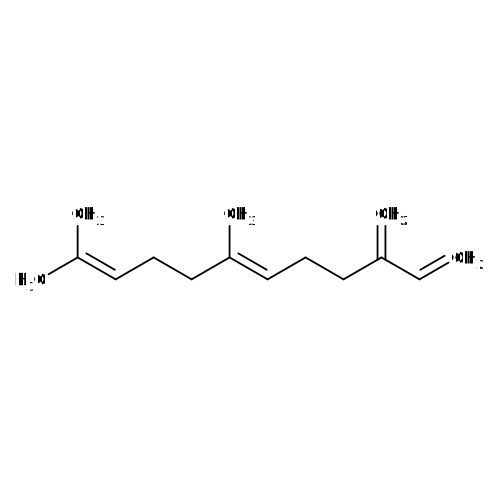
| Common Name | (E)-Beta-Farnesene |
|---|
| Description | (E)-Beta-Farnesene, also known as EBF or trans-beta-Farnesene , belongs to the class of organic compounds known as sesquiterpenoids. Sesquiterpenes are terpenes that contain 15 carbon atoms and are comprised of three isoprene units. The biosynthesis of sesquiterpenes is known to occur mainly through the mevalonic acid pathway (MVA), in the cytosol. However, recent studies have found evidence of pathway crosstalk with the methyl-erythritol-phosphate (MEP) pathway in the cytosol. The term farnesene refers to a set of six closely related chemical compounds (4 alpha-Farnesenes and 2 Beta-Farnesenes) which all are sesquiterpenes. Alpha-Farnesene and beta-Farnesene are isomers, differing by the location of one double bond. Beta-Farnesene is 7,11-dimethyl-3-methylene-1,6,10-dodecatriene while alpha-Farnesene is 3,7,11-trimethyl-1,3,6,10-dodecatetraene. The beta isomer exists as two stereoisomers (cis and trans) about the geometry of its central double bond. However, only the trans isomer exists in nature. Beta-Farnesene exists as a clear colorless liquid and is a hydrophobic, neutral compound that is insoluble in water. It has a woody, sweet, citrus aroma and is used as a masking or perfuming agent. Beta-Farnesene is found naturally in many plants and plant essential oils including basil, blood orange, carrots, celery, ginger, grapefruit, lavender, mint, orange peel, parsley, peppermint, pine, rosemary and thyme. It is one of several sesquiterpenes that are found in cannabis plants (PMID: 6991645 ). It is also found in cannabis smoke and is volatilized during the combustion of cannabis (https://Doi.Org/10.1007/978-1-59259-947-9_2). Beta-Farnesene is also released by aphids as an alarm pheremone upon death to warn away other aphids (PMID: 21092302 ) |
|---|
| Structure | CC(C)=CCC\C(C)=C\CCC(=C)C=C InChI=1S/C15H24/c1-6-14(4)10-8-12-15(5)11-7-9-13(2)3/h6,9,12H,1,4,7-8,10-11H2,2-3,5H3/b15-12+ |
|---|
| Synonyms | | Value | Source |
|---|
| (6E)-7,11-Dimethyl-3-methylene-1,6,10-dodecatriene | ChEBI | | (e)-7,11-Dimethyl-3-methylenedodeca-1,6,10-triene | ChEBI | | beta-Farnesene | ChEBI | | beta-trans-Farnesene | ChEBI | | trans-7,11-Dimethyl-3-methylene-1,6,10-dodecatriene | ChEBI | | b-Farnesene | Generator | | Β-farnesene | Generator | | b-trans-Farnesene | Generator | | Β-trans-farnesene | Generator | | (e)-b-Farnesene | Generator | | (e)-Β-farnesene | Generator | | (E)-beta-Farnesene | ChEBI, KEGG | | trans-b-Farnesene | Generator | | trans-β-Farnesene | Generator | | (E)-7,11-Dimethyl-3-methylene-1,6,10-dodecatriene | PhytoBank | | trans-beta-Farnesene | PhytoBank |
|
|---|
| Chemical Formula | C15H24 |
|---|
| Average Mass | 204.3570 Da |
|---|
| Monoisotopic Mass | 204.18780 Da |
|---|
| IUPAC Name | (6E)-7,11-dimethyl-3-methylidenedodeca-1,6,10-triene |
|---|
| Traditional Name | β-farnesene |
|---|
| CAS Registry Number | 18452-58-9 |
|---|
| SMILES | CC(C)=CCC\C(C)=C\CCC(=C)C=C |
|---|
| InChI Identifier | InChI=1S/C15H24/c1-6-14(4)10-8-12-15(5)11-7-9-13(2)3/h6,9,12H,1,4,7-8,10-11H2,2-3,5H3/b15-12+ |
|---|
| InChI Key | JSNRRGGBADWTMC-NTCAYCPXSA-N |
|---|
| Experimental Spectra |
|---|
|
| Not Available | | Predicted Spectra |
|---|
|
| | Spectrum Type | Description | Depositor ID | Depositor Organization | Depositor | Deposition Date | View |
|---|
| 1D NMR | 13C NMR Spectrum (1D, 25 MHz, D2O, predicted) | Wishart Lab | Wishart Lab | David Wishart | 2021-06-20 | View Spectrum | | 1D NMR | 1H NMR Spectrum (1D, 100 MHz, D2O, predicted) | Wishart Lab | Wishart Lab | David Wishart | 2021-06-20 | View Spectrum | | 1D NMR | 13C NMR Spectrum (1D, 252 MHz, D2O, predicted) | Wishart Lab | Wishart Lab | David Wishart | 2021-06-20 | View Spectrum | | 1D NMR | 1H NMR Spectrum (1D, 1000 MHz, D2O, predicted) | Wishart Lab | Wishart Lab | David Wishart | 2021-06-20 | View Spectrum | | 1D NMR | 13C NMR Spectrum (1D, 50 MHz, D2O, predicted) | Wishart Lab | Wishart Lab | David Wishart | 2021-06-20 | View Spectrum | | 1D NMR | 1H NMR Spectrum (1D, 200 MHz, D2O, predicted) | Wishart Lab | Wishart Lab | David Wishart | 2021-06-20 | View Spectrum | | 1D NMR | 13C NMR Spectrum (1D, 75 MHz, D2O, predicted) | Wishart Lab | Wishart Lab | David Wishart | 2021-06-20 | View Spectrum | | 1D NMR | 1H NMR Spectrum (1D, 300 MHz, D2O, predicted) | Wishart Lab | Wishart Lab | David Wishart | 2021-06-20 | View Spectrum | | 1D NMR | 13C NMR Spectrum (1D, 101 MHz, D2O, predicted) | Wishart Lab | Wishart Lab | David Wishart | 2021-06-20 | View Spectrum | | 1D NMR | 1H NMR Spectrum (1D, 400 MHz, D2O, predicted) | Wishart Lab | Wishart Lab | David Wishart | 2021-06-20 | View Spectrum | | 1D NMR | 13C NMR Spectrum (1D, 126 MHz, D2O, predicted) | Wishart Lab | Wishart Lab | David Wishart | 2021-06-20 | View Spectrum | | 1D NMR | 1H NMR Spectrum (1D, 500 MHz, D2O, predicted) | Wishart Lab | Wishart Lab | David Wishart | 2021-06-20 | View Spectrum | | 1D NMR | 13C NMR Spectrum (1D, 151 MHz, D2O, predicted) | Wishart Lab | Wishart Lab | David Wishart | 2021-06-20 | View Spectrum | | 1D NMR | 1H NMR Spectrum (1D, 600 MHz, D2O, predicted) | Wishart Lab | Wishart Lab | David Wishart | 2021-06-20 | View Spectrum | | 1D NMR | 13C NMR Spectrum (1D, 176 MHz, D2O, predicted) | Wishart Lab | Wishart Lab | David Wishart | 2021-06-20 | View Spectrum | | 1D NMR | 1H NMR Spectrum (1D, 700 MHz, D2O, predicted) | Wishart Lab | Wishart Lab | David Wishart | 2021-06-20 | View Spectrum | | 1D NMR | 13C NMR Spectrum (1D, 201 MHz, D2O, predicted) | Wishart Lab | Wishart Lab | David Wishart | 2021-06-20 | View Spectrum | | 1D NMR | 1H NMR Spectrum (1D, 800 MHz, D2O, predicted) | Wishart Lab | Wishart Lab | David Wishart | 2021-06-20 | View Spectrum | | 1D NMR | 13C NMR Spectrum (1D, 226 MHz, D2O, predicted) | Wishart Lab | Wishart Lab | David Wishart | 2021-06-20 | View Spectrum | | 1D NMR | 1H NMR Spectrum (1D, 900 MHz, D2O, predicted) | Wishart Lab | Wishart Lab | David Wishart | 2021-06-20 | View Spectrum |
| | Chemical Shift Submissions |
|---|
|
| Not Available | | Species |
|---|
| Species of Origin | |
|---|
| Chemical Taxonomy |
|---|
| Description | Belongs to the class of organic compounds known as sesquiterpenoids. These are terpenes with three consecutive isoprene units. |
|---|
| Kingdom | Organic compounds |
|---|
| Super Class | Lipids and lipid-like molecules |
|---|
| Class | Prenol lipids |
|---|
| Sub Class | Sesquiterpenoids |
|---|
| Direct Parent | Sesquiterpenoids |
|---|
| Alternative Parents | |
|---|
| Substituents | - Farsesane sesquiterpenoid
- Sesquiterpenoid
- Alkatetraene
- Branched unsaturated hydrocarbon
- Unsaturated aliphatic hydrocarbon
- Unsaturated hydrocarbon
- Olefin
- Acyclic olefin
- Hydrocarbon
- Aliphatic acyclic compound
|
|---|
| Molecular Framework | Aliphatic acyclic compounds |
|---|
| External Descriptors | |
|---|
| Physical Properties |
|---|
| State | Not Available |
|---|
| Experimental Properties | | Property | Value | Reference |
|---|
| Melting Point | Not Available | Not Available | | Boiling Point | Not Available | Not Available | | Water Solubility | Not Available | Not Available | | LogP | Not Available | Not Available |
|
|---|
| Predicted Properties | |
|---|
| General References | - Schnee C, Kollner TG, Gershenzon J, Degenhardt J: The maize gene terpene synthase 1 encodes a sesquiterpene synthase catalyzing the formation of (E)-beta-farnesene, (E)-nerolidol, and (E,E)-farnesol after herbivore damage. Plant Physiol. 2002 Dec;130(4):2049-60. doi: 10.1104/pp.008326. [PubMed:12481088 ]
- Kunert G, Reinhold C, Gershenzon J: Constitutive emission of the aphid alarm pheromone, (E)-beta-farnesene, from plants does not serve as a direct defense against aphids. BMC Ecol. 2010 Nov 23;10:23. doi: 10.1186/1472-6785-10-23. [PubMed:21092302 ]
- Tesh RB, Guzman H, Wilson ML: Trans-beta-farnesene as a feeding stimulant for the sand fly Lutzomyia longipalpis (Diptera: Psychodidae). J Med Entomol. 1992 Mar;29(2):226-31. doi: 10.1093/jmedent/29.2.226. [PubMed:1495034 ]
- Francis F, Lognay G, Haubruge E: Olfactory responses to aphid and host plant volatile releases: (E)-beta-farnesene an effective kairomone for the predator Adalia bipunctata. J Chem Ecol. 2004 Apr;30(4):741-55. doi: 10.1023/b:joec.0000028429.13413.a2. [PubMed:15260221 ]
- Byers JA: A cost of alarm pheromone production in cotton aphids, Aphis gossypii. Naturwissenschaften. 2005 Feb;92(2):69-72. doi: 10.1007/s00114-004-0592-y. Epub 2004 Dec 7. [PubMed:15586262 ]
- Su J, Zhu S, Zhang Z, Ge F: Effect of synthetic aphid alarm pheromone (E) -beta-farnesene on development and reproduction of Aphis gossypii (Homoptera: Aphididae). J Econ Entomol. 2006 Oct;99(5):1636-40. doi: 10.1603/0022-0493-99.5.1636. [PubMed:17066793 ]
- Qiao H, Tuccori E, He X, Gazzano A, Field L, Zhou JJ, Pelosi P: Discrimination of alarm pheromone (E)-beta-farnesene by aphid odorant-binding proteins. Insect Biochem Mol Biol. 2009 May-Jun;39(5-6):414-9. doi: 10.1016/j.ibmb.2009.03.004. Epub 2009 Mar 27. [PubMed:19328854 ]
- Vandermoten S, Mescher MC, Francis F, Haubruge E, Verheggen FJ: Aphid alarm pheromone: an overview of current knowledge on biosynthesis and functions. Insect Biochem Mol Biol. 2012 Mar;42(3):155-63. doi: 10.1016/j.ibmb.2011.11.008. Epub 2011 Dec 8. [PubMed:22178597 ]
|
|---|