| Record Information |
|---|
| Version | 2.0 |
|---|
| Created at | 2022-03-10 18:53:00 UTC |
|---|
| Updated at | 2022-03-10 22:16:30 UTC |
|---|
| NP-MRD ID | NP0045029 |
|---|
| Secondary Accession Numbers | None |
|---|
| Natural Product Identification |
|---|
| Common Name | (±)-trans-Nerolidol |
|---|
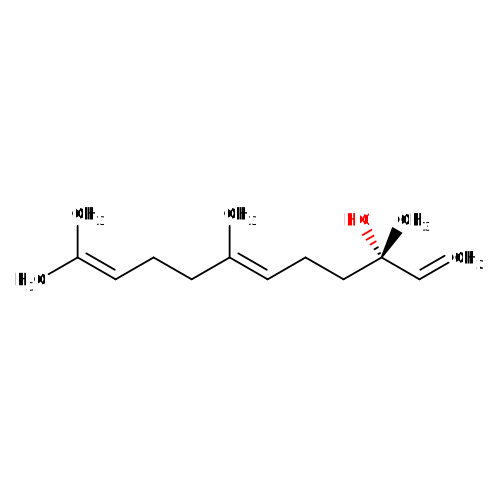
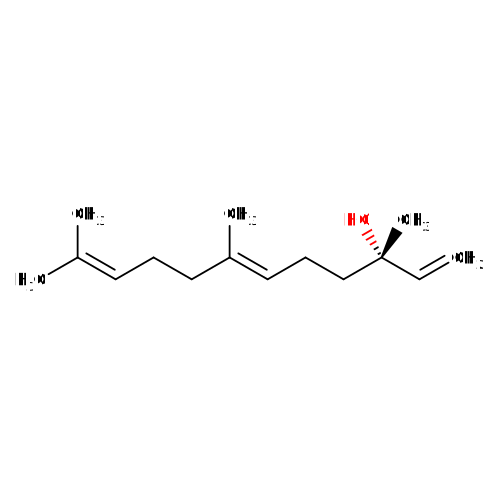
| Description | (±)-Trans-nerolidol, also known simply as Trans-nerolidol or penetrol, belongs to the class of organic compounds known as sesquiterpenoids. These are terpenes with three consecutive isoprene units. These are terpenes that contain 15 carbon atoms and are comprised of three isoprene units. The biosynthesis of sesquiterpenes is known to occur mainly through the mevalonic acid pathway (MVA), in the cytosol (PMID: 7640522 ). However, recent studies have found evidence of pathway crosstalk with the methyl-erythritol-phosphate (MEP) pathway in the cytosol. With regard to the production of nerolidol, (E)-nerolidol synthase was recently found to be responsible for the conversion of farnesyl diphosphate (FDP), the universal precursor of sesquiterpenes to (3S)-(E)-nerolidol. Trans-nerolidol is a also member of the class of compounds known as acyclic sesquiterpenoids. Acyclic sesquiterpenoids are sesquiterpenes that do not contain a cycle. There are two isomers of nerolidol, cis and trans, which differ in the geometry about the central double bond. (±)-Trans-nerolidol is a neutral, hydrophobic molecule that is practically insoluble in water. It exists as a pale, yellow liquid oil. (±)-Trans-nerolidol has a woody, fruity citrus aroma reminiscent of citrus, apples and roses. Industrially is used as a food flavoring agen and, a perfuming agent (in shampoos and perfumes). It is also used in non-cosmetic products such as detergents and cleansers (PMID: 27136520 ). Statistics have shown that the global usage of nerolidol per annum ranges from 10 to 100 metric tonnes. Trans-nerolidol is being tested as a skin penetration enhancer for the transdermal delivery of therapeutic drugs (PMID: 15855481 , 27136520 ). Trans-nerolidol is a naturally occurring compound found in many plants, foods and spices including ginger, hyssop, lemongrass, jasmine, tea tree, ginger and neroli (an essential oil distilled from bitter orange flowers). As with many terpenoids, it plays a very active role in the defense system of some plants. Trans-nerolidol has been traditionally used for its relaxing, slightly sedative effects. It appears to have anti-parasitic, antifungal and anti-bacterial properties (PMID: 15855481 , 27136520 ). These findings are consistent with the traditional use of orange oil as a natural disinfectant. Trans-nerolidol has been shown to sensitize pathogenic bacteria to the effects of conventional antibiotics by enhancing the permeability of the bacterial membrane (PMID: 14506058 ). It has also been shown to reduce Leishmaniasis infection by 95% (PMID: 15855481 ). Trans-nerolidol has also been shown to have anti-ulcer and anti-cancer activity (PMID: 27136520 ). Trans-Nerolidol is one of more than 140 terpenoids that are known in cannabis plants (PMID: 6991645 ). |
|---|
| Structure | CC(C)=CCC\C(C)=C\CC[C@](C)(O)C=C InChI=1S/C15H26O/c1-6-15(5,16)12-8-11-14(4)10-7-9-13(2)3/h6,9,11,16H,1,7-8,10,12H2,2-5H3/b14-11+/t15-/m1/s1 |
|---|
| Synonyms | | Value | Source |
|---|
| (S-(e))-3,7,11-Trimethyldodeca-1,6,10-trien-3-ol | ChEBI | | Nerolidol | ChEBI | | Nerolidol, (e)-isomer | MeSH | | Nerolidol, (S-(e))-isomer | MeSH | | 3,7,11-Trimethyl-1,6,10-dodecatrien-3-ol | MeSH | | Nerolidol, (S-(Z))-isomer | MeSH | | Peruviol | MeSH | | Nerolidol, (Z)-isomer | MeSH | | (+)-trans-Nerolidol | HMDB | | (3S)-(E)-Nerolidol | HMDB | | (3S)-trans-Nerolidol | HMDB | | (3S,6E)-3,7,11-Trimethyl-1,6,10-dodecatrien-3-ol | HMDB | | (3S,6E)-Nerolidol | HMDB | | (3S,E)-Nerolidol | HMDB | | (S)-(+)-trans-Nerolidol | HMDB | | (S)-trans-Nerolidol | HMDB | | (S,E)-3,7,11-Trimethyldodeca-1,6,10-trien-3-ol | HMDB | | (S,E)-Nerolidol | HMDB | | trans-(+)-Nerolidol | HMDB |
|
|---|
| Chemical Formula | C15H26O |
|---|
| Average Mass | 222.3720 Da |
|---|
| Monoisotopic Mass | 222.19837 Da |
|---|
| IUPAC Name | (3S,6E)-3,7,11-trimethyldodeca-1,6,10-trien-3-ol |
|---|
| Traditional Name | nerolidol |
|---|
| CAS Registry Number | 1119-38-6 |
|---|
| SMILES | CC(C)=CCC\C(C)=C\CC[C@](C)(O)C=C |
|---|
| InChI Identifier | InChI=1S/C15H26O/c1-6-15(5,16)12-8-11-14(4)10-7-9-13(2)3/h6,9,11,16H,1,7-8,10,12H2,2-5H3/b14-11+/t15-/m1/s1 |
|---|
| InChI Key | FQTLCLSUCSAZDY-ATGUSINASA-N |
|---|
| Experimental Spectra |
|---|
|
| Not Available | | Predicted Spectra |
|---|
|
| | Spectrum Type | Description | Depositor ID | Depositor Organization | Depositor | Deposition Date | View |
|---|
| 1D NMR | 13C NMR Spectrum (1D, 25 MHz, D2O, predicted) | Wishart Lab | Wishart Lab | David Wishart | 2021-06-20 | View Spectrum | | 1D NMR | 1H NMR Spectrum (1D, 100 MHz, D2O, predicted) | Wishart Lab | Wishart Lab | David Wishart | 2021-06-20 | View Spectrum | | 1D NMR | 13C NMR Spectrum (1D, 252 MHz, D2O, predicted) | Wishart Lab | Wishart Lab | David Wishart | 2021-06-20 | View Spectrum | | 1D NMR | 1H NMR Spectrum (1D, 1000 MHz, D2O, predicted) | Wishart Lab | Wishart Lab | David Wishart | 2021-06-20 | View Spectrum | | 1D NMR | 13C NMR Spectrum (1D, 50 MHz, D2O, predicted) | Wishart Lab | Wishart Lab | David Wishart | 2021-06-20 | View Spectrum | | 1D NMR | 1H NMR Spectrum (1D, 200 MHz, D2O, predicted) | Wishart Lab | Wishart Lab | David Wishart | 2021-06-20 | View Spectrum | | 1D NMR | 13C NMR Spectrum (1D, 75 MHz, D2O, predicted) | Wishart Lab | Wishart Lab | David Wishart | 2021-06-20 | View Spectrum | | 1D NMR | 1H NMR Spectrum (1D, 300 MHz, D2O, predicted) | Wishart Lab | Wishart Lab | David Wishart | 2021-06-20 | View Spectrum | | 1D NMR | 13C NMR Spectrum (1D, 101 MHz, D2O, predicted) | Wishart Lab | Wishart Lab | David Wishart | 2021-06-20 | View Spectrum | | 1D NMR | 1H NMR Spectrum (1D, 400 MHz, D2O, predicted) | Wishart Lab | Wishart Lab | David Wishart | 2021-06-20 | View Spectrum | | 1D NMR | 13C NMR Spectrum (1D, 126 MHz, D2O, predicted) | Wishart Lab | Wishart Lab | David Wishart | 2021-06-20 | View Spectrum | | 1D NMR | 1H NMR Spectrum (1D, 500 MHz, D2O, predicted) | Wishart Lab | Wishart Lab | David Wishart | 2021-06-20 | View Spectrum | | 1D NMR | 13C NMR Spectrum (1D, 151 MHz, D2O, predicted) | Wishart Lab | Wishart Lab | David Wishart | 2021-06-20 | View Spectrum | | 1D NMR | 1H NMR Spectrum (1D, 600 MHz, D2O, predicted) | Wishart Lab | Wishart Lab | David Wishart | 2021-06-20 | View Spectrum | | 1D NMR | 13C NMR Spectrum (1D, 176 MHz, D2O, predicted) | Wishart Lab | Wishart Lab | David Wishart | 2021-06-20 | View Spectrum | | 1D NMR | 1H NMR Spectrum (1D, 700 MHz, D2O, predicted) | Wishart Lab | Wishart Lab | David Wishart | 2021-06-20 | View Spectrum | | 1D NMR | 13C NMR Spectrum (1D, 201 MHz, D2O, predicted) | Wishart Lab | Wishart Lab | David Wishart | 2021-06-20 | View Spectrum | | 1D NMR | 1H NMR Spectrum (1D, 800 MHz, D2O, predicted) | Wishart Lab | Wishart Lab | David Wishart | 2021-06-20 | View Spectrum | | 1D NMR | 13C NMR Spectrum (1D, 226 MHz, D2O, predicted) | Wishart Lab | Wishart Lab | David Wishart | 2021-06-20 | View Spectrum | | 1D NMR | 1H NMR Spectrum (1D, 900 MHz, D2O, predicted) | Wishart Lab | Wishart Lab | David Wishart | 2021-06-20 | View Spectrum |
| | Chemical Shift Submissions |
|---|
|
| Not Available | | Species |
|---|
| Species of Origin | |
|---|
| Chemical Taxonomy |
|---|
| Description | Belongs to the class of organic compounds known as sesquiterpenoids. These are terpenes with three consecutive isoprene units. |
|---|
| Kingdom | Organic compounds |
|---|
| Super Class | Lipids and lipid-like molecules |
|---|
| Class | Prenol lipids |
|---|
| Sub Class | Sesquiterpenoids |
|---|
| Direct Parent | Sesquiterpenoids |
|---|
| Alternative Parents | |
|---|
| Substituents | - Farsesane sesquiterpenoid
- Sesquiterpenoid
- Tertiary alcohol
- Organic oxygen compound
- Hydrocarbon derivative
- Organooxygen compound
- Alcohol
- Aliphatic acyclic compound
|
|---|
| Molecular Framework | Aliphatic acyclic compounds |
|---|
| External Descriptors | |
|---|
| Physical Properties |
|---|
| State | Not Available |
|---|
| Experimental Properties | | Property | Value | Reference |
|---|
| Melting Point | Not Available | Not Available | | Boiling Point | Not Available | Not Available | | Water Solubility | Not Available | Not Available | | LogP | Not Available | Not Available |
|
|---|
| Predicted Properties | |
|---|