| Record Information |
|---|
| Version | 2.0 |
|---|
| Created at | 2022-03-10 18:52:55 UTC |
|---|
| Updated at | 2022-03-10 22:19:46 UTC |
|---|
| NP-MRD ID | NP0045024 |
|---|
| Secondary Accession Numbers | None |
|---|
| Natural Product Identification |
|---|
| Common Name | Carotene |
|---|
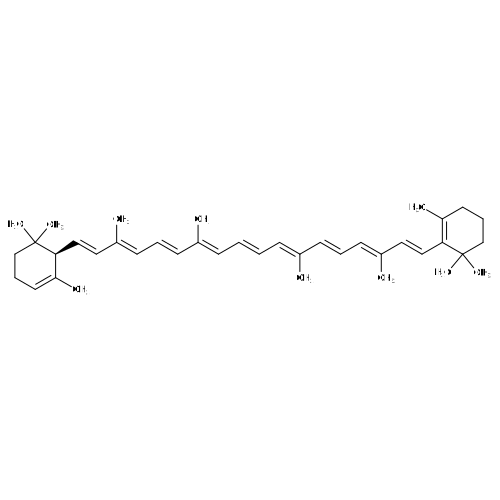
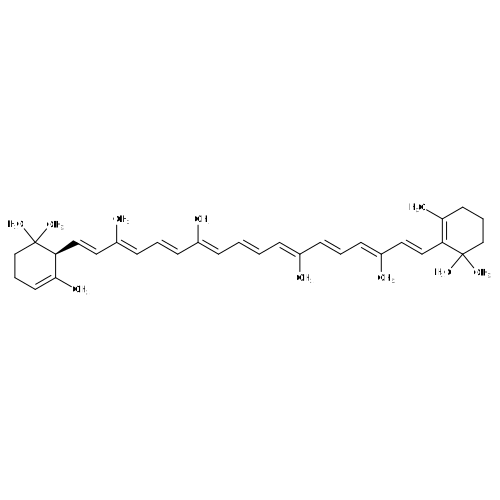
| Description | Alpha carotene belongs to the group of compounds known as carotenoids. More specifically carotenoids are classified as tetraterpenoids, being built from four terpene units (8 isoprene units) each containing 10 carbon atoms. As a result, carotenoids typically have a total of 40 carbon atoms. They are characterized by the presence of two end-groups (mostly cyclohexene rings, but also cyclopentene rings or acyclic groups) linked by a long-branched alkyl chain. There are more than 1100 known carotenoids. Carotenoids can be further categorized into two classes, xanthophylls (which contain oxygen) and carotenes (which are purely hydrocarbons and contain no oxygen). Carotenoids are among the most common pigments in nature and are natural lipid soluble antioxidants. Alpha-carotene is one of the primary isomers of carotene, although Beta-carotene is the most abundant. There are six known carotene isomers including alpha-, beta-, gamma-, δ-, ε-, and ζ-carotene. These carotene isomers contain unsubstituted beta-ionone rings, which means they can be readily converted to retinol and vitamin A. In other words, they have pro-vitamin A activity. Alpha-carotene has less vitamin A activity than Beta-Carotene. This is because of its structure, as Alpha-carotene it is converted to just one molecule of biologically active retinol after central cleavage, while Beta-carotene is converted to two molecules after cleavage. Plants, fungi, and photosynthetic bacteria synthesize carotenes, while animals must obtain them as a dietary nutrient. In plants carotenes contribute to photosynthesis by transmitting the light energy they absorb to chlorophyll. They also protect plant tissues by helping to absorb the energy from singlet oxygen, an excited form of the oxygen molecule O2 which is formed during photosynthesis. Alpha-carotene is a very hydrophobic molecule, practically insoluble in water, and relatively neutral. Alpha-carotene is found in many common orange-, yellow-, and green-colored fruits and vegetables such as carrots, pumpkins, squash, apricots, sweet potatoes, and beans. The concentration of alpha-Carotene is especially high in orange carrots and high serum concentrations are associated with high carrot intake. Other plants and foods that have high levels of alpha-carotene include cloves, shallots, cumin, wolfberries, cantaloupes, papaya, spinach, broccoli, turnip, avocado, green peas, orange and red peppers, and tomatoes. Alpha-carotene (along with beta-carotene) exhibits numerous beneficial health or pharmacological properties including antioxidant, anti-obesity, anti-cancer, anti-aging, anti-atherosclerotic and anti-sunburn properties as well as hepatoprotective, neuroprotective and improved vision and night blindness prevention ( PMID: 27047317 ). Alpha-carotene is one of a small number of pigments including (beta-carotene and xanthophylls) found in cannabis plants. It was first isolated from hemp leaves and identified as a cannabis constituent in 1969 (PMID: 6991645 ). |
|---|
| Structure | C\C(\C=C\C=C(/C)\C=C\[C@H]1C(C)=CCCC1(C)C)=C/C=C/C=C(\C)/C=C/C=C(\C)/C=C/C1=C(C)CCCC1(C)C InChI=1S/C40H56/c1-31(19-13-21-33(3)25-27-37-35(5)23-15-29-39(37,7)8)17-11-12-18-32(2)20-14-22-34(4)26-28-38-36(6)24-16-30-40(38,9)10/h11-14,17-23,25-28,37H,15-16,24,29-30H2,1-10H3/b12-11+,19-13+,20-14+,27-25+,28-26+,31-17+,32-18+,33-21+,34-22+/t37-/m0/s1 |
|---|
| Synonyms | | Value | Source |
|---|
| (+)-alpha-Carotene | ChEBI | | alpha-Carotene (natural) | ChEBI | | (+)-a-Carotene | Generator | | (+)-α-Carotene | Generator | | a-Carotene | Generator | | α-Carotene | Generator | | a-Carotene (natural) | Generator | | α-carotene (natural) | Generator | | Carotenes | MeSH | | Carotenoids | MeSH | | alpha-Carotene, (6'R)-isomer | MeSH | | alpha-Carotene | MeSH | | (6'R)-alpha-Carotene | HMDB | | (6'R)-beta,epsilon-Carotene | HMDB | | (6'R)-α-Carotene | HMDB | | (6'R)-β,ε-Carotene | HMDB | | (6’R)-α-Carotene | HMDB | | (6’R)-β,ε-Carotene | HMDB | | all-trans-alpha-Carotene | HMDB | | all-trans-α-Carotene | HMDB | | α-Carotene, (6’R)-isomer | HMDB |
|
|---|
| Chemical Formula | C40H56 |
|---|
| Average Mass | 536.8726 Da |
|---|
| Monoisotopic Mass | 536.43820 Da |
|---|
| IUPAC Name | (6R)-1,5,5-trimethyl-6-[(1E,3E,5E,7E,9E,11E,13E,15E,17E)-3,7,12,16-tetramethyl-18-(2,6,6-trimethylcyclohex-1-en-1-yl)octadeca-1,3,5,7,9,11,13,15,17-nonaen-1-yl]cyclohex-1-ene |
|---|
| Traditional Name | hi-α |
|---|
| CAS Registry Number | Not Available |
|---|
| SMILES | C\C(\C=C\C=C(/C)\C=C\[C@H]1C(C)=CCCC1(C)C)=C/C=C/C=C(\C)/C=C/C=C(\C)/C=C/C1=C(C)CCCC1(C)C |
|---|
| InChI Identifier | InChI=1S/C40H56/c1-31(19-13-21-33(3)25-27-37-35(5)23-15-29-39(37,7)8)17-11-12-18-32(2)20-14-22-34(4)26-28-38-36(6)24-16-30-40(38,9)10/h11-14,17-23,25-28,37H,15-16,24,29-30H2,1-10H3/b12-11+,19-13+,20-14+,27-25+,28-26+,31-17+,32-18+,33-21+,34-22+/t37-/m0/s1 |
|---|
| InChI Key | ANVAOWXLWRTKGA-NTXLUARGSA-N |
|---|
| Experimental Spectra |
|---|
|
| Not Available | | Predicted Spectra |
|---|
|
| | Spectrum Type | Description | Depositor ID | Depositor Organization | Depositor | Deposition Date | View |
|---|
| 1D NMR | 13C NMR Spectrum (1D, 25 MHz, D2O, predicted) | Wishart Lab | Wishart Lab | David Wishart | 2021-06-20 | View Spectrum | | 1D NMR | 1H NMR Spectrum (1D, 100 MHz, D2O, predicted) | Wishart Lab | Wishart Lab | David Wishart | 2021-06-20 | View Spectrum | | 1D NMR | 13C NMR Spectrum (1D, 252 MHz, D2O, predicted) | Wishart Lab | Wishart Lab | David Wishart | 2021-06-20 | View Spectrum | | 1D NMR | 1H NMR Spectrum (1D, 1000 MHz, D2O, predicted) | Wishart Lab | Wishart Lab | David Wishart | 2021-06-20 | View Spectrum | | 1D NMR | 13C NMR Spectrum (1D, 50 MHz, D2O, predicted) | Wishart Lab | Wishart Lab | David Wishart | 2021-06-20 | View Spectrum | | 1D NMR | 1H NMR Spectrum (1D, 200 MHz, D2O, predicted) | Wishart Lab | Wishart Lab | David Wishart | 2021-06-20 | View Spectrum | | 1D NMR | 13C NMR Spectrum (1D, 75 MHz, D2O, predicted) | Wishart Lab | Wishart Lab | David Wishart | 2021-06-20 | View Spectrum | | 1D NMR | 1H NMR Spectrum (1D, 300 MHz, D2O, predicted) | Wishart Lab | Wishart Lab | David Wishart | 2021-06-20 | View Spectrum | | 1D NMR | 13C NMR Spectrum (1D, 101 MHz, D2O, predicted) | Wishart Lab | Wishart Lab | David Wishart | 2021-06-20 | View Spectrum | | 1D NMR | 1H NMR Spectrum (1D, 400 MHz, D2O, predicted) | Wishart Lab | Wishart Lab | David Wishart | 2021-06-20 | View Spectrum | | 1D NMR | 13C NMR Spectrum (1D, 126 MHz, D2O, predicted) | Wishart Lab | Wishart Lab | David Wishart | 2021-06-20 | View Spectrum | | 1D NMR | 1H NMR Spectrum (1D, 500 MHz, D2O, predicted) | Wishart Lab | Wishart Lab | David Wishart | 2021-06-20 | View Spectrum | | 1D NMR | 13C NMR Spectrum (1D, 151 MHz, D2O, predicted) | Wishart Lab | Wishart Lab | David Wishart | 2021-06-20 | View Spectrum | | 1D NMR | 1H NMR Spectrum (1D, 600 MHz, D2O, predicted) | Wishart Lab | Wishart Lab | David Wishart | 2021-06-20 | View Spectrum | | 1D NMR | 13C NMR Spectrum (1D, 176 MHz, D2O, predicted) | Wishart Lab | Wishart Lab | David Wishart | 2021-06-20 | View Spectrum | | 1D NMR | 1H NMR Spectrum (1D, 700 MHz, D2O, predicted) | Wishart Lab | Wishart Lab | David Wishart | 2021-06-20 | View Spectrum | | 1D NMR | 13C NMR Spectrum (1D, 201 MHz, D2O, predicted) | Wishart Lab | Wishart Lab | David Wishart | 2021-06-20 | View Spectrum | | 1D NMR | 1H NMR Spectrum (1D, 800 MHz, D2O, predicted) | Wishart Lab | Wishart Lab | David Wishart | 2021-06-20 | View Spectrum | | 1D NMR | 13C NMR Spectrum (1D, 226 MHz, D2O, predicted) | Wishart Lab | Wishart Lab | David Wishart | 2021-06-20 | View Spectrum | | 1D NMR | 1H NMR Spectrum (1D, 900 MHz, D2O, predicted) | Wishart Lab | Wishart Lab | David Wishart | 2021-06-20 | View Spectrum |
| | Chemical Shift Submissions |
|---|
|
| Not Available | | Species |
|---|
| Species of Origin | |
|---|
| Chemical Taxonomy |
|---|
| Description | Belongs to the class of organic compounds known as carotenes. These are a type of unsaturated hydrocarbons containing eight consecutive isoprene units. They are characterized by the presence of two end-groups (mostly cyclohexene rings, but also cyclopentene rings or acyclic groups) linked by a long branched alkyl chain. Carotenes belonging form a subgroup of the carotenoids family. |
|---|
| Kingdom | Organic compounds |
|---|
| Super Class | Lipids and lipid-like molecules |
|---|
| Class | Prenol lipids |
|---|
| Sub Class | Tetraterpenoids |
|---|
| Direct Parent | Carotenes |
|---|
| Alternative Parents | |
|---|
| Substituents | - Carotene
- Branched unsaturated hydrocarbon
- Cycloalkene
- Cyclic olefin
- Unsaturated aliphatic hydrocarbon
- Unsaturated hydrocarbon
- Olefin
- Hydrocarbon
- Aliphatic homomonocyclic compound
|
|---|
| Molecular Framework | Aliphatic homomonocyclic compounds |
|---|
| External Descriptors | |
|---|
| Physical Properties |
|---|
| State | Not Available |
|---|
| Experimental Properties | | Property | Value | Reference |
|---|
| Melting Point | Not Available | Not Available | | Boiling Point | Not Available | Not Available | | Water Solubility | Not Available | Not Available | | LogP | Not Available | Not Available |
|
|---|
| Predicted Properties | |
|---|