| Record Information |
|---|
| Version | 2.0 |
|---|
| Created at | 2022-03-10 18:52:34 UTC |
|---|
| Updated at | 2022-03-10 22:20:38 UTC |
|---|
| NP-MRD ID | NP0045003 |
|---|
| Secondary Accession Numbers | None |
|---|
| Natural Product Identification |
|---|
| Common Name | epi-beta-santalene |
|---|
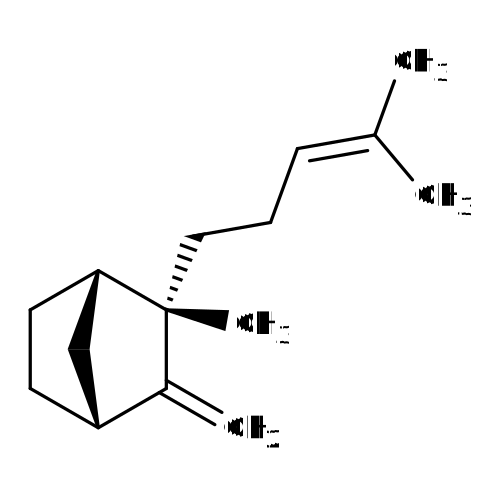
| Description | Epi-beta-Santalene, also known as epi-santalene, belongs to the class of organic compounds known as sesquiterpenoids. It is formally classified as a polycyclic hydrocarbon although it is biochemically a sesquiterpenoid. Sesquiterpenoids are terpenes that contain 15 carbon atoms and are comprised of three isoprene units. The biosynthesis of sesquiterpenes is known to occur mainly through the mevalonic acid pathway (MVA), in the cytosol. However, recent studies have found evidence of pathway crosstalk with the methyl-erythritol-phosphate (MEP) pathway in the cytosol. Farnesyl diphosphate (FPP) is a key intermediate in the biosynthesis of cyclic sesquiterpenes. FPP undergoes several cyclization reactions to yield a diverse number of cyclic arrangements. Technically Epi-beta-santalene is a carbobicyclic compound that is bicyclo[2.2.1]Heptane in which the hydrogens at position 3 are substituted by a methylidene group, while the 2-exo- and 2-endo- hydrogens are subsitituted by 2-methylpent-2-en-5-yl and methyl groups, respectively (the 1S,2R,4R enantiomer). Epi-beta-Santalene is a hydrophobic, neutral molecule that is insoluble in water. Epi-beta-Santalene is one of many terpenes that are found in cannabis plants (PMID: 6991645 ). It is also found in the essential oil of sandalwood which is a tropical tree (PMID: 24324844 ). |
|---|
| Structure | CC(C)=CCC[C@@]1(C)[C@H]2CC[C@H](C2)C1=C InChI=1S/C15H24/c1-11(2)6-5-9-15(4)12(3)13-7-8-14(15)10-13/h6,13-14H,3,5,7-10H2,1-2,4H3/t13-,14+,15-/m1/s1 |
|---|
| Synonyms | | Value | Source |
|---|
| Epi-b-santalene | Generator | | Epi-β-santalene | Generator |
|
|---|
| Chemical Formula | C15H24 |
|---|
| Average Mass | 204.3570 Da |
|---|
| Monoisotopic Mass | 204.18780 Da |
|---|
| IUPAC Name | (1S,2S,4R)-2-methyl-3-methylidene-2-(4-methylpent-3-en-1-yl)bicyclo[2.2.1]heptane |
|---|
| Traditional Name | (1S,2S,4R)-2-methyl-3-methylidene-2-(4-methylpent-3-en-1-yl)bicyclo[2.2.1]heptane |
|---|
| CAS Registry Number | Not Available |
|---|
| SMILES | CC(C)=CCC[C@@]1(C)[C@H]2CC[C@H](C2)C1=C |
|---|
| InChI Identifier | InChI=1S/C15H24/c1-11(2)6-5-9-15(4)12(3)13-7-8-14(15)10-13/h6,13-14H,3,5,7-10H2,1-2,4H3/t13-,14+,15-/m1/s1 |
|---|
| InChI Key | PGBNIHXXFQBCPU-QLFBSQMISA-N |
|---|
| Experimental Spectra |
|---|
|
| Not Available | | Predicted Spectra |
|---|
|
| | Spectrum Type | Description | Depositor ID | Depositor Organization | Depositor | Deposition Date | View |
|---|
| 1D NMR | 13C NMR Spectrum (1D, 25 MHz, D2O, predicted) | Wishart Lab | Wishart Lab | David Wishart | 2021-06-20 | View Spectrum | | 1D NMR | 1H NMR Spectrum (1D, 100 MHz, D2O, predicted) | Wishart Lab | Wishart Lab | David Wishart | 2021-06-20 | View Spectrum | | 1D NMR | 13C NMR Spectrum (1D, 252 MHz, D2O, predicted) | Wishart Lab | Wishart Lab | David Wishart | 2021-06-20 | View Spectrum | | 1D NMR | 1H NMR Spectrum (1D, 1000 MHz, D2O, predicted) | Wishart Lab | Wishart Lab | David Wishart | 2021-06-20 | View Spectrum | | 1D NMR | 13C NMR Spectrum (1D, 50 MHz, D2O, predicted) | Wishart Lab | Wishart Lab | David Wishart | 2021-06-20 | View Spectrum | | 1D NMR | 1H NMR Spectrum (1D, 200 MHz, D2O, predicted) | Wishart Lab | Wishart Lab | David Wishart | 2021-06-20 | View Spectrum | | 1D NMR | 13C NMR Spectrum (1D, 75 MHz, D2O, predicted) | Wishart Lab | Wishart Lab | David Wishart | 2021-06-20 | View Spectrum | | 1D NMR | 1H NMR Spectrum (1D, 300 MHz, D2O, predicted) | Wishart Lab | Wishart Lab | David Wishart | 2021-06-20 | View Spectrum | | 1D NMR | 13C NMR Spectrum (1D, 101 MHz, D2O, predicted) | Wishart Lab | Wishart Lab | David Wishart | 2021-06-20 | View Spectrum | | 1D NMR | 1H NMR Spectrum (1D, 400 MHz, D2O, predicted) | Wishart Lab | Wishart Lab | David Wishart | 2021-06-20 | View Spectrum | | 1D NMR | 13C NMR Spectrum (1D, 126 MHz, D2O, predicted) | Wishart Lab | Wishart Lab | David Wishart | 2021-06-20 | View Spectrum | | 1D NMR | 1H NMR Spectrum (1D, 500 MHz, D2O, predicted) | Wishart Lab | Wishart Lab | David Wishart | 2021-06-20 | View Spectrum | | 1D NMR | 13C NMR Spectrum (1D, 151 MHz, D2O, predicted) | Wishart Lab | Wishart Lab | David Wishart | 2021-06-20 | View Spectrum | | 1D NMR | 1H NMR Spectrum (1D, 600 MHz, D2O, predicted) | Wishart Lab | Wishart Lab | David Wishart | 2021-06-20 | View Spectrum | | 1D NMR | 13C NMR Spectrum (1D, 176 MHz, D2O, predicted) | Wishart Lab | Wishart Lab | David Wishart | 2021-06-20 | View Spectrum | | 1D NMR | 1H NMR Spectrum (1D, 700 MHz, D2O, predicted) | Wishart Lab | Wishart Lab | David Wishart | 2021-06-20 | View Spectrum | | 1D NMR | 13C NMR Spectrum (1D, 201 MHz, D2O, predicted) | Wishart Lab | Wishart Lab | David Wishart | 2021-06-20 | View Spectrum | | 1D NMR | 1H NMR Spectrum (1D, 800 MHz, D2O, predicted) | Wishart Lab | Wishart Lab | David Wishart | 2021-06-20 | View Spectrum | | 1D NMR | 13C NMR Spectrum (1D, 226 MHz, D2O, predicted) | Wishart Lab | Wishart Lab | David Wishart | 2021-06-20 | View Spectrum | | 1D NMR | 1H NMR Spectrum (1D, 900 MHz, D2O, predicted) | Wishart Lab | Wishart Lab | David Wishart | 2021-06-20 | View Spectrum |
| | Chemical Shift Submissions |
|---|
|
| Not Available | | Species |
|---|
| Species of Origin | |
|---|
| Chemical Taxonomy |
|---|
| Description | Belongs to the class of organic compounds known as sesquiterpenoids. These are terpenes with three consecutive isoprene units. |
|---|
| Kingdom | Organic compounds |
|---|
| Super Class | Lipids and lipid-like molecules |
|---|
| Class | Prenol lipids |
|---|
| Sub Class | Sesquiterpenoids |
|---|
| Direct Parent | Sesquiterpenoids |
|---|
| Alternative Parents | |
|---|
| Substituents | - Sesquiterpenoid
- Branched unsaturated hydrocarbon
- Polycyclic hydrocarbon
- Cyclic olefin
- Unsaturated aliphatic hydrocarbon
- Unsaturated hydrocarbon
- Olefin
- Hydrocarbon
- Aliphatic homopolycyclic compound
|
|---|
| Molecular Framework | Aliphatic homopolycyclic compounds |
|---|
| External Descriptors | Not Available |
|---|
| Physical Properties |
|---|
| State | Not Available |
|---|
| Experimental Properties | | Property | Value | Reference |
|---|
| Melting Point | Not Available | Not Available | | Boiling Point | Not Available | Not Available | | Water Solubility | Not Available | Not Available | | LogP | Not Available | Not Available |
|
|---|
| Predicted Properties | |
|---|