| Record Information |
|---|
| Version | 2.0 |
|---|
| Created at | 2022-03-10 18:52:16 UTC |
|---|
| Updated at | 2022-03-10 22:11:42 UTC |
|---|
| NP-MRD ID | NP0044985 |
|---|
| Secondary Accession Numbers | None |
|---|
| Natural Product Identification |
|---|
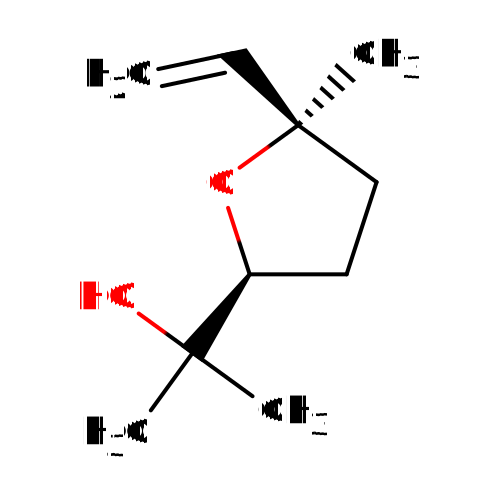
| Common Name | (±)-cis-Linalyl oxide |
|---|
| Description | (±)-Cis-Linalyl oxide, also known as cis-Linalool-oxide or Linalool oxide B, is an oxidized derivative of Linalool which is a terpene alcohol common in various flowers and spice plants. It belongs to the class of organic compounds known as tetrahydrofurans. These are heterocyclic compounds containing a saturated, aliphatic, five-membered ring where a carbon is replaced by an oxygen. Biochemically, cis-Linalool-oxide is a monoterpenoid as it synthesized via multiple isoprene units. Monoterpenoids are terpenes that contain 10 carbon atoms and are comprised of two isoprene units. The biosynthesis of monoterpenes is known to occur mainly through the methyl-erythritol-phosphate (MEP) pathway in plastids (PMID: 7640522 ). Geranyl diphosphate (GPP) is a key intermediate in the biosynthesis of cyclic monoterpenes. GPP undergoes several cyclization reactions to yield a diverse number of cyclic arrangements. Linalool oxide occurs in two distinctly different structural guises in nature. The most common structural form is based on a five member, furan-like ring structure. The less common form is based on a six member, pyran-like structure. Both types of linalool oxide exist as cis- and trans- isomers. Despite the differences in structure, the aromas of the different forms of linalool oxide have a strong family resemblance. The furan-based linalool oxide has a floral character, somewhat reminiscent of lavender, but this is dominated by the profile of black tea. The pyran-based linalool oxide is more obviously floral, with less resemblance to tea. More specifically, cis-Linalool-oxide has a sweet, earthy, and floral aroma and is used as a perfuming agent and a flavoring agent. Cis-Linalool-oxide exists as a clear or slightly yellow oil. It is a neutral, hydrophobic molecule that is insoluble in water. Cis-Linalool-oxide is found in black and green tea leaves has also been detected, but not quantified in, several different foods, spices or oils, such as sweet basils, black elderberries, coriander, common oregano, garden tomato (var.), Peppermint oil and papaya. Cis-Linalool oxide is also found in Lavender (https://Doi.Org/10.4028/Www.Scientific.Net/KEM.688.31). Cis-Linalool oxide is one of more than 140 terpenoids that are found in cannabis plants (PMID: 6991645 ) And the combination of these terpenoids produces the skunky, fruity odor characteristic of C. Savita. |
|---|
| Structure | CC(C)(O)[C@@H]1CC[C@@](C)(O1)C=C InChI=1S/C10H18O2/c1-5-10(4)7-6-8(12-10)9(2,3)11/h5,8,11H,1,6-7H2,2-4H3/t8-,10-/m0/s1 |
|---|
| Synonyms | Not Available |
|---|
| Chemical Formula | C10H18O2 |
|---|
| Average Mass | 170.2520 Da |
|---|
| Monoisotopic Mass | 170.13068 Da |
|---|
| IUPAC Name | 2-[(2S,5R)-5-ethenyl-5-methyloxolan-2-yl]propan-2-ol |
|---|
| Traditional Name | 2-[(2S,5R)-5-ethenyl-5-methyloxolan-2-yl]propan-2-ol |
|---|
| CAS Registry Number | 11063-77-7 |
|---|
| SMILES | CC(C)(O)[C@@H]1CC[C@@](C)(O1)C=C |
|---|
| InChI Identifier | InChI=1S/C10H18O2/c1-5-10(4)7-6-8(12-10)9(2,3)11/h5,8,11H,1,6-7H2,2-4H3/t8-,10-/m0/s1 |
|---|
| InChI Key | BRHDDEIRQPDPMG-WPRPVWTQSA-N |
|---|
| Experimental Spectra |
|---|
|
| Not Available | | Predicted Spectra |
|---|
|
| | Spectrum Type | Description | Depositor ID | Depositor Organization | Depositor | Deposition Date | View |
|---|
| 1D NMR | 13C NMR Spectrum (1D, 25 MHz, D2O, predicted) | Wishart Lab | Wishart Lab | David Wishart | 2021-06-20 | View Spectrum | | 1D NMR | 1H NMR Spectrum (1D, 100 MHz, D2O, predicted) | Wishart Lab | Wishart Lab | David Wishart | 2021-06-20 | View Spectrum | | 1D NMR | 13C NMR Spectrum (1D, 252 MHz, D2O, predicted) | Wishart Lab | Wishart Lab | David Wishart | 2021-06-20 | View Spectrum | | 1D NMR | 1H NMR Spectrum (1D, 1000 MHz, D2O, predicted) | Wishart Lab | Wishart Lab | David Wishart | 2021-06-20 | View Spectrum | | 1D NMR | 13C NMR Spectrum (1D, 50 MHz, D2O, predicted) | Wishart Lab | Wishart Lab | David Wishart | 2021-06-20 | View Spectrum | | 1D NMR | 1H NMR Spectrum (1D, 200 MHz, D2O, predicted) | Wishart Lab | Wishart Lab | David Wishart | 2021-06-20 | View Spectrum | | 1D NMR | 13C NMR Spectrum (1D, 75 MHz, D2O, predicted) | Wishart Lab | Wishart Lab | David Wishart | 2021-06-20 | View Spectrum | | 1D NMR | 1H NMR Spectrum (1D, 300 MHz, D2O, predicted) | Wishart Lab | Wishart Lab | David Wishart | 2021-06-20 | View Spectrum | | 1D NMR | 13C NMR Spectrum (1D, 101 MHz, D2O, predicted) | Wishart Lab | Wishart Lab | David Wishart | 2021-06-20 | View Spectrum | | 1D NMR | 1H NMR Spectrum (1D, 400 MHz, D2O, predicted) | Wishart Lab | Wishart Lab | David Wishart | 2021-06-20 | View Spectrum | | 1D NMR | 13C NMR Spectrum (1D, 126 MHz, D2O, predicted) | Wishart Lab | Wishart Lab | David Wishart | 2021-06-20 | View Spectrum | | 1D NMR | 1H NMR Spectrum (1D, 500 MHz, D2O, predicted) | Wishart Lab | Wishart Lab | David Wishart | 2021-06-20 | View Spectrum | | 1D NMR | 13C NMR Spectrum (1D, 151 MHz, D2O, predicted) | Wishart Lab | Wishart Lab | David Wishart | 2021-06-20 | View Spectrum | | 1D NMR | 1H NMR Spectrum (1D, 600 MHz, D2O, predicted) | Wishart Lab | Wishart Lab | David Wishart | 2021-06-20 | View Spectrum | | 1D NMR | 13C NMR Spectrum (1D, 176 MHz, D2O, predicted) | Wishart Lab | Wishart Lab | David Wishart | 2021-06-20 | View Spectrum | | 1D NMR | 1H NMR Spectrum (1D, 700 MHz, D2O, predicted) | Wishart Lab | Wishart Lab | David Wishart | 2021-06-20 | View Spectrum | | 1D NMR | 13C NMR Spectrum (1D, 201 MHz, D2O, predicted) | Wishart Lab | Wishart Lab | David Wishart | 2021-06-20 | View Spectrum | | 1D NMR | 1H NMR Spectrum (1D, 800 MHz, D2O, predicted) | Wishart Lab | Wishart Lab | David Wishart | 2021-06-20 | View Spectrum | | 1D NMR | 13C NMR Spectrum (1D, 226 MHz, D2O, predicted) | Wishart Lab | Wishart Lab | David Wishart | 2021-06-20 | View Spectrum | | 1D NMR | 1H NMR Spectrum (1D, 900 MHz, D2O, predicted) | Wishart Lab | Wishart Lab | David Wishart | 2021-06-20 | View Spectrum |
| | Chemical Shift Submissions |
|---|
|
| Not Available | | Species |
|---|
| Species of Origin | |
|---|
| Chemical Taxonomy |
|---|
| Description | Belongs to the class of organic compounds known as oxolanes. These are organic compounds containing an oxolane (tetrahydrofuran) ring, which is a saturated aliphatic five-member ring containing one oxygen and five carbon atoms. |
|---|
| Kingdom | Organic compounds |
|---|
| Super Class | Organoheterocyclic compounds |
|---|
| Class | Oxolanes |
|---|
| Sub Class | Not Available |
|---|
| Direct Parent | Oxolanes |
|---|
| Alternative Parents | |
|---|
| Substituents | - Tertiary alcohol
- Oxolane
- Oxacycle
- Ether
- Dialkyl ether
- Organic oxygen compound
- Hydrocarbon derivative
- Organooxygen compound
- Alcohol
- Aliphatic heteromonocyclic compound
|
|---|
| Molecular Framework | Aliphatic heteromonocyclic compounds |
|---|
| External Descriptors | Not Available |
|---|
| Physical Properties |
|---|
| State | Not Available |
|---|
| Experimental Properties | | Property | Value | Reference |
|---|
| Melting Point | Not Available | Not Available | | Boiling Point | Not Available | Not Available | | Water Solubility | Not Available | Not Available | | LogP | Not Available | Not Available |
|
|---|
| Predicted Properties | |
|---|