| Record Information |
|---|
| Version | 2.0 |
|---|
| Created at | 2022-03-10 18:52:14 UTC |
|---|
| Updated at | 2022-03-10 22:18:46 UTC |
|---|
| NP-MRD ID | NP0044983 |
|---|
| Secondary Accession Numbers | None |
|---|
| Natural Product Identification |
|---|
| Common Name | camphenehydrate |
|---|
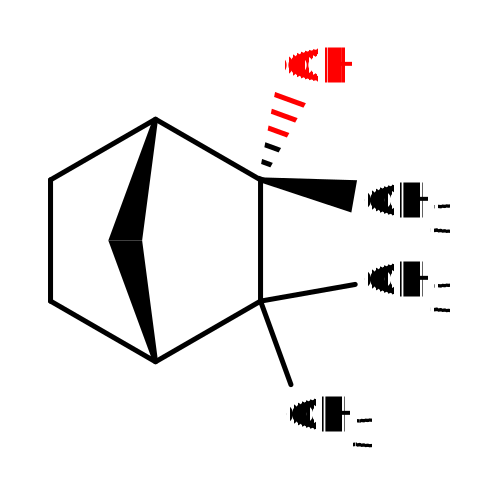
| Description | Camphene-hydrate, also known as 3-Methylcamphenilol, is a member of the class of compounds known as bicyclic monoterpenoids. Bicyclic monoterpenoids are monoterpenoids containing exactly 2 rings, which are fused to each other. Monoterpenoids are terpenes that contain 10 carbon atoms and are comprised of two isoprene units. The biosynthesis of monoterpenes is known to occur mainly through the methyl-erythritol-phosphate (MEP) pathway in plastids (PMID: 7640522 ). Geranyl diphosphate (GPP) is a key intermediate in the biosynthesis of cyclic monoterpenes. GPP undergoes several cyclization reactions to yield a diverse number of cyclic arrangements. Camphene-hydrate is a neutral, hydrophobic molecule that is practically insoluble in water. It is a colorless solid with a musty camphoreous odor. Camphene-hydrate can be found in ginger and is one of many monoterpenes that are found in cannabis plants (PMID: 6991645 ). There are more than 140 known terpenes in cannabis and the combination of these terepenoids produces the skunky, fruity odor characteristic of C. Savita. |
|---|
| Structure | CC1(C)[C@@H]2CC[C@@H](C2)[C@]1(C)O InChI=1S/C10H18O/c1-9(2)7-4-5-8(6-7)10(9,3)11/h7-8,11H,4-6H2,1-3H3/t7-,8+,10+/m1/s1 |
|---|
| Synonyms | Not Available |
|---|
| Chemical Formula | C10H18O |
|---|
| Average Mass | 154.2530 Da |
|---|
| Monoisotopic Mass | 154.13577 Da |
|---|
| IUPAC Name | (1S,2S,4R)-2,3,3-trimethylbicyclo[2.2.1]heptan-2-ol |
|---|
| Traditional Name | (1S,2S,4R)-2,3,3-trimethylbicyclo[2.2.1]heptan-2-ol |
|---|
| CAS Registry Number | Not Available |
|---|
| SMILES | CC1(C)[C@@H]2CC[C@@H](C2)[C@]1(C)O |
|---|
| InChI Identifier | InChI=1S/C10H18O/c1-9(2)7-4-5-8(6-7)10(9,3)11/h7-8,11H,4-6H2,1-3H3/t7-,8+,10+/m1/s1 |
|---|
| InChI Key | PXRCIOIWVGAZEP-WEDXCCLWSA-N |
|---|
| Experimental Spectra |
|---|
|
| Not Available | | Predicted Spectra |
|---|
|
| | Spectrum Type | Description | Depositor ID | Depositor Organization | Depositor | Deposition Date | View |
|---|
| 1D NMR | 13C NMR Spectrum (1D, 25 MHz, D2O, predicted) | Wishart Lab | Wishart Lab | David Wishart | 2021-06-20 | View Spectrum | | 1D NMR | 1H NMR Spectrum (1D, 100 MHz, D2O, predicted) | Wishart Lab | Wishart Lab | David Wishart | 2021-06-20 | View Spectrum | | 1D NMR | 13C NMR Spectrum (1D, 252 MHz, D2O, predicted) | Wishart Lab | Wishart Lab | David Wishart | 2021-06-20 | View Spectrum | | 1D NMR | 1H NMR Spectrum (1D, 1000 MHz, D2O, predicted) | Wishart Lab | Wishart Lab | David Wishart | 2021-06-20 | View Spectrum | | 1D NMR | 13C NMR Spectrum (1D, 50 MHz, D2O, predicted) | Wishart Lab | Wishart Lab | David Wishart | 2021-06-20 | View Spectrum | | 1D NMR | 1H NMR Spectrum (1D, 200 MHz, D2O, predicted) | Wishart Lab | Wishart Lab | David Wishart | 2021-06-20 | View Spectrum | | 1D NMR | 13C NMR Spectrum (1D, 75 MHz, D2O, predicted) | Wishart Lab | Wishart Lab | David Wishart | 2021-06-20 | View Spectrum | | 1D NMR | 1H NMR Spectrum (1D, 300 MHz, D2O, predicted) | Wishart Lab | Wishart Lab | David Wishart | 2021-06-20 | View Spectrum | | 1D NMR | 13C NMR Spectrum (1D, 101 MHz, D2O, predicted) | Wishart Lab | Wishart Lab | David Wishart | 2021-06-20 | View Spectrum | | 1D NMR | 1H NMR Spectrum (1D, 400 MHz, D2O, predicted) | Wishart Lab | Wishart Lab | David Wishart | 2021-06-20 | View Spectrum | | 1D NMR | 13C NMR Spectrum (1D, 126 MHz, D2O, predicted) | Wishart Lab | Wishart Lab | David Wishart | 2021-06-20 | View Spectrum | | 1D NMR | 1H NMR Spectrum (1D, 500 MHz, D2O, predicted) | Wishart Lab | Wishart Lab | David Wishart | 2021-06-20 | View Spectrum | | 1D NMR | 13C NMR Spectrum (1D, 151 MHz, D2O, predicted) | Wishart Lab | Wishart Lab | David Wishart | 2021-06-20 | View Spectrum | | 1D NMR | 1H NMR Spectrum (1D, 600 MHz, D2O, predicted) | Wishart Lab | Wishart Lab | David Wishart | 2021-06-20 | View Spectrum | | 1D NMR | 13C NMR Spectrum (1D, 176 MHz, D2O, predicted) | Wishart Lab | Wishart Lab | David Wishart | 2021-06-20 | View Spectrum | | 1D NMR | 1H NMR Spectrum (1D, 700 MHz, D2O, predicted) | Wishart Lab | Wishart Lab | David Wishart | 2021-06-20 | View Spectrum | | 1D NMR | 13C NMR Spectrum (1D, 201 MHz, D2O, predicted) | Wishart Lab | Wishart Lab | David Wishart | 2021-06-20 | View Spectrum | | 1D NMR | 1H NMR Spectrum (1D, 800 MHz, D2O, predicted) | Wishart Lab | Wishart Lab | David Wishart | 2021-06-20 | View Spectrum | | 1D NMR | 13C NMR Spectrum (1D, 226 MHz, D2O, predicted) | Wishart Lab | Wishart Lab | David Wishart | 2021-06-20 | View Spectrum | | 1D NMR | 1H NMR Spectrum (1D, 900 MHz, D2O, predicted) | Wishart Lab | Wishart Lab | David Wishart | 2021-06-20 | View Spectrum |
| | Chemical Shift Submissions |
|---|
|
| Not Available | | Species |
|---|
| Species of Origin | |
|---|
| Chemical Taxonomy |
|---|
| Description | Belongs to the class of organic compounds known as bicyclic monoterpenoids. These are monoterpenoids containing exactly 2 rings, which are fused to each other. |
|---|
| Kingdom | Organic compounds |
|---|
| Super Class | Lipids and lipid-like molecules |
|---|
| Class | Prenol lipids |
|---|
| Sub Class | Monoterpenoids |
|---|
| Direct Parent | Bicyclic monoterpenoids |
|---|
| Alternative Parents | |
|---|
| Substituents | - Bicyclic monoterpenoid
- Tertiary alcohol
- Cyclic alcohol
- Organic oxygen compound
- Hydrocarbon derivative
- Organooxygen compound
- Alcohol
- Aliphatic homopolycyclic compound
|
|---|
| Molecular Framework | Aliphatic homopolycyclic compounds |
|---|
| External Descriptors | Not Available |
|---|
| Physical Properties |
|---|
| State | Not Available |
|---|
| Experimental Properties | | Property | Value | Reference |
|---|
| Melting Point | Not Available | Not Available | | Boiling Point | Not Available | Not Available | | Water Solubility | Not Available | Not Available | | LogP | Not Available | Not Available |
|
|---|
| Predicted Properties | |
|---|