| Record Information |
|---|
| Version | 2.0 |
|---|
| Created at | 2022-03-10 18:52:08 UTC |
|---|
| Updated at | 2022-03-10 22:16:55 UTC |
|---|
| NP-MRD ID | NP0044977 |
|---|
| Secondary Accession Numbers | None |
|---|
| Natural Product Identification |
|---|
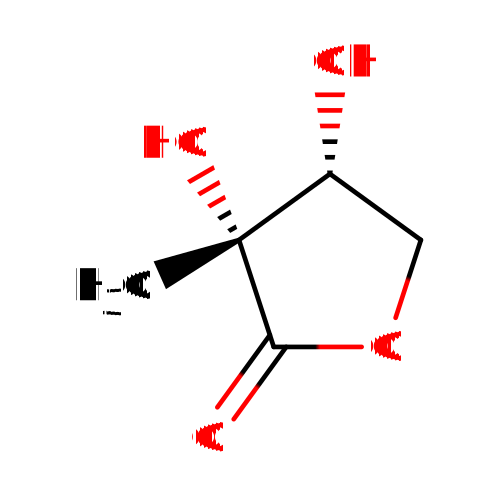
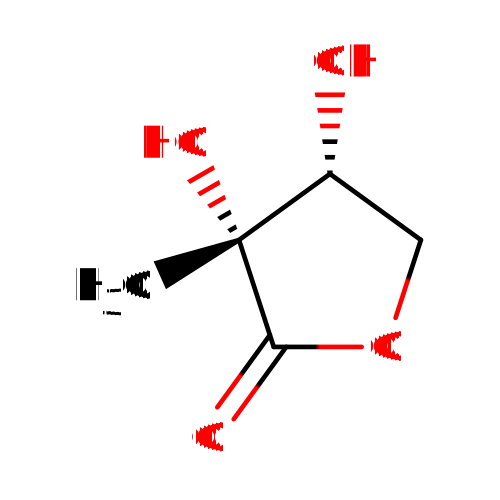
| Common Name | 2-C-Methyl-aldotetronolactone |
|---|
| Description | 2-C-Methyl-1,4-erythrono-D-lactone, 2-C-methyl-D-erythrono-1,4-lactone (MDEL) or 2-C-Methyl-Aldotetronolactone belongs to the class of organic compounds known as gamma butyrolactones. Gamma butyrolactones are compounds containing a gamma butyrolactone moiety, which consists of an aliphatic five-membered ring with four carbon atoms, one oxygen atom, forming part of a carboxyl functional group. 2-C-Methyl-1,4-erythrono-D-lactone is a neutral, hydrophobic molecule that is not soluble in water. 2-C-Methyl-1,4-erythrono-D-lactone is a known constituent of Trifolium incarnatum (crimson clover) and Phaseolus vulgaris (kidney bean). It has also been detected, but not quantified in several different foods, such as green beans, pulses, tea, and yellow wax beans. It has been identified as an insect pheromone that acts as an oviposition stimulant for the Swallowtail butterfly (PMID: 11055405 ). 2-C-Methyl-1,4-erythrono-D-lactone is synthesized in plants via the terpenoid precursor 1‚Äêdeoxy‚ÄêD‚Äêxylulose, which is phosphorylated to 1‚Äêdeoxy‚ÄêD‚Äêxylulose‚Äê5‚Äêphosphate, which is then transformed by the enzyme 1‚Äêdeoxy‚ÄêD‚Äêxylulose‚Äê5‚Äêphosphate reducto isomerase to 2C‚ÄêMethyl‚ÄêD‚Äêerythritol‚Äê4‚Äêphosphate. This compound is then oxidized at the alcoholic group at C‚Äê1 to 2-Methyl-2,3,4-trihydroxybutanoic acid-4-phosphate by an uncharacterized dehydrogenase. Dephosphorylation yields the free acid which spontaneously forms the lactone. 2-C-Methyl-1,4-erythrono-D-lactone is one of a small number of lactones found in cannabis plants (PMID: 6991645 ). |
|---|
| Structure | InChI=1S/C5H8O4/c1-5(8)3(6)2-9-4(5)7/h3,6,8H,2H2,1H3/t3-,5-/m1/s1 |
|---|
| Synonyms | Not Available |
|---|
| Chemical Formula | C5H8O4 |
|---|
| Average Mass | 132.1150 Da |
|---|
| Monoisotopic Mass | 132.04226 Da |
|---|
| IUPAC Name | (3R,4R)-3,4-dihydroxy-3-methyloxolan-2-one |
|---|
| Traditional Name | (3R,4R)-3,4-dihydroxy-3-methyloxolan-2-one |
|---|
| CAS Registry Number | 18465-71-9 |
|---|
| SMILES | C[C@@]1(O)[C@H](O)COC1=O |
|---|
| InChI Identifier | InChI=1S/C5H8O4/c1-5(8)3(6)2-9-4(5)7/h3,6,8H,2H2,1H3/t3-,5-/m1/s1 |
|---|
| InChI Key | OHTGZAWPVDWARE-NQXXGFSBSA-N |
|---|
| Experimental Spectra |
|---|
|
| Not Available | | Predicted Spectra |
|---|
|
| | Spectrum Type | Description | Depositor ID | Depositor Organization | Depositor | Deposition Date | View |
|---|
| 1D NMR | 13C NMR Spectrum (1D, 25 MHz, D2O, predicted) | Wishart Lab | Wishart Lab | David Wishart | 2021-06-20 | View Spectrum | | 1D NMR | 1H NMR Spectrum (1D, 100 MHz, D2O, predicted) | Wishart Lab | Wishart Lab | David Wishart | 2021-06-20 | View Spectrum | | 1D NMR | 13C NMR Spectrum (1D, 252 MHz, D2O, predicted) | Wishart Lab | Wishart Lab | David Wishart | 2021-06-20 | View Spectrum | | 1D NMR | 1H NMR Spectrum (1D, 1000 MHz, D2O, predicted) | Wishart Lab | Wishart Lab | David Wishart | 2021-06-20 | View Spectrum | | 1D NMR | 13C NMR Spectrum (1D, 50 MHz, D2O, predicted) | Wishart Lab | Wishart Lab | David Wishart | 2021-06-20 | View Spectrum | | 1D NMR | 1H NMR Spectrum (1D, 200 MHz, D2O, predicted) | Wishart Lab | Wishart Lab | David Wishart | 2021-06-20 | View Spectrum | | 1D NMR | 13C NMR Spectrum (1D, 75 MHz, D2O, predicted) | Wishart Lab | Wishart Lab | David Wishart | 2021-06-20 | View Spectrum | | 1D NMR | 1H NMR Spectrum (1D, 300 MHz, D2O, predicted) | Wishart Lab | Wishart Lab | David Wishart | 2021-06-20 | View Spectrum | | 1D NMR | 13C NMR Spectrum (1D, 101 MHz, D2O, predicted) | Wishart Lab | Wishart Lab | David Wishart | 2021-06-20 | View Spectrum | | 1D NMR | 1H NMR Spectrum (1D, 400 MHz, D2O, predicted) | Wishart Lab | Wishart Lab | David Wishart | 2021-06-20 | View Spectrum | | 1D NMR | 13C NMR Spectrum (1D, 126 MHz, D2O, predicted) | Wishart Lab | Wishart Lab | David Wishart | 2021-06-20 | View Spectrum | | 1D NMR | 1H NMR Spectrum (1D, 500 MHz, D2O, predicted) | Wishart Lab | Wishart Lab | David Wishart | 2021-06-20 | View Spectrum | | 1D NMR | 13C NMR Spectrum (1D, 151 MHz, D2O, predicted) | Wishart Lab | Wishart Lab | David Wishart | 2021-06-20 | View Spectrum | | 1D NMR | 1H NMR Spectrum (1D, 600 MHz, D2O, predicted) | Wishart Lab | Wishart Lab | David Wishart | 2021-06-20 | View Spectrum | | 1D NMR | 13C NMR Spectrum (1D, 176 MHz, D2O, predicted) | Wishart Lab | Wishart Lab | David Wishart | 2021-06-20 | View Spectrum | | 1D NMR | 1H NMR Spectrum (1D, 700 MHz, D2O, predicted) | Wishart Lab | Wishart Lab | David Wishart | 2021-06-20 | View Spectrum | | 1D NMR | 13C NMR Spectrum (1D, 201 MHz, D2O, predicted) | Wishart Lab | Wishart Lab | David Wishart | 2021-06-20 | View Spectrum | | 1D NMR | 1H NMR Spectrum (1D, 800 MHz, D2O, predicted) | Wishart Lab | Wishart Lab | David Wishart | 2021-06-20 | View Spectrum | | 1D NMR | 13C NMR Spectrum (1D, 226 MHz, D2O, predicted) | Wishart Lab | Wishart Lab | David Wishart | 2021-06-20 | View Spectrum | | 1D NMR | 1H NMR Spectrum (1D, 900 MHz, D2O, predicted) | Wishart Lab | Wishart Lab | David Wishart | 2021-06-20 | View Spectrum |
| | Chemical Shift Submissions |
|---|
|
| Not Available | | Species |
|---|
| Species of Origin | |
|---|
| Chemical Taxonomy |
|---|
| Description | Belongs to the class of organic compounds known as gamma butyrolactones. Gamma butyrolactones are compounds containing a gamma butyrolactone moiety, which consists of an aliphatic five-member ring with four carbon atoms, one oxygen atom, and bears a ketone group on the carbon adjacent to the oxygen atom. |
|---|
| Kingdom | Organic compounds |
|---|
| Super Class | Organoheterocyclic compounds |
|---|
| Class | Lactones |
|---|
| Sub Class | Gamma butyrolactones |
|---|
| Direct Parent | Gamma butyrolactones |
|---|
| Alternative Parents | |
|---|
| Substituents | - Gamma butyrolactone
- Oxolane
- Tertiary alcohol
- 1,2-diol
- Carboxylic acid ester
- Secondary alcohol
- Carboxylic acid derivative
- Monocarboxylic acid or derivatives
- Oxacycle
- Hydrocarbon derivative
- Organic oxide
- Organic oxygen compound
- Carbonyl group
- Alcohol
- Organooxygen compound
- Aliphatic heteromonocyclic compound
|
|---|
| Molecular Framework | Aliphatic heteromonocyclic compounds |
|---|
| External Descriptors | Not Available |
|---|
| Physical Properties |
|---|
| State | Not Available |
|---|
| Experimental Properties | | Property | Value | Reference |
|---|
| Melting Point | Not Available | Not Available | | Boiling Point | Not Available | Not Available | | Water Solubility | Not Available | Not Available | | LogP | Not Available | Not Available |
|
|---|
| Predicted Properties | |
|---|