| Record Information |
|---|
| Version | 2.0 |
|---|
| Created at | 2022-03-10 18:36:50 UTC |
|---|
| Updated at | 2022-03-10 22:21:13 UTC |
|---|
| NP-MRD ID | NP0044865 |
|---|
| Secondary Accession Numbers | None |
|---|
| Natural Product Identification |
|---|
| Common Name | Hordenine |
|---|
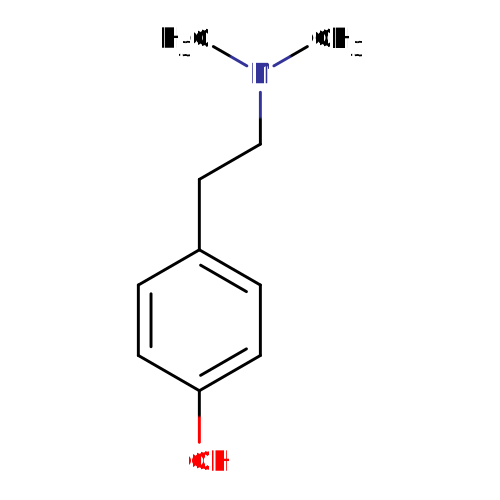
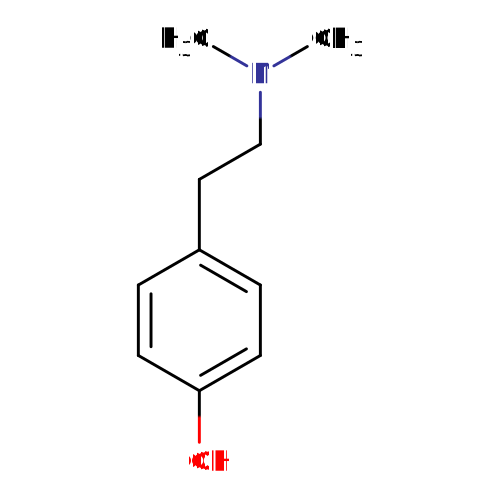
| Description | Hordenine belongs to the class of organic compounds known as phenethylamines. Phenethylamines are compounds containing a phenethylamine moiety, which consists of a phenyl group substituted at the second position by an ethan-1-amine. Hordenine, a strong basic compound, is a colorless solid that is soluble in organic solvents. Hordenine is biosynthesized by the stepwise N-methylation of tyramine, which is first converted to N-methyltyramine by tyramine N-methyltransferase and then is methylated to hordenine (PMID: 24257763 ). Hordenine exists in all living organisms, ranging from plants to humans. It is found in highest concentrations with barley (Hordeum species), from which its name is derived. Hordenine is also found in cannabis plants (PMID:6991645 ). Several varieties of plants in the family Cactacea (cacti) produce hordenine which, as a potent phenylethylamine alkaloid, has antibacterial and antibiotic properties (PMID: 30609368 ; PMID: 30128579 ). Hordenine has been found in several different foods, such as cereals and cereal products, corns, oats, sweet oranges, and tamarinds making it a potential biomarker for the consumption of these foods. People consuming beer brewed from barley will have higher levels of hordenine. However, hordenine in urine interferes with tests for morphine, heroin and other opioid drugs (PMID: 1618458 ). Hordenine is widely sold as an ingredient of nutritional supplements, with the claims that it is a stimulant of the central nervous system and can promote weight loss by enhancing metabolism. |
|---|
| Structure | InChI=1S/C10H15NO/c1-11(2)8-7-9-3-5-10(12)6-4-9/h3-6,12H,7-8H2,1-2H3 |
|---|
| Synonyms | | Value | Source |
|---|
| 4-[2-(Dimethylamino)ethyl]phenol | ChEBI | | N,N-Dimethyl-2-(4-hydroxyphenyl)ethylamine | ChEBI | | N,N-Dimethyl-4-hydroxy-beta-phenethylamine | ChEBI | | N,N-Dimethyltyramine | ChEBI | | p-(2-Dimethylaminoethyl)phenol | ChEBI | | N,N-Dimethyl-4-hydroxy-b-phenethylamine | Generator | | N,N-Dimethyl-4-hydroxy-β-phenethylamine | Generator | | Hordenine hydrochloride | HMDB | | Hordenine sulfate (2:1) | HMDB | | Hordenine sulfate (1:1) | HMDB | | 4-(2-Dimethylaminoethyl)phenol | HMDB | | Anhalin | HMDB | | Anhaline | HMDB | | Cactine | HMDB | | Eremursine | HMDB | | Hordenin | HMDB | | Hordetin | HMDB | | N,N-Dimethyl-p-hydroxyphenethylamine | HMDB | | Ordenina | HMDB | | Ordenine | HMDB | | p-Hydroxy-N,N-dimethylphenethylamine | HMDB | | p-[2-(Dimethylamino)ethyl]phenol | HMDB | | Peyocactine | HMDB |
|
|---|
| Chemical Formula | C10H15NO |
|---|
| Average Mass | 165.2322 Da |
|---|
| Monoisotopic Mass | 165.11536 Da |
|---|
| IUPAC Name | 4-[2-(dimethylamino)ethyl]phenol |
|---|
| Traditional Name | hordenine |
|---|
| CAS Registry Number | 539-15-1 |
|---|
| SMILES | CN(C)CCC1=CC=C(O)C=C1 |
|---|
| InChI Identifier | InChI=1S/C10H15NO/c1-11(2)8-7-9-3-5-10(12)6-4-9/h3-6,12H,7-8H2,1-2H3 |
|---|
| InChI Key | KUBCEEMXQZUPDQ-UHFFFAOYSA-N |
|---|
| Experimental Spectra |
|---|
|
| Not Available | | Predicted Spectra |
|---|
|
| | Spectrum Type | Description | Depositor ID | Depositor Organization | Depositor | Deposition Date | View |
|---|
| 1D NMR | 13C NMR Spectrum (1D, 25 MHz, D2O, predicted) | Wishart Lab | Wishart Lab | David Wishart | 2021-06-20 | View Spectrum | | 1D NMR | 1H NMR Spectrum (1D, 100 MHz, D2O, predicted) | Wishart Lab | Wishart Lab | David Wishart | 2021-06-20 | View Spectrum | | 1D NMR | 13C NMR Spectrum (1D, 252 MHz, D2O, predicted) | Wishart Lab | Wishart Lab | David Wishart | 2021-06-20 | View Spectrum | | 1D NMR | 1H NMR Spectrum (1D, 1000 MHz, D2O, predicted) | Wishart Lab | Wishart Lab | David Wishart | 2021-06-20 | View Spectrum | | 1D NMR | 13C NMR Spectrum (1D, 50 MHz, D2O, predicted) | Wishart Lab | Wishart Lab | David Wishart | 2021-06-20 | View Spectrum | | 1D NMR | 1H NMR Spectrum (1D, 200 MHz, D2O, predicted) | Wishart Lab | Wishart Lab | David Wishart | 2021-06-20 | View Spectrum | | 1D NMR | 13C NMR Spectrum (1D, 75 MHz, D2O, predicted) | Wishart Lab | Wishart Lab | David Wishart | 2021-06-20 | View Spectrum | | 1D NMR | 1H NMR Spectrum (1D, 300 MHz, D2O, predicted) | Wishart Lab | Wishart Lab | David Wishart | 2021-06-20 | View Spectrum | | 1D NMR | 13C NMR Spectrum (1D, 101 MHz, D2O, predicted) | Wishart Lab | Wishart Lab | David Wishart | 2021-06-20 | View Spectrum | | 1D NMR | 1H NMR Spectrum (1D, 400 MHz, D2O, predicted) | Wishart Lab | Wishart Lab | David Wishart | 2021-06-20 | View Spectrum | | 1D NMR | 13C NMR Spectrum (1D, 126 MHz, D2O, predicted) | Wishart Lab | Wishart Lab | David Wishart | 2021-06-20 | View Spectrum | | 1D NMR | 1H NMR Spectrum (1D, 500 MHz, D2O, predicted) | Wishart Lab | Wishart Lab | David Wishart | 2021-06-20 | View Spectrum | | 1D NMR | 13C NMR Spectrum (1D, 151 MHz, D2O, predicted) | Wishart Lab | Wishart Lab | David Wishart | 2021-06-20 | View Spectrum | | 1D NMR | 1H NMR Spectrum (1D, 600 MHz, D2O, predicted) | Wishart Lab | Wishart Lab | David Wishart | 2021-06-20 | View Spectrum | | 1D NMR | 13C NMR Spectrum (1D, 176 MHz, D2O, predicted) | Wishart Lab | Wishart Lab | David Wishart | 2021-06-20 | View Spectrum | | 1D NMR | 1H NMR Spectrum (1D, 700 MHz, D2O, predicted) | Wishart Lab | Wishart Lab | David Wishart | 2021-06-20 | View Spectrum | | 1D NMR | 13C NMR Spectrum (1D, 201 MHz, D2O, predicted) | Wishart Lab | Wishart Lab | David Wishart | 2021-06-20 | View Spectrum | | 1D NMR | 1H NMR Spectrum (1D, 800 MHz, D2O, predicted) | Wishart Lab | Wishart Lab | David Wishart | 2021-06-20 | View Spectrum | | 1D NMR | 13C NMR Spectrum (1D, 226 MHz, D2O, predicted) | Wishart Lab | Wishart Lab | David Wishart | 2021-06-20 | View Spectrum | | 1D NMR | 1H NMR Spectrum (1D, 900 MHz, D2O, predicted) | Wishart Lab | Wishart Lab | David Wishart | 2021-06-20 | View Spectrum |
| | Chemical Shift Submissions |
|---|
|
| Not Available | | Species |
|---|
| Species of Origin | |
|---|
| Chemical Taxonomy |
|---|
| Description | Belongs to the class of organic compounds known as phenethylamines. Phenethylamines are compounds containing a phenethylamine moiety, which consists of a phenyl group substituted at the second position by an ethan-1-amine. |
|---|
| Kingdom | Organic compounds |
|---|
| Super Class | Benzenoids |
|---|
| Class | Benzene and substituted derivatives |
|---|
| Sub Class | Phenethylamines |
|---|
| Direct Parent | Phenethylamines |
|---|
| Alternative Parents | |
|---|
| Substituents | - Phenethylamine
- 1-hydroxy-2-unsubstituted benzenoid
- Aralkylamine
- Phenol
- Tertiary aliphatic amine
- Tertiary amine
- Organic nitrogen compound
- Organic oxygen compound
- Organopnictogen compound
- Hydrocarbon derivative
- Organooxygen compound
- Organonitrogen compound
- Amine
- Aromatic homomonocyclic compound
|
|---|
| Molecular Framework | Aromatic homomonocyclic compounds |
|---|
| External Descriptors | |
|---|
| Physical Properties |
|---|
| State | Not Available |
|---|
| Experimental Properties | | Property | Value | Reference |
|---|
| Melting Point | Not Available | Not Available | | Boiling Point | Not Available | Not Available | | Water Solubility | Not Available | Not Available | | LogP | Not Available | Not Available |
|
|---|
| Predicted Properties | |
|---|
| General References | - Meyer E: Separation of two distinct S-adenosylmethionine dependent N-methyltransferases involved in hordenine biosynthesis in Hordeum vulgare. Plant Cell Rep. 1982 Dec;1(6):236-9. doi: 10.1007/BF00272627. [PubMed:24257763 ]
- Zhou JW, Ruan LY, Chen HJ, Luo HZ, Jiang H, Wang JS, Jia AQ: Inhibition of Quorum Sensing and Virulence in Serratia marcescens by Hordenine. J Agric Food Chem. 2019 Jan 23;67(3):784-795. doi: 10.1021/acs.jafc.8b05922. Epub 2019 Jan 14. [PubMed:30609368 ]
- Zhou JW, Hou B, Liu GY, Jiang H, Sun B, Wang ZN, Shi RF, Xu Y, Wang R, Jia AQ: Attenuation of Pseudomonas aeruginosa biofilm by hordenine: a combinatorial study with aminoglycoside antibiotics. Appl Microbiol Biotechnol. 2018 Nov;102(22):9745-9758. doi: 10.1007/s00253-018-9315-8. Epub 2018 Aug 20. [PubMed:30128579 ]
- Singh AK, Granley K, Misrha U, Naeem K, White T, Jiang Y: Screening and confirmation of drugs in urine: interference of hordenine with the immunoassays and thin layer chromatography methods. Forensic Sci Int. 1992 Apr;54(1):9-22. doi: 10.1016/0379-0738(92)90076-9. [PubMed:1618458 ]
|
|---|