| Record Information |
|---|
| Version | 2.0 |
|---|
| Created at | 2022-03-10 18:36:26 UTC |
|---|
| Updated at | 2022-03-10 22:19:00 UTC |
|---|
| NP-MRD ID | NP0044841 |
|---|
| Secondary Accession Numbers | None |
|---|
| Natural Product Identification |
|---|
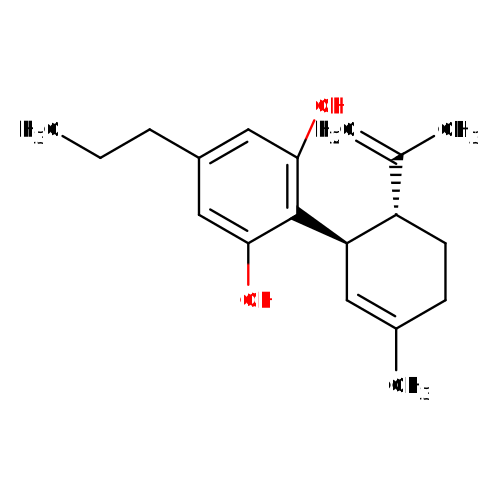
| Common Name | Cannabidivarin |
|---|
| Description | Cannabidivarin (CBDV) is a non-psychoactive cannabinoid found within medical Cannabis. It is one of over 100 cannabinoids identified from the Cannabis plants that can modulate the physiological activity of cannabis, or marijuana (PMID: 23408483 ). CBDV is the C3 analogue of cannabidiol (CBD). Notably, both cannabidiol and CBDV have demonstrated anticonvulsant activity in animal and human models with promising clinical trial results (PMID: 22970845 ; PMID: 25029033 ; PMID: 29290836 ; PMID: 29588939 ). Other cannabinoids with demonstrated anti-epileptic activity include Tetrahydrocannabivarin (THCV) and Δ9-tetrahydrocannabinolic acid. While the primary components of cannabis, CBD and THC, have been shown to modulate many of their physiological effects through their binding to the cannabinoid-1 (CB1) and cannabinoid-2 (CB2) receptors, the anticonvulsant cannabinoids do not interact with CB1 and CB2. The anti-epileptic activity of CBD and CBDV is thought to be modulated by their effects on transient receptor potential cation channel subfamily V member 1 (TRPV1), also known as the capsaicin receptor. TRPV1 is a member of a large family of ion channels that are involved in the onset and progression of several types of epilepsy. CBD and CBDV have been shown to dose-dependently activate and then desensitize TRPV1 as well as TRPV2 and transient receptor potential ankyrin 1 (TRPA1) channels (PMID 25029033 ; PMID: 29842819 ; PMID: 21175579 ). Desensitization of these ion channels is a potential mechanism by which these molecules cause a reduction of neuronal hyperexcitability that contributes to epileptic activity and seizures. CBDV has also been shown to inhibit the activity of diacylglycerol (DAG) lipase-alpha, the primary enzyme responsible for the synthesis of the endocannabinoid, 2-arachidonoylglycerol (2-AG) (PMID: 24282673 ; PMID: 14610053 ). The clinical implications of this are unclear however, as this interaction has not been shown to affect CBDV's anticonvulsant activity. CBDV is being actively developed by GW Pharmaceuticals as the experimental compound GWP42006 as it has "shown the ability to treat seizures in pre-clinical models of epilepsy with significantly fewer side effects than currently approved anti-epileptic drugs". Unfortunately, as of February 2018, GW Pharmaceuticals announced that their Phase 2a placebo-controlled study of CBDV for focal seizure did not reach its primary endpoints. They will continue to study its use in epilepsy, however, and are expanding their investigations to include its potential use in Autism Spectrum Disorder, Rett syndrome and Fragile X among others. In October 2017 CBDV was given orphan designation by the European Medicines Agency for use in Rett Syndrome and again in February 2018 for treatment of Fragile X Syndrome. |
|---|
| Structure | [H][C@]1(CCC(C)=C[C@@]1([H])C1=C(O)C=C(CCC)C=C1O)C(C)=C InChI=1S/C19H26O2/c1-5-6-14-10-17(20)19(18(21)11-14)16-9-13(4)7-8-15(16)12(2)3/h9-11,15-16,20-21H,2,5-8H2,1,3-4H3/t15-,16+/m0/s1 |
|---|
| Synonyms | | Value | Source |
|---|
| CBDV | Kegg | | CBDV Compound | MeSH |
|
|---|
| Chemical Formula | C19H26O2 |
|---|
| Average Mass | 286.4150 Da |
|---|
| Monoisotopic Mass | 286.19328 Da |
|---|
| IUPAC Name | 2-[(1R,6R)-3-methyl-6-(prop-1-en-2-yl)cyclohex-2-en-1-yl]-5-propylbenzene-1,3-diol |
|---|
| Traditional Name | 2-[(1R,6R)-3-methyl-6-(prop-1-en-2-yl)cyclohex-2-en-1-yl]-5-propylbenzene-1,3-diol |
|---|
| CAS Registry Number | 24274-48-4 |
|---|
| SMILES | [H][C@]1(CCC(C)=C[C@@]1([H])C1=C(O)C=C(CCC)C=C1O)C(C)=C |
|---|
| InChI Identifier | InChI=1S/C19H26O2/c1-5-6-14-10-17(20)19(18(21)11-14)16-9-13(4)7-8-15(16)12(2)3/h9-11,15-16,20-21H,2,5-8H2,1,3-4H3/t15-,16+/m0/s1 |
|---|
| InChI Key | REOZWEGFPHTFEI-JKSUJKDBSA-N |
|---|
| Experimental Spectra |
|---|
|
| Not Available | | Predicted Spectra |
|---|
|
| | Spectrum Type | Description | Depositor ID | Depositor Organization | Depositor | Deposition Date | View |
|---|
| 1D NMR | 13C NMR Spectrum (1D, 25 MHz, D2O, predicted) | Wishart Lab | Wishart Lab | David Wishart | 2021-06-20 | View Spectrum | | 1D NMR | 1H NMR Spectrum (1D, 100 MHz, D2O, predicted) | Wishart Lab | Wishart Lab | David Wishart | 2021-06-20 | View Spectrum | | 1D NMR | 13C NMR Spectrum (1D, 252 MHz, D2O, predicted) | Wishart Lab | Wishart Lab | David Wishart | 2021-06-20 | View Spectrum | | 1D NMR | 1H NMR Spectrum (1D, 1000 MHz, D2O, predicted) | Wishart Lab | Wishart Lab | David Wishart | 2021-06-20 | View Spectrum | | 1D NMR | 13C NMR Spectrum (1D, 50 MHz, D2O, predicted) | Wishart Lab | Wishart Lab | David Wishart | 2021-06-20 | View Spectrum | | 1D NMR | 1H NMR Spectrum (1D, 200 MHz, D2O, predicted) | Wishart Lab | Wishart Lab | David Wishart | 2021-06-20 | View Spectrum | | 1D NMR | 13C NMR Spectrum (1D, 75 MHz, D2O, predicted) | Wishart Lab | Wishart Lab | David Wishart | 2021-06-20 | View Spectrum | | 1D NMR | 1H NMR Spectrum (1D, 300 MHz, D2O, predicted) | Wishart Lab | Wishart Lab | David Wishart | 2021-06-20 | View Spectrum | | 1D NMR | 13C NMR Spectrum (1D, 101 MHz, D2O, predicted) | Wishart Lab | Wishart Lab | David Wishart | 2021-06-20 | View Spectrum | | 1D NMR | 1H NMR Spectrum (1D, 400 MHz, D2O, predicted) | Wishart Lab | Wishart Lab | David Wishart | 2021-06-20 | View Spectrum | | 1D NMR | 13C NMR Spectrum (1D, 126 MHz, D2O, predicted) | Wishart Lab | Wishart Lab | David Wishart | 2021-06-20 | View Spectrum | | 1D NMR | 1H NMR Spectrum (1D, 500 MHz, D2O, predicted) | Wishart Lab | Wishart Lab | David Wishart | 2021-06-20 | View Spectrum | | 1D NMR | 13C NMR Spectrum (1D, 151 MHz, D2O, predicted) | Wishart Lab | Wishart Lab | David Wishart | 2021-06-20 | View Spectrum | | 1D NMR | 1H NMR Spectrum (1D, 600 MHz, D2O, predicted) | Wishart Lab | Wishart Lab | David Wishart | 2021-06-20 | View Spectrum | | 1D NMR | 13C NMR Spectrum (1D, 176 MHz, D2O, predicted) | Wishart Lab | Wishart Lab | David Wishart | 2021-06-20 | View Spectrum | | 1D NMR | 1H NMR Spectrum (1D, 700 MHz, D2O, predicted) | Wishart Lab | Wishart Lab | David Wishart | 2021-06-20 | View Spectrum | | 1D NMR | 13C NMR Spectrum (1D, 201 MHz, D2O, predicted) | Wishart Lab | Wishart Lab | David Wishart | 2021-06-20 | View Spectrum | | 1D NMR | 1H NMR Spectrum (1D, 800 MHz, D2O, predicted) | Wishart Lab | Wishart Lab | David Wishart | 2021-06-20 | View Spectrum | | 1D NMR | 13C NMR Spectrum (1D, 226 MHz, D2O, predicted) | Wishart Lab | Wishart Lab | David Wishart | 2021-06-20 | View Spectrum | | 1D NMR | 1H NMR Spectrum (1D, 900 MHz, D2O, predicted) | Wishart Lab | Wishart Lab | David Wishart | 2021-06-20 | View Spectrum |
| | Chemical Shift Submissions |
|---|
|
| Not Available | | Species |
|---|
| Species of Origin | |
|---|
| Chemical Taxonomy |
|---|
| Description | Belongs to the class of organic compounds known as aromatic monoterpenoids. These are monoterpenoids containing at least one aromatic ring. |
|---|
| Kingdom | Organic compounds |
|---|
| Super Class | Lipids and lipid-like molecules |
|---|
| Class | Prenol lipids |
|---|
| Sub Class | Monoterpenoids |
|---|
| Direct Parent | Aromatic monoterpenoids |
|---|
| Alternative Parents | |
|---|
| Substituents | - P-menthane monoterpenoid
- Monocyclic monoterpenoid
- Aromatic monoterpenoid
- Phenylpropane
- Resorcinol
- 1-hydroxy-4-unsubstituted benzenoid
- 1-hydroxy-2-unsubstituted benzenoid
- Phenol
- Benzenoid
- Monocyclic benzene moiety
- Organic oxygen compound
- Hydrocarbon derivative
- Organooxygen compound
- Aromatic homomonocyclic compound
|
|---|
| Molecular Framework | Aromatic homomonocyclic compounds |
|---|
| External Descriptors | Not Available |
|---|
| Physical Properties |
|---|
| State | Not Available |
|---|
| Experimental Properties | | Property | Value | Reference |
|---|
| Melting Point | Not Available | Not Available | | Boiling Point | Not Available | Not Available | | Water Solubility | Not Available | Not Available | | LogP | Not Available | Not Available |
|
|---|
| Predicted Properties | |
|---|
| General References | - Hill AJ, Mercier MS, Hill TD, Glyn SE, Jones NA, Yamasaki Y, Futamura T, Duncan M, Stott CG, Stephens GJ, Williams CM, Whalley BJ: Cannabidivarin is anticonvulsant in mouse and rat. Br J Pharmacol. 2012 Dec;167(8):1629-42. doi: 10.1111/j.1476-5381.2012.02207.x. [PubMed:22970845 ]
- Iannotti FA, Hill CL, Leo A, Alhusaini A, Soubrane C, Mazzarella E, Russo E, Whalley BJ, Di Marzo V, Stephens GJ: Nonpsychotropic plant cannabinoids, cannabidivarin (CBDV) and cannabidiol (CBD), activate and desensitize transient receptor potential vanilloid 1 (TRPV1) channels in vitro: potential for the treatment of neuronal hyperexcitability. ACS Chem Neurosci. 2014 Nov 19;5(11):1131-41. doi: 10.1021/cn5000524. Epub 2014 Jul 29. [PubMed:25029033 ]
- Morano A, Cifelli P, Nencini P, Antonilli L, Fattouch J, Ruffolo G, Roseti C, Aronica E, Limatola C, Di Bonaventura C, Palma E, Giallonardo AT: Cannabis in epilepsy: From clinical practice to basic research focusing on the possible role of cannabidivarin. Epilepsia Open. 2016 Sep 19;1(3-4):145-151. doi: 10.1002/epi4.12015. eCollection 2016 Dec. [PubMed:29588939 ]
- Ruzic Zecevic D, Folic M, Tantoush Z, Radovanovic M, Babic G, Jankovic SM: Investigational cannabinoids in seizure disorders, what have we learned thus far? Expert Opin Investig Drugs. 2018 Jun;27(6):535-541. doi: 10.1080/13543784.2018.1482275. Epub 2018 Jun 6. [PubMed:29842819 ]
- De Petrocellis L, Ligresti A, Moriello AS, Allara M, Bisogno T, Petrosino S, Stott CG, Di Marzo V: Effects of cannabinoids and cannabinoid-enriched Cannabis extracts on TRP channels and endocannabinoid metabolic enzymes. Br J Pharmacol. 2011 Aug;163(7):1479-94. doi: 10.1111/j.1476-5381.2010.01166.x. [PubMed:21175579 ]
- Amada N, Yamasaki Y, Williams CM, Whalley BJ: Cannabidivarin (CBDV) suppresses pentylenetetrazole (PTZ)-induced increases in epilepsy-related gene expression. PeerJ. 2013 Nov 21;1:e214. doi: 10.7717/peerj.214. eCollection 2013. [PubMed:24282673 ]
|
|---|