| Record Information |
|---|
| Version | 2.0 |
|---|
| Created at | 2022-02-24 21:16:06 UTC |
|---|
| Updated at | 2022-02-24 21:16:06 UTC |
|---|
| NP-MRD ID | NP0044785 |
|---|
| Secondary Accession Numbers | None |
|---|
| Natural Product Identification |
|---|
| Common Name | Syringetin |
|---|
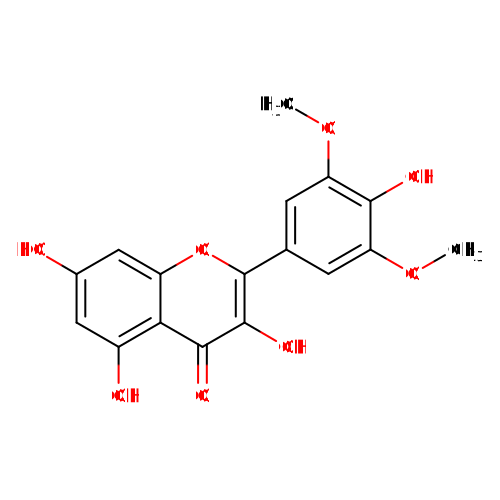
| Description | Syringetin belongs to the class of organic compounds known as flavonols. Flavonols are compounds that contain a flavone (2-phenyl-1-benzopyran-4-one) backbone carrying a hydroxyl group at the 3-position. Thus, syringetin is considered to be a flavonoid lipid molecule. Syringetin is a very hydrophobic molecule, practically insoluble (in water), and relatively neutral. Syringetin is found in Cedrus atlantica, Cistus symphytifolius, Ginkgo biloba , Lathyrus pratensis, Nelumbo nucifera, Picea abies , Pinus brutia, Pinus halepensis, Rhus salicifolia, Soymida febrifuga and Turnera subulata. Syringetin was first documented in 2009 (PMID: 19784998). A dimethoxyflavone that is myricetin in which the hydroxy groups at positions 3' and 5' have been replaced by methoxy groups (PMID: 22980782) (PMID: 21745360). |
|---|
| Structure | COC1=CC(=CC(OC)=C1O)C1=C(O)C(=O)C2=C(O)C=C(O)C=C2O1 InChI=1S/C17H14O8/c1-23-11-3-7(4-12(24-2)14(11)20)17-16(22)15(21)13-9(19)5-8(18)6-10(13)25-17/h3-6,18-20,22H,1-2H3 |
|---|
| Synonyms | | Value | Source |
|---|
| 3',5'-O-Dimethylmyricetin | ChEBI | | 3,5,7,4'-Tetrahydroxy-3',5'-dimethoxyflavone | ChEBI | | 3,5,7,4'-Tetrahydroxy-3',5'dimethoxyflavone | MeSH | | 3,4',5,7-Tetrahydroxy-3',5'-dimethoxyflavone | PhytoBank | | 3,4’,5,7-Tetrahydroxy-3’,5’-dimethoxyflavone | PhytoBank | | 3,5,7-Trihydroxy-2-(4-hydroxy-3,5-dimethoxyphenyl)-4H-1-benzopyran-4-one | PhytoBank | | Myricetin-3',5'-dimethyl ether | PhytoBank | | Myricetin-3’,5’-dimethyl ether | PhytoBank |
|
|---|
| Chemical Formula | C17H14O8 |
|---|
| Average Mass | 346.2910 Da |
|---|
| Monoisotopic Mass | 346.06887 Da |
|---|
| IUPAC Name | 3,5,7-trihydroxy-2-(4-hydroxy-3,5-dimethoxyphenyl)-4H-chromen-4-one |
|---|
| Traditional Name | syringetin |
|---|
| CAS Registry Number | Not Available |
|---|
| SMILES | COC1=CC(=CC(OC)=C1O)C1=C(O)C(=O)C2=C(O)C=C(O)C=C2O1 |
|---|
| InChI Identifier | InChI=1S/C17H14O8/c1-23-11-3-7(4-12(24-2)14(11)20)17-16(22)15(21)13-9(19)5-8(18)6-10(13)25-17/h3-6,18-20,22H,1-2H3 |
|---|
| InChI Key | UZMAPBJVXOGOFT-UHFFFAOYSA-N |
|---|
| Experimental Spectra |
|---|
|
| | Spectrum Type | Description | Depositor Email | Depositor Organization | Depositor | Deposition Date | View |
|---|
| 1D NMR | 13C NMR Spectrum (1D, 100 MHz, Dimethylsulfoxide-d6, simulated) | Wishart Lab | Wishart Lab | David Wishart | 2021-06-20 | View Spectrum | | 1D NMR | 13C NMR Spectrum (1D, 125 MHz, Dimethylsulfoxide-d6, simulated) | Wishart Lab | Wishart Lab | David Wishart | 2021-06-20 | View Spectrum | | 1D NMR | 13C NMR Spectrum (1D, 150 MHz, Dimethylsulfoxide-d6, simulated) | Wishart Lab | Wishart Lab | David Wishart | 2021-06-20 | View Spectrum | | 1D NMR | 13C NMR Spectrum (1D, 175 MHz, Dimethylsulfoxide-d6, simulated) | Wishart Lab | Wishart Lab | David Wishart | 2021-06-20 | View Spectrum | | 1D NMR | 13C NMR Spectrum (1D, 200 MHz, Dimethylsulfoxide-d6, simulated) | Wishart Lab | Wishart Lab | David Wishart | 2021-06-20 | View Spectrum | | 1D NMR | 13C NMR Spectrum (1D, 225 MHz, Dimethylsulfoxide-d6, simulated) | Wishart Lab | Wishart Lab | David Wishart | 2021-06-20 | View Spectrum | | 1D NMR | 13C NMR Spectrum (1D, 25 MHz, Dimethylsulfoxide-d6, simulated) | Wishart Lab | Wishart Lab | David Wishart | 2021-06-20 | View Spectrum | | 1D NMR | 13C NMR Spectrum (1D, 250 MHz, Dimethylsulfoxide-d6, simulated) | Wishart Lab | Wishart Lab | David Wishart | 2021-06-20 | View Spectrum | | 1D NMR | 13C NMR Spectrum (1D, 50 MHz, Dimethylsulfoxide-d6, simulated) | Wishart Lab | Wishart Lab | David Wishart | 2021-06-20 | View Spectrum | | 1D NMR | 13C NMR Spectrum (1D, 75 MHz, Dimethylsulfoxide-d6, simulated) | Wishart Lab | Wishart Lab | David Wishart | 2021-06-20 | View Spectrum |
| | Predicted Spectra |
|---|
|
| | Spectrum Type | Description | Depositor ID | Depositor Organization | Depositor | Deposition Date | View |
|---|
| 1D NMR | 13C NMR Spectrum (1D, 25 MHz, D2O, predicted) | Wishart Lab | Wishart Lab | David Wishart | 2021-06-20 | View Spectrum | | 1D NMR | 1H NMR Spectrum (1D, 100 MHz, D2O, predicted) | Wishart Lab | Wishart Lab | David Wishart | 2021-06-20 | View Spectrum | | 1D NMR | 13C NMR Spectrum (1D, 252 MHz, D2O, predicted) | Wishart Lab | Wishart Lab | David Wishart | 2021-06-20 | View Spectrum | | 1D NMR | 1H NMR Spectrum (1D, 1000 MHz, D2O, predicted) | Wishart Lab | Wishart Lab | David Wishart | 2021-06-20 | View Spectrum | | 1D NMR | 13C NMR Spectrum (1D, 50 MHz, D2O, predicted) | Wishart Lab | Wishart Lab | David Wishart | 2021-06-20 | View Spectrum | | 1D NMR | 1H NMR Spectrum (1D, 200 MHz, D2O, predicted) | Wishart Lab | Wishart Lab | David Wishart | 2021-06-20 | View Spectrum | | 1D NMR | 13C NMR Spectrum (1D, 75 MHz, D2O, predicted) | Wishart Lab | Wishart Lab | David Wishart | 2021-06-20 | View Spectrum | | 1D NMR | 1H NMR Spectrum (1D, 300 MHz, D2O, predicted) | Wishart Lab | Wishart Lab | David Wishart | 2021-06-20 | View Spectrum | | 1D NMR | 13C NMR Spectrum (1D, 101 MHz, D2O, predicted) | Wishart Lab | Wishart Lab | David Wishart | 2021-06-20 | View Spectrum | | 1D NMR | 1H NMR Spectrum (1D, 400 MHz, D2O, predicted) | Wishart Lab | Wishart Lab | David Wishart | 2021-06-20 | View Spectrum | | 1D NMR | 13C NMR Spectrum (1D, 126 MHz, D2O, predicted) | Wishart Lab | Wishart Lab | David Wishart | 2021-06-20 | View Spectrum | | 1D NMR | 1H NMR Spectrum (1D, 500 MHz, D2O, predicted) | Wishart Lab | Wishart Lab | David Wishart | 2021-06-20 | View Spectrum | | 1D NMR | 13C NMR Spectrum (1D, 151 MHz, D2O, predicted) | Wishart Lab | Wishart Lab | David Wishart | 2021-06-20 | View Spectrum | | 1D NMR | 1H NMR Spectrum (1D, 600 MHz, D2O, predicted) | Wishart Lab | Wishart Lab | David Wishart | 2021-06-20 | View Spectrum | | 1D NMR | 13C NMR Spectrum (1D, 176 MHz, D2O, predicted) | Wishart Lab | Wishart Lab | David Wishart | 2021-06-20 | View Spectrum | | 1D NMR | 1H NMR Spectrum (1D, 700 MHz, D2O, predicted) | Wishart Lab | Wishart Lab | David Wishart | 2021-06-20 | View Spectrum | | 1D NMR | 13C NMR Spectrum (1D, 201 MHz, D2O, predicted) | Wishart Lab | Wishart Lab | David Wishart | 2021-06-20 | View Spectrum | | 1D NMR | 1H NMR Spectrum (1D, 800 MHz, D2O, predicted) | Wishart Lab | Wishart Lab | David Wishart | 2021-06-20 | View Spectrum | | 1D NMR | 13C NMR Spectrum (1D, 226 MHz, D2O, predicted) | Wishart Lab | Wishart Lab | David Wishart | 2021-06-20 | View Spectrum | | 1D NMR | 1H NMR Spectrum (1D, 900 MHz, D2O, predicted) | Wishart Lab | Wishart Lab | David Wishart | 2021-06-20 | View Spectrum |
| | Chemical Shift Submissions |
|---|
|
| Not Available | | Species |
|---|
| Species of Origin | |
|---|
| Chemical Taxonomy |
|---|
| Description | Belongs to the class of organic compounds known as flavonols. Flavonols are compounds that contain a flavone (2-phenyl-1-benzopyran-4-one) backbone carrying a hydroxyl group at the 3-position. |
|---|
| Kingdom | Organic compounds |
|---|
| Super Class | Phenylpropanoids and polyketides |
|---|
| Class | Flavonoids |
|---|
| Sub Class | Flavones |
|---|
| Direct Parent | Flavonols |
|---|
| Alternative Parents | |
|---|
| Substituents | - 3p-methoxyflavonoid-skeleton
- 3-hydroxyflavone
- 3-hydroxyflavonoid
- 4'-hydroxyflavonoid
- 5-hydroxyflavonoid
- 7-hydroxyflavonoid
- Hydroxyflavonoid
- Chromone
- Benzopyran
- M-dimethoxybenzene
- Dimethoxybenzene
- Methoxyphenol
- 1-benzopyran
- Phenoxy compound
- Anisole
- Methoxybenzene
- Phenol ether
- Phenol
- 1-hydroxy-2-unsubstituted benzenoid
- Pyranone
- 1-hydroxy-4-unsubstituted benzenoid
- Alkyl aryl ether
- Benzenoid
- Pyran
- Monocyclic benzene moiety
- Vinylogous acid
- Heteroaromatic compound
- Polyol
- Organoheterocyclic compound
- Oxacycle
- Ether
- Organic oxygen compound
- Organic oxide
- Hydrocarbon derivative
- Organooxygen compound
- Aromatic heteropolycyclic compound
|
|---|
| Molecular Framework | Aromatic heteropolycyclic compounds |
|---|
| External Descriptors | |
|---|
| Physical Properties |
|---|
| State | Not Available |
|---|
| Experimental Properties | | Property | Value | Reference |
|---|
| Melting Point | Not Available | Not Available | | Boiling Point | Not Available | Not Available | | Water Solubility | Not Available | Not Available | | LogP | Not Available | Not Available |
|
|---|
| Predicted Properties | |
|---|
| General References | - Mikulic-Petkovsek M, Slatnar A, Stampar F, Veberic R: HPLC-MSn identification and quantification of flavonol glycosides in 28 wild and cultivated berry species. Food Chem. 2012 Dec 15;135(4):2138-46. doi: 10.1016/j.foodchem.2012.06.115. Epub 2012 Jul 14. [PubMed:22980782 ]
- Hsu YL, Liang HL, Hung CH, Kuo PL: Syringetin, a flavonoid derivative in grape and wine, induces human osteoblast differentiation through bone morphogenetic protein-2/extracellular signal-regulated kinase 1/2 pathway. Mol Nutr Food Res. 2009 Nov;53(11):1452-61. doi: 10.1002/mnfr.200800483. [PubMed:19784998 ]
- Bojic M, Debeljak Z, Tomicic M, Medic-Saric M, Tomic S: Evaluation of antiaggregatory activity of flavonoid aglycone series. Nutr J. 2011 Jul 11;10:73. doi: 10.1186/1475-2891-10-73. [PubMed:21745360 ]
- Jian Guo, Dong-Lei Yu, Lizhen Xu, Min Zhu, Shi-Lin Yang (1998). Jian Guo, Dong-Lei Yu, Lizhen Xu, Min Zhu, Shi-Lin Yang Flavonol glycosides from Lysimachia congestiflora. Phytochemistry, Volume 48, Issue 8, 1998, Pages 1445-1447, DOI: 10.1016/S0031-9422(97)01025-X. Phytochemistry.
|
|---|