| Record Information |
|---|
| Version | 2.0 |
|---|
| Created at | 2022-02-14 20:56:51 UTC |
|---|
| Updated at | 2022-03-10 22:21:39 UTC |
|---|
| NP-MRD ID | NP0044444 |
|---|
| Secondary Accession Numbers | None |
|---|
| Natural Product Identification |
|---|
| Common Name | Malonyl-CoA |
|---|
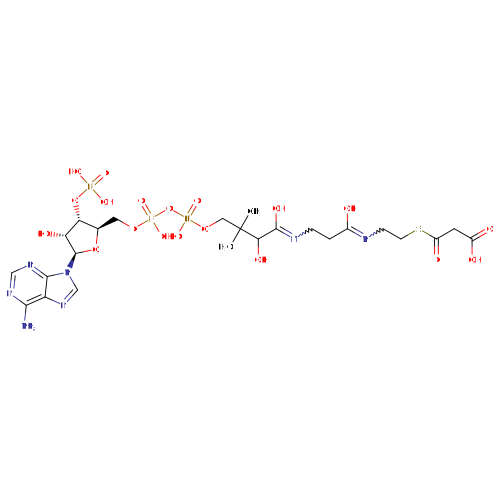
| Description | Malonyl-CoA, also known as malonyl CoA or CoA, malonyl, belongs to the class of organic compounds known as 1,3-dicarbonyl compounds. These are carbonyl compounds with the generic formula O=C(R)C(H)C(R')=O, where R and R' can be any group. Malonyl-CoA is a strong basic compound (based on its pKa). Within humans, malonyl-CoA participates in a number of enzymatic reactions. In particular, malonyl-CoA can be biosynthesized from acetyl-CoA through the action of the enzyme acetyl-CoA carboxylase 1. In addition, malonyl-CoA can be converted into malonic acid and coenzyme A; which is catalyzed by the enzyme fatty acid synthase. Malonyl/acetyl transferase domain. Malonyl-CoA is a highly regulated molecule in fatty acid synthesis; as such, it inhibits the rate-limiting step in beta-oxidation of fatty acids. Malonyl-CoA inhibits fatty acids from associating with carnitine by regulating the enzyme carnitine acyltransferase, thereby preventing them from entering the mitochondria, where fatty acid oxidation and degradation occur. Malonyl-CoA is formed by carboxylating acetyl-CoA using the enzyme acetyl-CoA carboxylase. MCAT serves to transfer malonate from malonyl-CoA to the terminal thiol of holo-acyl carrier protein (ACP). In humans, malonyl-CoA is involved in fatty acid biosynthesis. In the former, it provides 2-carbon units to fatty acids and commits them to fatty acid chain synthesis. Malonyl-CoA is a potentially toxic compound. Malonyl-CoA is a coenzyme A derivative of malonic acid. MCAT is also involved in bacterial polyketide biosynthesis. The enzyme MCAT together with an acyl carrier protein (ACP), and a polyketide synthase (PKS) and chain-length factor heterodimer, constitutes the minimal PKS of type II polyketides. One molecule of acetyl-CoA joins with a molecule of bicarbonate, requiring energy rendered from ATP.Malonyl-CoA is utilised in fatty acid biosynthesis by the enzyme malonyl coenzyme A:Acyl carrier protein transacylase (MCAT). It plays a key role in chain elongation in fatty acid biosynthesis and polyketide biosynthesis. Malonyl-CoA is expected to be in Cannabis as all living plants are known to produce and metabolize it. |
|---|
| Structure | [H]C(O)(C(O)=NCCC(O)=NCCSC(=O)CC(O)=O)C(C)(C)COP(O)(=O)OP(O)(=O)OC[C@@]1([H])O[C@@]([H])(N2C=NC3=C(N)N=CN=C23)[C@]([H])(O)[C@]1([H])OP(O)(O)=O InChI=1S/C24H38N7O19P3S/c1-24(2,19(37)22(38)27-4-3-13(32)26-5-6-54-15(35)7-14(33)34)9-47-53(44,45)50-52(42,43)46-8-12-18(49-51(39,40)41)17(36)23(48-12)31-11-30-16-20(25)28-10-29-21(16)31/h10-12,17-19,23,36-37H,3-9H2,1-2H3,(H,26,32)(H,27,38)(H,33,34)(H,42,43)(H,44,45)(H2,25,28,29)(H2,39,40,41)/t12-,17-,18-,19?,23-/m1/s1 |
|---|
| Synonyms | | Value | Source |
|---|
| Malonyl CoA | HMDB | | Malonyl coenzyme A | HMDB | | Malonyl-coenzyme A | HMDB | | Omega-carboxyacyl-CoA | HMDB | | Omega-carboxyacyl-coenzyme A | HMDB | | S-(Hydrogen malonyl)coenzyme A | HMDB | | S-(Hydrogen propanedioate | HMDB | | S-(Hydrogen propanedioate) CoA | HMDB | | S-(Hydrogen propanedioate) coenzyme A | HMDB | | S-(Hydrogen propanedioic acid | HMDB | | a, Malonyl coenzyme | HMDB | | CoA, Malonyl | HMDB | | coenzyme A, Malonyl | HMDB |
|
|---|
| Chemical Formula | C24H38N7O19P3S |
|---|
| Average Mass | 853.5800 Da |
|---|
| Monoisotopic Mass | 853.11560 Da |
|---|
| IUPAC Name | 3-{[2-(3-{3-[({[({[(2R,3S,4R,5R)-5-(6-amino-9H-purin-9-yl)-4-hydroxy-3-(phosphonooxy)oxolan-2-yl]methoxy}(hydroxy)phosphoryl)oxy](hydroxy)phosphoryl}oxy)methyl]-2-hydroxy-3-methylbutanamido}propanamido)ethyl]sulfanyl}-3-oxopropanoic acid |
|---|
| Traditional Name | 3-({2-[3-(3-{[({[(2R,3S,4R,5R)-5-(6-aminopurin-9-yl)-4-hydroxy-3-(phosphonooxy)oxolan-2-yl]methoxy(hydroxy)phosphoryl}oxy(hydroxy)phosphoryl)oxy]methyl}-2-hydroxy-3-methylbutanamido)propanamido]ethyl}sulfanyl)-3-oxopropanoic acid |
|---|
| CAS Registry Number | 524-14-1 |
|---|
| SMILES | [H]C(O)(C(O)=NCCC(O)=NCCSC(=O)CC(O)=O)C(C)(C)COP(O)(=O)OP(O)(=O)OC[C@@]1([H])O[C@@]([H])(N2C=NC3=C(N)N=CN=C23)[C@]([H])(O)[C@]1([H])OP(O)(O)=O |
|---|
| InChI Identifier | InChI=1S/C24H38N7O19P3S/c1-24(2,19(37)22(38)27-4-3-13(32)26-5-6-54-15(35)7-14(33)34)9-47-53(44,45)50-52(42,43)46-8-12-18(49-51(39,40)41)17(36)23(48-12)31-11-30-16-20(25)28-10-29-21(16)31/h10-12,17-19,23,36-37H,3-9H2,1-2H3,(H,26,32)(H,27,38)(H,33,34)(H,42,43)(H,44,45)(H2,25,28,29)(H2,39,40,41)/t12-,17-,18-,19?,23-/m1/s1 |
|---|
| InChI Key | LTYOQGRJFJAKNA-VFLPNFFSSA-N |
|---|
| Experimental Spectra |
|---|
|
| Not Available | | Predicted Spectra |
|---|
|
| | Spectrum Type | Description | Depositor ID | Depositor Organization | Depositor | Deposition Date | View |
|---|
| 1D NMR | 13C NMR Spectrum (1D, 25 MHz, D2O, predicted) | Wishart Lab | Wishart Lab | David Wishart | 2021-06-20 | View Spectrum | | 1D NMR | 1H NMR Spectrum (1D, 100 MHz, D2O, predicted) | Wishart Lab | Wishart Lab | David Wishart | 2021-06-20 | View Spectrum | | 1D NMR | 13C NMR Spectrum (1D, 252 MHz, D2O, predicted) | Wishart Lab | Wishart Lab | David Wishart | 2021-06-20 | View Spectrum | | 1D NMR | 1H NMR Spectrum (1D, 1000 MHz, D2O, predicted) | Wishart Lab | Wishart Lab | David Wishart | 2021-06-20 | View Spectrum | | 1D NMR | 13C NMR Spectrum (1D, 50 MHz, D2O, predicted) | Wishart Lab | Wishart Lab | David Wishart | 2021-06-20 | View Spectrum | | 1D NMR | 1H NMR Spectrum (1D, 200 MHz, D2O, predicted) | Wishart Lab | Wishart Lab | David Wishart | 2021-06-20 | View Spectrum | | 1D NMR | 13C NMR Spectrum (1D, 75 MHz, D2O, predicted) | Wishart Lab | Wishart Lab | David Wishart | 2021-06-20 | View Spectrum | | 1D NMR | 1H NMR Spectrum (1D, 300 MHz, D2O, predicted) | Wishart Lab | Wishart Lab | David Wishart | 2021-06-20 | View Spectrum | | 1D NMR | 13C NMR Spectrum (1D, 101 MHz, D2O, predicted) | Wishart Lab | Wishart Lab | David Wishart | 2021-06-20 | View Spectrum | | 1D NMR | 1H NMR Spectrum (1D, 400 MHz, D2O, predicted) | Wishart Lab | Wishart Lab | David Wishart | 2021-06-20 | View Spectrum | | 1D NMR | 13C NMR Spectrum (1D, 126 MHz, D2O, predicted) | Wishart Lab | Wishart Lab | David Wishart | 2021-06-20 | View Spectrum | | 1D NMR | 1H NMR Spectrum (1D, 500 MHz, D2O, predicted) | Wishart Lab | Wishart Lab | David Wishart | 2021-06-20 | View Spectrum | | 1D NMR | 13C NMR Spectrum (1D, 151 MHz, D2O, predicted) | Wishart Lab | Wishart Lab | David Wishart | 2021-06-20 | View Spectrum | | 1D NMR | 1H NMR Spectrum (1D, 600 MHz, D2O, predicted) | Wishart Lab | Wishart Lab | David Wishart | 2021-06-20 | View Spectrum | | 1D NMR | 13C NMR Spectrum (1D, 176 MHz, D2O, predicted) | Wishart Lab | Wishart Lab | David Wishart | 2021-06-20 | View Spectrum | | 1D NMR | 1H NMR Spectrum (1D, 700 MHz, D2O, predicted) | Wishart Lab | Wishart Lab | David Wishart | 2021-06-20 | View Spectrum | | 1D NMR | 13C NMR Spectrum (1D, 201 MHz, D2O, predicted) | Wishart Lab | Wishart Lab | David Wishart | 2021-06-20 | View Spectrum | | 1D NMR | 1H NMR Spectrum (1D, 800 MHz, D2O, predicted) | Wishart Lab | Wishart Lab | David Wishart | 2021-06-20 | View Spectrum | | 1D NMR | 13C NMR Spectrum (1D, 226 MHz, D2O, predicted) | Wishart Lab | Wishart Lab | David Wishart | 2021-06-20 | View Spectrum | | 1D NMR | 1H NMR Spectrum (1D, 900 MHz, D2O, predicted) | Wishart Lab | Wishart Lab | David Wishart | 2021-06-20 | View Spectrum |
| | Chemical Shift Submissions |
|---|
|
| Not Available | | Species |
|---|
| Species of Origin | |
|---|
| Chemical Taxonomy |
|---|
| Description | Belongs to the class of organic compounds known as 1,3-dicarbonyl compounds. These are carbonyl compounds with the generic formula O=C(R)C(H)C(R')=O, where R and R' can be any group. |
|---|
| Kingdom | Organic compounds |
|---|
| Super Class | Organic oxygen compounds |
|---|
| Class | Organooxygen compounds |
|---|
| Sub Class | Carbonyl compounds |
|---|
| Direct Parent | 1,3-dicarbonyl compounds |
|---|
| Alternative Parents | |
|---|
| Substituents | - 1,3-dicarbonyl compound
- Monocarboxylic acid or derivatives
- Carboxylic acid
- Carboxylic acid derivative
- Organic oxide
- Hydrocarbon derivative
- Short-chain aldehyde
- Aldehyde
- Aliphatic acyclic compound
|
|---|
| Molecular Framework | Aliphatic acyclic compounds |
|---|
| External Descriptors | |
|---|
| Physical Properties |
|---|
| State | Not Available |
|---|
| Experimental Properties | | Property | Value | Reference |
|---|
| Melting Point | Not Available | Not Available | | Boiling Point | Not Available | Not Available | | Water Solubility | Not Available | Not Available | | LogP | Not Available | Not Available |
|
|---|
| Predicted Properties | |
|---|
| General References | - Napal L, Dai J, Treber M, Haro D, Marrero PF, Woldegiorgis G: A single amino acid change (substitution of the conserved Glu-590 with alanine) in the C-terminal domain of rat liver carnitine palmitoyltransferase I increases its malonyl-CoA sensitivity close to that observed with the muscle isoform of the enzyme. J Biol Chem. 2003 Sep 5;278(36):34084-9. doi: 10.1074/jbc.M305826200. Epub 2003 Jun 25. [PubMed:12826662 ]
- Kuhl JE, Ruderman NB, Musi N, Goodyear LJ, Patti ME, Crunkhorn S, Dronamraju D, Thorell A, Nygren J, Ljungkvist O, Degerblad M, Stahle A, Brismar TB, Andersen KL, Saha AK, Efendic S, Bavenholm PN: Exercise training decreases the concentration of malonyl-CoA and increases the expression and activity of malonyl-CoA decarboxylase in human muscle. Am J Physiol Endocrinol Metab. 2006 Jun;290(6):E1296-303. doi: 10.1152/ajpendo.00341.2005. Epub 2006 Jan 24. [PubMed:16434556 ]
- Odland LM, Howlett RA, Heigenhauser GJ, Hultman E, Spriet LL: Skeletal muscle malonyl-CoA content at the onset of exercise at varying power outputs in humans. Am J Physiol. 1998 Jun;274(6):E1080-5. doi: 10.1152/ajpendo.1998.274.6.E1080. [PubMed:9611159 ]
- Bandyopadhyay GK, Yu JG, Ofrecio J, Olefsky JM: Increased malonyl-CoA levels in muscle from obese and type 2 diabetic subjects lead to decreased fatty acid oxidation and increased lipogenesis; thiazolidinedione treatment reverses these defects. Diabetes. 2006 Aug;55(8):2277-85. doi: 10.2337/db06-0062. [PubMed:16873691 ]
- Pender C, Trentadue AR, Pories WJ, Dohm GL, Houmard JA, Youngren JF: Expression of genes regulating malonyl-CoA in human skeletal muscle. J Cell Biochem. 2006 Oct 15;99(3):860-7. doi: 10.1002/jcb.20944. [PubMed:16721829 ]
|
|---|