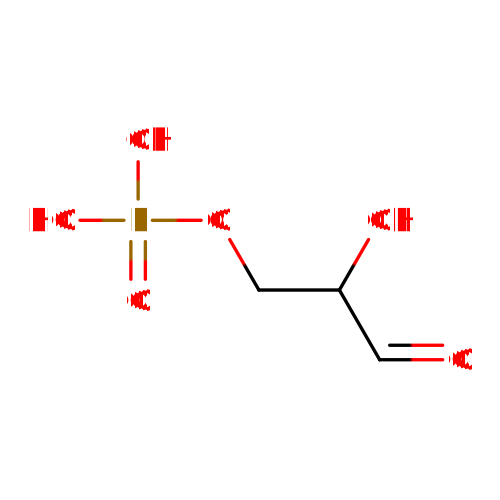
| Record Information |
|---|
| Version | 2.0 |
|---|
| Created at | 2022-02-14 20:49:42 UTC |
|---|
| Updated at | 2022-03-10 22:30:19 UTC |
|---|
| NP-MRD ID | NP0044384 |
|---|
| Secondary Accession Numbers | None |
|---|
| Natural Product Identification |
|---|
| Common Name | D-Glyceraldehyde 3-phosphate |
|---|
| Description | D-Glyceraldehyde 3-phosphate, also known as 3-phosphoglyceraldehyde or GAP, belongs to the class of organic compounds known as glyceraldehyde-3-phosphates. Glyceraldehyde-3-phosphates are compounds containing a glyceraldehyde substituted at position O3 by a phosphate group. This is the process by which glycerol (as DHAP) enters the glycolytic and gluconeogenesis pathways. G3P is formed from fructose 1,6-bisphosphate, dihydroxyacetone phosphate (DHAP), and 1,3-bisphosphoglycerate (1,3BPG). D-Glyceraldehyde 3-phosphate is an extremely weak basic (essentially neutral) compound (based on its pKa). D-Glyceraldehyde 3-phosphate (G3P) or triose phosphate is an aldotriose, an important metabolic intermediate in both glycolysis and gluconeogenesis, and in tryptophan biosynthesis. D-Glyceraldehyde 3-phosphate exists in all living species, ranging from bacteria to humans. In humans, glyceraldehyde 3-phosphate is involved in the metabolic disorder called the transaldolase deficiency pathway. D-Glyceraldehyde 3-phosphate is expected to be in Cannabis as all living plants are known to produce and metabolize it. |
|---|
| Structure | InChI=1S/C3H7O6P/c4-1-3(5)2-9-10(6,7)8/h1,3,5H,2H2,(H2,6,7,8) |
|---|
| Synonyms | | Value | Source |
|---|
| 2-Hydroxy-3-(phosphonooxy)propanal | ChEBI | | 3-Phosphoglyceraldehyde | ChEBI | | DL-Glyceraldehyde 3-phosphate | ChEBI | | GAP | ChEBI | | Gliceraldehido-3-fosfato | ChEBI | | Glyceraldehyde 3-(dihydrogen phosphate) | ChEBI | | Glyceraldehyde-3-phosphate | ChEBI | | Glycerinaldehyd-3-phosphat | ChEBI | | Glyzerinaldehyd-3-phosphat | ChEBI | | DL-Glyceraldehyde 3-phosphoric acid | Generator | | Glyceraldehyde 3-(dihydrogen phosphoric acid) | Generator | | Glyceraldehyde-3-phosphoric acid | Generator | | Glyceraldehyde 3-phosphoric acid | Generator | | D-Glyceraldehyde 3-phosphoric acid | HMDB | | 2-Hydroxy-3-(phosphonooxy)-propanal | HMDB | | D-Glyceraldehyde-3-p | HMDB | | Glyceraldehyde-3-p | HMDB | | Glyceraldehyde-p | HMDB | | Glyceraldehyde-phosphate | HMDB | | 3 Phosphoglyceraldehyde | HMDB | | Glyceraldehyde 3 phosphate | HMDB | | Glyceraldehyde 3-phosphate | MeSH, HMDB |
|
|---|
| Chemical Formula | C3H7O6P |
|---|
| Average Mass | 170.0578 Da |
|---|
| Monoisotopic Mass | 169.99802 Da |
|---|
| IUPAC Name | (2-hydroxy-3-oxopropoxy)phosphonic acid |
|---|
| Traditional Name | glyceraldehyde 3 phosphate |
|---|
| CAS Registry Number | 91469-44-2 |
|---|
| SMILES | OC(COP(O)(O)=O)C=O |
|---|
| InChI Identifier | InChI=1S/C3H7O6P/c4-1-3(5)2-9-10(6,7)8/h1,3,5H,2H2,(H2,6,7,8) |
|---|
| InChI Key | LXJXRIRHZLFYRP-UHFFFAOYSA-N |
|---|
| Experimental Spectra |
|---|
|
| Not Available | | Predicted Spectra |
|---|
|
| | Spectrum Type | Description | Depositor ID | Depositor Organization | Depositor | Deposition Date | View |
|---|
| 1D NMR | 13C NMR Spectrum (1D, 25 MHz, D2O, predicted) | Wishart Lab | Wishart Lab | David Wishart | 2021-06-20 | View Spectrum | | 1D NMR | 1H NMR Spectrum (1D, 100 MHz, D2O, predicted) | Wishart Lab | Wishart Lab | David Wishart | 2021-06-20 | View Spectrum | | 1D NMR | 13C NMR Spectrum (1D, 252 MHz, D2O, predicted) | Wishart Lab | Wishart Lab | David Wishart | 2021-06-20 | View Spectrum | | 1D NMR | 1H NMR Spectrum (1D, 1000 MHz, D2O, predicted) | Wishart Lab | Wishart Lab | David Wishart | 2021-06-20 | View Spectrum | | 1D NMR | 13C NMR Spectrum (1D, 50 MHz, D2O, predicted) | Wishart Lab | Wishart Lab | David Wishart | 2021-06-20 | View Spectrum | | 1D NMR | 1H NMR Spectrum (1D, 200 MHz, D2O, predicted) | Wishart Lab | Wishart Lab | David Wishart | 2021-06-20 | View Spectrum | | 1D NMR | 13C NMR Spectrum (1D, 75 MHz, D2O, predicted) | Wishart Lab | Wishart Lab | David Wishart | 2021-06-20 | View Spectrum | | 1D NMR | 1H NMR Spectrum (1D, 300 MHz, D2O, predicted) | Wishart Lab | Wishart Lab | David Wishart | 2021-06-20 | View Spectrum | | 1D NMR | 13C NMR Spectrum (1D, 101 MHz, D2O, predicted) | Wishart Lab | Wishart Lab | David Wishart | 2021-06-20 | View Spectrum | | 1D NMR | 1H NMR Spectrum (1D, 400 MHz, D2O, predicted) | Wishart Lab | Wishart Lab | David Wishart | 2021-06-20 | View Spectrum | | 1D NMR | 13C NMR Spectrum (1D, 126 MHz, D2O, predicted) | Wishart Lab | Wishart Lab | David Wishart | 2021-06-20 | View Spectrum | | 1D NMR | 1H NMR Spectrum (1D, 500 MHz, D2O, predicted) | Wishart Lab | Wishart Lab | David Wishart | 2021-06-20 | View Spectrum | | 1D NMR | 13C NMR Spectrum (1D, 151 MHz, D2O, predicted) | Wishart Lab | Wishart Lab | David Wishart | 2021-06-20 | View Spectrum | | 1D NMR | 1H NMR Spectrum (1D, 600 MHz, D2O, predicted) | Wishart Lab | Wishart Lab | David Wishart | 2021-06-20 | View Spectrum | | 1D NMR | 13C NMR Spectrum (1D, 176 MHz, D2O, predicted) | Wishart Lab | Wishart Lab | David Wishart | 2021-06-20 | View Spectrum | | 1D NMR | 1H NMR Spectrum (1D, 700 MHz, D2O, predicted) | Wishart Lab | Wishart Lab | David Wishart | 2021-06-20 | View Spectrum | | 1D NMR | 13C NMR Spectrum (1D, 201 MHz, D2O, predicted) | Wishart Lab | Wishart Lab | David Wishart | 2021-06-20 | View Spectrum | | 1D NMR | 1H NMR Spectrum (1D, 800 MHz, D2O, predicted) | Wishart Lab | Wishart Lab | David Wishart | 2021-06-20 | View Spectrum | | 1D NMR | 13C NMR Spectrum (1D, 226 MHz, D2O, predicted) | Wishart Lab | Wishart Lab | David Wishart | 2021-06-20 | View Spectrum | | 1D NMR | 1H NMR Spectrum (1D, 900 MHz, D2O, predicted) | Wishart Lab | Wishart Lab | David Wishart | 2021-06-20 | View Spectrum |
| | Chemical Shift Submissions |
|---|
|
| Not Available | | Species |
|---|
| Species of Origin | |
|---|
| Chemical Taxonomy |
|---|
| Description | Belongs to the class of organic compounds known as glyceraldehyde-3-phosphates. Glyceraldehyde-3-phosphates are compounds containing a glyceraldehyde substituted at position O3 by a phosphate group. |
|---|
| Kingdom | Organic compounds |
|---|
| Super Class | Organic oxygen compounds |
|---|
| Class | Organooxygen compounds |
|---|
| Sub Class | Carbohydrates and carbohydrate conjugates |
|---|
| Direct Parent | Glyceraldehyde-3-phosphates |
|---|
| Alternative Parents | |
|---|
| Substituents | - Glyceraldehyde-3-phosphate
- Monoalkyl phosphate
- Alkyl phosphate
- Phosphoric acid ester
- Organic phosphoric acid derivative
- Alpha-hydroxyaldehyde
- Secondary alcohol
- Organic oxide
- Hydrocarbon derivative
- Carbonyl group
- Aldehyde
- Alcohol
- Aliphatic acyclic compound
|
|---|
| Molecular Framework | Aliphatic acyclic compounds |
|---|
| External Descriptors | |
|---|
| Physical Properties |
|---|
| State | Not Available |
|---|
| Experimental Properties | | Property | Value | Reference |
|---|
| Melting Point | Not Available | Not Available | | Boiling Point | Not Available | Not Available | | Water Solubility | Not Available | Not Available | | LogP | Not Available | Not Available |
|
|---|
| Predicted Properties | |
|---|