| Record Information |
|---|
| Version | 2.0 |
|---|
| Created at | 2021-06-22 17:42:52 UTC |
|---|
| Updated at | 2026-02-09 04:01:13 UTC |
|---|
| NP-MRD ID | NP0043959 |
|---|
| Natural Product DOI | https://doi.org/10.57994/5880 |
|---|
| Secondary Accession Numbers | None |
|---|
| Natural Product Identification |
|---|
| Common Name | Retusin |
|---|
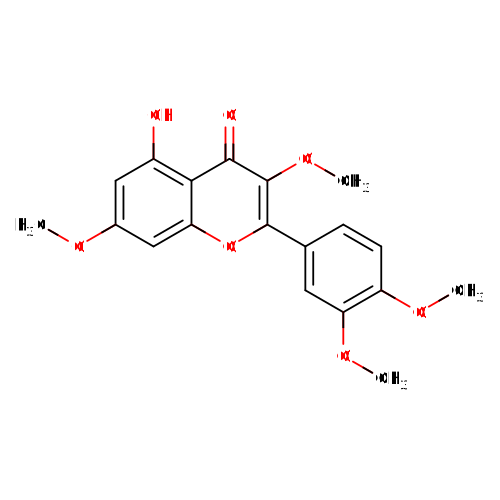
| Description | Retusin belongs to the class of organic compounds known as 7-o-methylated flavonoids. These are flavonoids with methoxy groups attached to the C7 atom of the flavonoid backbone. Thus, retusin is considered to be a flavonoid. Retusin is a secondary metabolite. Secondary metabolites are metabolically or physiologically non-essential metabolites that may serve a role as defense or signalling molecules. In some cases they are simply molecules that arise from the incomplete metabolism of other secondary metabolites. Retusin was first documented in 2017 (PMID: 28572959). Based on a literature review a small amount of articles have been published on Retusin (PMID: 34305198) (PMID: 32148963) (PMID: 28572953). |
|---|
| Structure | |
|---|
| Synonyms | | Value | Source |
|---|
| 2-(3,4-Dimethoxyphenyl)-5-hydroxy-3,7-dimethoxy-4H-1-benzopyran-4-one | ChEBI | | 3,3',4',7-O-Tetramethylquercetin | ChEBI | | 3,3',4',7-Tetramethylquercetin | ChEBI | | 3,7,3',4'-Tetramethylquercetin | ChEBI | | Quercetin 3,3',4',7-tetramethyl ether | ChEBI | | Quercetin 3,7,3',4'-tetramethyl ether | ChEBI | | Retusine | ChEBI | | 5-Hydroxy-3,7,3',4'-tetramethoxyflavone | HMDB | | 3,7,3',4'-Tetra-O-methylquercetin | HMDB | | Retusin | ChEBI |
|
|---|
| Chemical Formula | C19H18O7 |
|---|
| Average Mass | 358.3420 Da |
|---|
| Monoisotopic Mass | 358.10525 Da |
|---|
| IUPAC Name | Not Available |
|---|
| Traditional Name | Not Available |
|---|
| CAS Registry Number | Not Available |
|---|
| SMILES | Not Available |
|---|
| InChI Identifier | InChI=1S/C19H18O7/c1-22-11-8-12(20)16-15(9-11)26-18(19(25-4)17(16)21)10-5-6-13(23-2)14(7-10)24-3/h5-9,20H,1-4H3 |
|---|
| InChI Key | HHGPYJLEJGNWJA-UHFFFAOYSA-N |
|---|
| Experimental Spectra |
|---|
|
| | Spectrum Type | Description | Depositor Email | Depositor Organization | Depositor | Deposition Date | View |
|---|
| | Predicted Spectra |
|---|
|
| Not Available | | Chemical Shift Submissions |
|---|
|
| | Spectrum Type | Description | Depositor Email | Depositor Organization | Depositor | Deposition Date | View |
|---|
| 1D NMR | 1H NMR Spectrum (1D, 500.0, Chloroform-d, simulated) | [email protected] | Not Available | Not Available | 2026-02-09 | View Spectrum | | 1D NMR | 13C NMR Spectrum (1D, 125.0, Chloroform-d, simulated) | [email protected] | Not Available | Not Available | 2026-02-09 | View Spectrum | | 1D NMR | 13C NMR Spectrum (1D, 125.0, Chloroform-d, simulated) | [email protected] | Not Available | Not Available | 2026-02-09 | View Spectrum | | 1D NMR | 13C NMR Spectrum (1D, 125.0, Chloroform-d, simulated) | [email protected] | Not Available | Not Available | 2026-02-09 | View Spectrum |
| | Species |
|---|
| Species of Origin | |
|---|
| Chemical Taxonomy |
|---|
| Description | Belongs to the class of organic compounds known as 7-o-methylated flavonoids. These are flavonoids with methoxy groups attached to the C7 atom of the flavonoid backbone. |
|---|
| Kingdom | Organic compounds |
|---|
| Super Class | Phenylpropanoids and polyketides |
|---|
| Class | Flavonoids |
|---|
| Sub Class | O-methylated flavonoids |
|---|
| Direct Parent | 7-O-methylated flavonoids |
|---|
| Alternative Parents | |
|---|
| Substituents | - 3p-methoxyflavonoid-skeleton
- 3-methoxyflavonoid-skeleton
- 4p-methoxyflavonoid-skeleton
- 7-methoxyflavonoid-skeleton
- Hydroxyflavonoid
- Flavone
- 5-hydroxyflavonoid
- 3-methoxychromone
- Chromone
- 1-benzopyran
- Benzopyran
- Dimethoxybenzene
- O-dimethoxybenzene
- Anisole
- Phenoxy compound
- Phenol ether
- Methoxybenzene
- 1-hydroxy-4-unsubstituted benzenoid
- 1-hydroxy-2-unsubstituted benzenoid
- Alkyl aryl ether
- Pyranone
- Monocyclic benzene moiety
- Benzenoid
- Pyran
- Vinylogous acid
- Heteroaromatic compound
- Organoheterocyclic compound
- Oxacycle
- Ether
- Organic oxide
- Organic oxygen compound
- Hydrocarbon derivative
- Organooxygen compound
- Aromatic heteropolycyclic compound
|
|---|
| Molecular Framework | Aromatic heteropolycyclic compounds |
|---|
| External Descriptors | |
|---|
| Physical Properties |
|---|
| State | Not Available |
|---|
| Experimental Properties | | Property | Value | Reference |
|---|
| Melting Point | Not Available | Not Available | | Boiling Point | Not Available | Not Available | | Water Solubility | Not Available | Not Available | | LogP | Not Available | Not Available |
|
|---|
| Predicted Properties | Not Available |
|---|
| General References | - Leal CM, Leitao SG, Sausset R, Mendonca SC, Nascimento PHA, de Araujo R Cheohen CF, Esteves MEA, Leal da Silva M, Gondim TS, Monteiro MES, Tucci AR, Fintelman-Rodrigues N, Siqueira MM, Miranda MD, Costa FN, Simas RC, Leitao GG: Flavonoids from Siparuna cristata as Potential Inhibitors of SARS-CoV-2 Replication. Rev Bras Farmacogn. 2021 Jul 20:1-9. doi: 10.1007/s43450-021-00162-5. [PubMed:34305198 ]
- Phan MG, Do TVH, Nguyen QB: Methylated Flavonols from Amomum koenigii J.F.Gmel. and Their Antimicrobial and Antioxidant Activities. Biochem Res Int. 2020 Feb 18;2020:4812312. doi: 10.1155/2020/4812312. eCollection 2020. [PubMed:32148963 ]
- Ikewuchi CC, Ikewuchi JC, Ifeanacho MO: Bioactive phytochemicals in an aqueous extract of the leaves of Talinum triangulare. Food Sci Nutr. 2016 Dec 2;5(3):696-701. doi: 10.1002/fsn3.449. eCollection 2017 May. [PubMed:28572959 ]
- Ifeanacho MO, Ikewuchi CC, Ikewuchi JC: Investigation of the profile of phenolic compounds in the leaves and stems of Pandiaka heudelotii using gas chromatography coupled with flame ionization detector. Food Sci Nutr. 2016 Nov 23;5(3):646-652. doi: 10.1002/fsn3.443. eCollection 2017 May. [PubMed:28572953 ]
- Lai-King Sy, Geoffrey D. Brown (1998). Lai-King Sy, Geoffrey D. Brown. Three sesquiterpenes from Artemisia annua. Phytochemistry Volume 48, Issue 7, August 1998, Pages 1207-1211 DOI: 10.1016/S0031-9422(97)01047-9. Phytochemistry.
- DOI: 10.1016/s0031-9422(98)00622-0
|
|---|