| Record Information |
|---|
| Version | 2.0 |
|---|
| Created at | 2021-06-22 17:24:47 UTC |
|---|
| Updated at | 2021-06-22 17:24:48 UTC |
|---|
| NP-MRD ID | NP0043831 |
|---|
| Secondary Accession Numbers | None |
|---|
| Natural Product Identification |
|---|
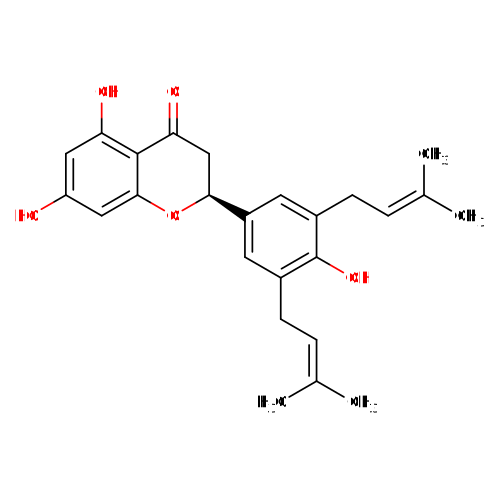
| Common Name | Abyssinone V |
|---|
| Description | Abyssinone V belongs to the class of organic compounds known as 3'-prenylated flavanones. These are flavanones that features a C5-isoprenoid substituent at the 3'-position. Thus, abyssinone V is considered to be a flavonoid. Abyssinone V is a secondary metabolite. Secondary metabolites are metabolically or physiologically non-essential metabolites that may serve a role as defense or signalling molecules. In some cases they are simply molecules that arise from the incomplete metabolism of other secondary metabolites. Abyssinone V is found in Azadirachta indica, Erythrina burttii, Erythrina mildbraedii, Maackia amurensis and Trypanosoma brucei. Abyssinone V was first documented in 2000 (PMID: 11140607). Based on a literature review a significant number of articles have been published on abyssinone V (PMID: 18171023) (PMID: 30793315) (PMID: 32774424) (PMID: 32365905) (PMID: 30105067) (PMID: 27257160). |
|---|
| Structure | CC(C)=CCC1=CC(=CC(CC=C(C)C)=C1O)[C@@H]1CC(=O)C2=C(O)C=C(O)C=C2O1 InChI=1S/C25H28O5/c1-14(2)5-7-16-9-18(10-17(25(16)29)8-6-15(3)4)22-13-21(28)24-20(27)11-19(26)12-23(24)30-22/h5-6,9-12,22,26-27,29H,7-8,13H2,1-4H3/t22-/m0/s1 |
|---|
| Synonyms | | Value | Source |
|---|
| Abyssinone-V | ChEBI |
|
|---|
| Chemical Formula | C25H28O5 |
|---|
| Average Mass | 408.4940 Da |
|---|
| Monoisotopic Mass | 408.19367 Da |
|---|
| IUPAC Name | (2S)-5,7-dihydroxy-2-[4-hydroxy-3,5-bis(3-methylbut-2-en-1-yl)phenyl]-3,4-dihydro-2H-1-benzopyran-4-one |
|---|
| Traditional Name | abyssinone V |
|---|
| CAS Registry Number | Not Available |
|---|
| SMILES | CC(C)=CCC1=CC(=CC(CC=C(C)C)=C1O)[C@@H]1CC(=O)C2=C(O)C=C(O)C=C2O1 |
|---|
| InChI Identifier | InChI=1S/C25H28O5/c1-14(2)5-7-16-9-18(10-17(25(16)29)8-6-15(3)4)22-13-21(28)24-20(27)11-19(26)12-23(24)30-22/h5-6,9-12,22,26-27,29H,7-8,13H2,1-4H3/t22-/m0/s1 |
|---|
| InChI Key | LQHKFMYWTKORCE-QFIPXVFZSA-N |
|---|
| Experimental Spectra |
|---|
|
| | Spectrum Type | Description | Depositor Email | Depositor Organization | Depositor | Deposition Date | View |
|---|
| 1D NMR | 13C NMR Spectrum (1D, 75 MHz, Chloroform-d, simulated) | Wishart Lab | Wishart Lab | David Wishart | 2021-06-20 | View Spectrum | | 1D NMR | 1H NMR Spectrum (1D, 300 MHz, Chloroform-d, simulated) | Wishart Lab | Wishart Lab | David Wishart | 2021-06-20 | View Spectrum | | 1D NMR | 13C NMR Spectrum (1D, 50 MHz, Chloroform-d, simulated) | Wishart Lab | Wishart Lab | David Wishart | 2021-06-20 | View Spectrum | | 1D NMR | 13C NMR Spectrum (1D, 150 MHz, Chloroform-d, simulated) | Wishart Lab | Wishart Lab | David Wishart | 2021-06-20 | View Spectrum | | 1D NMR | 13C NMR Spectrum (1D, 250 MHz, Chloroform-d, simulated) | Wishart Lab | Wishart Lab | David Wishart | 2021-06-20 | View Spectrum | | 1D NMR | 13C NMR Spectrum (1D, 175 MHz, Chloroform-d, simulated) | Wishart Lab | Wishart Lab | David Wishart | 2021-06-20 | View Spectrum | | 1D NMR | 13C NMR Spectrum (1D, 100 MHz, Chloroform-d, simulated) | Wishart Lab | Wishart Lab | David Wishart | 2021-06-20 | View Spectrum | | 1D NMR | 13C NMR Spectrum (1D, 225 MHz, Chloroform-d, simulated) | Wishart Lab | Wishart Lab | David Wishart | 2021-06-20 | View Spectrum | | 1D NMR | 13C NMR Spectrum (1D, 200 MHz, Chloroform-d, simulated) | Wishart Lab | Wishart Lab | David Wishart | 2021-06-20 | View Spectrum | | 1D NMR | 13C NMR Spectrum (1D, 125 MHz, Chloroform-d, simulated) | Wishart Lab | Wishart Lab | David Wishart | 2021-06-20 | View Spectrum | | 1D NMR | 13C NMR Spectrum (1D, 25 MHz, Chloroform-d, simulated) | Wishart Lab | Wishart Lab | David Wishart | 2021-06-20 | View Spectrum | | 1D NMR | 1H NMR Spectrum (1D, 900 MHz, Chloroform-d, simulated) | Wishart Lab | Wishart Lab | David Wishart | 2021-06-20 | View Spectrum | | 1D NMR | 1H NMR Spectrum (1D, 700 MHz, Chloroform-d, simulated) | Wishart Lab | Wishart Lab | David Wishart | 2021-06-20 | View Spectrum | | 1D NMR | 1H NMR Spectrum (1D, 400 MHz, Chloroform-d, simulated) | Wishart Lab | Wishart Lab | David Wishart | 2021-06-20 | View Spectrum | | 1D NMR | 1H NMR Spectrum (1D, 100 MHz, Chloroform-d, simulated) | Wishart Lab | Wishart Lab | David Wishart | 2021-06-20 | View Spectrum | | 1D NMR | 1H NMR Spectrum (1D, 500 MHz, Chloroform-d, simulated) | Wishart Lab | Wishart Lab | David Wishart | 2021-06-20 | View Spectrum | | 1D NMR | 1H NMR Spectrum (1D, 1000 MHz, Chloroform-d, simulated) | Wishart Lab | Wishart Lab | David Wishart | 2021-06-20 | View Spectrum | | 1D NMR | 1H NMR Spectrum (1D, 800 MHz, Chloroform-d, simulated) | Wishart Lab | Wishart Lab | David Wishart | 2021-06-20 | View Spectrum | | 1D NMR | 1H NMR Spectrum (1D, 200 MHz, Chloroform-d, simulated) | Wishart Lab | Wishart Lab | David Wishart | 2021-06-20 | View Spectrum | | 1D NMR | 1H NMR Spectrum (1D, 600 MHz, Chloroform-d, simulated) | Wishart Lab | Wishart Lab | David Wishart | 2021-06-20 | View Spectrum |
| | Predicted Spectra |
|---|
|
| Not Available | | Chemical Shift Submissions |
|---|
|
| Not Available | | Species |
|---|
| Species of Origin | |
|---|
| Chemical Taxonomy |
|---|
| Description | Belongs to the class of organic compounds known as 3'-prenylated flavanones. These are flavanones that features a C5-isoprenoid substituent at the 3'-position. |
|---|
| Kingdom | Organic compounds |
|---|
| Super Class | Phenylpropanoids and polyketides |
|---|
| Class | Flavonoids |
|---|
| Sub Class | Flavans |
|---|
| Direct Parent | 3'-prenylated flavanones |
|---|
| Alternative Parents | |
|---|
| Substituents | - 3'-prenylated flavanone
- 4'-hydroxyflavonoid
- 5-hydroxyflavonoid
- 7-hydroxyflavonoid
- Flavanone
- Hydroxyflavonoid
- Chromone
- Chromane
- Benzopyran
- 1-benzopyran
- Aryl alkyl ketone
- Aryl ketone
- 1-hydroxy-4-unsubstituted benzenoid
- 1-hydroxy-2-unsubstituted benzenoid
- Alkyl aryl ether
- Phenol
- Monocyclic benzene moiety
- Benzenoid
- Vinylogous acid
- Ketone
- Organoheterocyclic compound
- Ether
- Oxacycle
- Hydrocarbon derivative
- Organic oxide
- Organooxygen compound
- Organic oxygen compound
- Aromatic heteropolycyclic compound
|
|---|
| Molecular Framework | Aromatic heteropolycyclic compounds |
|---|
| External Descriptors | |
|---|
| Physical Properties |
|---|
| State | Not Available |
|---|
| Experimental Properties | | Property | Value | Reference |
|---|
| Melting Point | Not Available | Not Available | | Boiling Point | Not Available | Not Available | | Water Solubility | Not Available | Not Available | | LogP | Not Available | Not Available |
|
|---|
| Predicted Properties | |
|---|
| General References | - Yenesew A, Midiwo JO, Heydenreich M, Schanzenbach D, Peter MG: Two isoflavanones from the stem bark of Erythrina sacleuxii. Phytochemistry. 2000 Nov;55(5):457-9. doi: 10.1016/s0031-9422(00)00349-6. [PubMed:11140607 ]
- Rukachaisirikul T, Innok P, Suksamrarn A: Erythrina alkaloids and a pterocarpan from the bark of Erythrina subumbrans. J Nat Prod. 2008 Jan;71(1):156-8. doi: 10.1021/np070506w. Epub 2008 Jan 3. [PubMed:18171023 ]
- Koch K, Schulz G, Doring W, Buchter C, Havermann S, Mutiso PC, Passreiter C, Watjen W: Abyssinone V, a prenylated flavonoid isolated from the stem bark of Erythrina melanacantha increases oxidative stress and decreases stress resistance in Caenorhabditis elegans. J Pharm Pharmacol. 2019 Jun;71(6):1007-1016. doi: 10.1111/jphp.13074. Epub 2019 Feb 21. [PubMed:30793315 ]
- Zingue S, Gbaweng Yaya AJ, Cisilotto J, Kenmogne LV, Talla E, Bishayee A, Njamen D, Creczynski-Pasa TB, Ndinteh DT: Abyssinone V-4' Methyl Ether, a Flavanone Isolated from Erythrina droogmansiana, Exhibits Cytotoxic Effects on Human Breast Cancer Cells by Induction of Apoptosis and Suppression of Invasion. Evid Based Complement Alternat Med. 2020 Jul 22;2020:6454853. doi: 10.1155/2020/6454853. eCollection 2020. [PubMed:32774424 ]
- Sadgrove NJ, Oliveira TB, Khumalo GP, Vuuren SFV, van Wyk BE: Antimicrobial Isoflavones and Derivatives from Erythrina (Fabaceae): Structure Activity Perspective (Sar & Qsar) on Experimental and Mined Values Against Staphylococcus Aureus. Antibiotics (Basel). 2020 Apr 30;9(5). pii: antibiotics9050223. doi: 10.3390/antibiotics9050223. [PubMed:32365905 ]
- Tueche AB, Zingue S, Tchoupang EN, Gueyo TN, Gbaweng Yaya AJ, Njuh AN, Ntsa DM, Njamen D: Abyssinone V-4' Methyl Ether Isolated from Erythrina droogmansiana (Leguminosae) Inhibits Cell Growth and Mammary Glands Hyperplasia Induced in Swiss Mice by the 7,12-Dimethylbenz(a)anthracene. Evid Based Complement Alternat Med. 2018 Jul 11;2018:7959068. doi: 10.1155/2018/7959068. eCollection 2018. [PubMed:30105067 ]
- Grienke U, Richter M, Walther E, Hoffmann A, Kirchmair J, Makarov V, Nietzsche S, Schmidtke M, Rollinger JM: Discovery of prenylated flavonoids with dual activity against influenza virus and Streptococcus pneumoniae. Sci Rep. 2016 Jun 3;6:27156. doi: 10.1038/srep27156. [PubMed:27257160 ]
- Mvondo MA, Njamen D, Kretzschmar G, Imma Bader M, Tanee Fomum S, Wandji J, Vollmer G: Alpinumisoflavone and abyssinone V 4'-methylether derived from Erythrina lysistemon (Fabaceae) promote HDL-cholesterol synthesis and prevent cholesterol gallstone formation in ovariectomized rats. J Pharm Pharmacol. 2015 Jul;67(7):990-6. doi: 10.1111/jphp.12386. Epub 2015 Feb 14. [PubMed:25683903 ]
|
|---|