| Record Information |
|---|
| Version | 2.0 |
|---|
| Created at | 2021-06-20 21:48:40 UTC |
|---|
| Updated at | 2021-06-30 00:12:38 UTC |
|---|
| NP-MRD ID | NP0039355 |
|---|
| Secondary Accession Numbers | None |
|---|
| Natural Product Identification |
|---|
| Common Name | atalantoflavone |
|---|
| Provided By | JEOL Database |
|---|
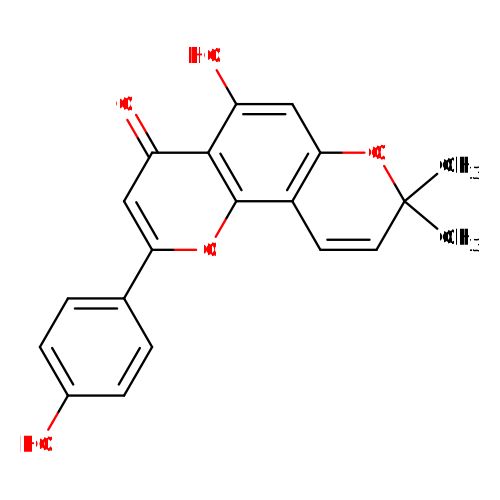
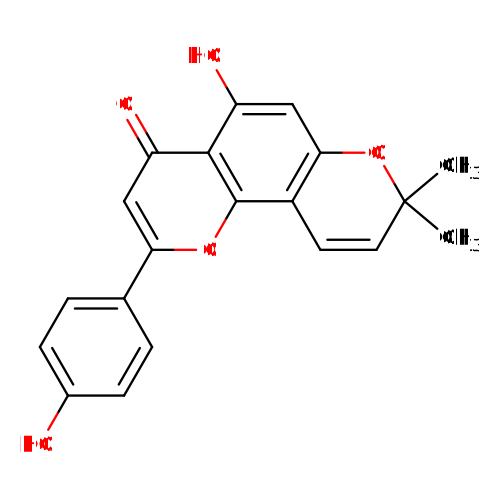
| Description | Atalantoflavone, also known as limonianin, belongs to the class of organic compounds known as pyranoflavonoids. Pyranoflavonoids are compounds containing a pyran ring fused to a 2-phenyl-1,4-benzopyran skeleton. Thus, atalantoflavone is considered to be a flavonoid. atalantoflavone is found in Atalantia buxifolia, Citrus limon, Citrus medica, Citrus sinensis, Citrus trifoliata, Severinia buxi and Ulex europaeus. atalantoflavone was first documented in 2013 (PMID: 24066509). Based on a literature review a significant number of articles have been published on Atalantoflavone (PMID: 25114960) (PMID: 30755289) (PMID: 29600742) (PMID: 26715029) (PMID: 25034000) (PMID: 23057815). |
|---|
| Structure | [H]OC1=C([H])C([H])=C(C([H])=C1[H])C1=C([H])C(=O)C2=C(O[H])C([H])=C3OC(C([H])=C([H])C3=C2O1)(C([H])([H])[H])C([H])([H])[H] InChI=1S/C20H16O5/c1-20(2)8-7-13-17(25-20)10-15(23)18-14(22)9-16(24-19(13)18)11-3-5-12(21)6-4-11/h3-10,21,23H,1-2H3 |
|---|
| Synonyms | | Value | Source |
|---|
| 5-Hydroxy-2-(4-hydroxyphenyl)-8,8-dimethyl-4H,8H-benzo[1,2-b:3,4-b']dipyran-4-one, 9ci | HMDB | | Limonianin | HMDB |
|
|---|
| Chemical Formula | C20H16O5 |
|---|
| Average Mass | 336.3380 Da |
|---|
| Monoisotopic Mass | 336.09977 Da |
|---|
| IUPAC Name | 5-hydroxy-2-(4-hydroxyphenyl)-8,8-dimethyl-4H,8H-pyrano[2,3-f]chromen-4-one |
|---|
| Traditional Name | atalantoflavone |
|---|
| CAS Registry Number | Not Available |
|---|
| SMILES | [H]OC1=C([H])C([H])=C(C([H])=C1[H])C1=C([H])C(=O)C2=C(O[H])C([H])=C3OC(C([H])=C([H])C3=C2O1)(C([H])([H])[H])C([H])([H])[H] |
|---|
| InChI Identifier | InChI=1S/C20H16O5/c1-20(2)8-7-13-17(25-20)10-15(23)18-14(22)9-16(24-19(13)18)11-3-5-12(21)6-4-11/h3-10,21,23H,1-2H3 |
|---|
| InChI Key | YEUHAZULDUVZLA-UHFFFAOYSA-N |
|---|
| Experimental Spectra |
|---|
|
| | Spectrum Type | Description | Depositor Email | Depositor Organization | Depositor | Deposition Date | View |
|---|
| 1D NMR | 13C NMR Spectrum (1D, 400 MHz, acetone-d6, simulated) | Wishart Lab | Wishart Lab | David Wishart | 2021-06-20 | View Spectrum | | 1D NMR | 1H NMR Spectrum (1D, 400 MHz, acetone-d6, simulated) | Wishart Lab | Wishart Lab | David Wishart | 2021-06-20 | View Spectrum | | 1D NMR | 13C NMR Spectrum (1D, 100 MHz, acetone-d6, simulated) | Wishart Lab | Wishart Lab | David Wishart | 2021-06-20 | View Spectrum | | 1D NMR | 1H NMR Spectrum (1D, 100 MHz, acetone-d6, simulated) | Wishart Lab | Wishart Lab | David Wishart | 2021-06-20 | View Spectrum | | 1D NMR | 13C NMR Spectrum (1D, 200 MHz, acetone-d6, simulated) | Wishart Lab | Wishart Lab | David Wishart | 2021-06-20 | View Spectrum | | 1D NMR | 1H NMR Spectrum (1D, 200 MHz, acetone-d6, simulated) | Wishart Lab | Wishart Lab | David Wishart | 2021-06-20 | View Spectrum | | 1D NMR | 13C NMR Spectrum (1D, 300 MHz, acetone-d6, simulated) | Wishart Lab | Wishart Lab | David Wishart | 2021-06-20 | View Spectrum | | 1D NMR | 1H NMR Spectrum (1D, 300 MHz, acetone-d6, simulated) | Wishart Lab | Wishart Lab | David Wishart | 2021-06-20 | View Spectrum | | 1D NMR | 13C NMR Spectrum (1D, 500 MHz, acetone-d6, simulated) | Wishart Lab | Wishart Lab | David Wishart | 2021-06-20 | View Spectrum | | 1D NMR | 1H NMR Spectrum (1D, 500 MHz, acetone-d6, simulated) | Wishart Lab | Wishart Lab | David Wishart | 2021-06-20 | View Spectrum | | 1D NMR | 13C NMR Spectrum (1D, 600 MHz, acetone-d6, simulated) | Wishart Lab | Wishart Lab | David Wishart | 2021-06-20 | View Spectrum | | 1D NMR | 1H NMR Spectrum (1D, 600 MHz, acetone-d6, simulated) | Wishart Lab | Wishart Lab | David Wishart | 2021-06-20 | View Spectrum | | 1D NMR | 13C NMR Spectrum (1D, 700 MHz, acetone-d6, simulated) | Wishart Lab | Wishart Lab | David Wishart | 2021-06-20 | View Spectrum | | 1D NMR | 1H NMR Spectrum (1D, 700 MHz, acetone-d6, simulated) | Wishart Lab | Wishart Lab | David Wishart | 2021-06-20 | View Spectrum | | 1D NMR | 13C NMR Spectrum (1D, 800 MHz, acetone-d6, simulated) | Wishart Lab | Wishart Lab | David Wishart | 2021-06-20 | View Spectrum | | 1D NMR | 1H NMR Spectrum (1D, 800 MHz, acetone-d6, simulated) | Wishart Lab | Wishart Lab | David Wishart | 2021-06-20 | View Spectrum | | 1D NMR | 13C NMR Spectrum (1D, 900 MHz, acetone-d6, simulated) | Wishart Lab | Wishart Lab | David Wishart | 2021-06-20 | View Spectrum | | 1D NMR | 1H NMR Spectrum (1D, 900 MHz, acetone-d6, simulated) | Wishart Lab | Wishart Lab | David Wishart | 2021-06-20 | View Spectrum | | 1D NMR | 13C NMR Spectrum (1D, 1000 MHz, acetone-d6, simulated) | Wishart Lab | Wishart Lab | David Wishart | 2021-06-20 | View Spectrum | | 1D NMR | 1H NMR Spectrum (1D, 1000 MHz, acetone-d6, simulated) | Wishart Lab | Wishart Lab | David Wishart | 2021-06-20 | View Spectrum |
| | Predicted Spectra |
|---|
|
| Not Available | | Chemical Shift Submissions |
|---|
|
| Not Available | | Species |
|---|
| Species of Origin | |
|---|
| Chemical Taxonomy |
|---|
| Description | Belongs to the class of organic compounds known as pyranoflavonoids. Pyranoflavonoids are compounds containing a pyran ring fused to a 2-phenyl-1,4-benzopyran skeleton. |
|---|
| Kingdom | Organic compounds |
|---|
| Super Class | Phenylpropanoids and polyketides |
|---|
| Class | Flavonoids |
|---|
| Sub Class | Pyranoflavonoids |
|---|
| Direct Parent | Pyranoflavonoids |
|---|
| Alternative Parents | Not Available |
|---|
| Substituents | Not Available |
|---|
| Molecular Framework | Aromatic heteropolycyclic compounds |
|---|
| External Descriptors | Not Available |
|---|
| Physical Properties |
|---|
| State | Not Available |
|---|
| Experimental Properties | | Property | Value | Reference |
|---|
| Melting Point | Not Available | Not Available | | Boiling Point | Not Available | Not Available | | Water Solubility | Not Available | Not Available | | LogP | Not Available | Not Available |
|
|---|
| Predicted Properties | |
|---|
| General References | - Ahmed SA, Kamel EM: Cytotoxic activities of flavonoids from Centaurea scoparia. ScientificWorldJournal. 2014;2014:274207. doi: 10.1155/2014/274207. Epub 2014 Jun 11. [PubMed:25114960 ]
- Lemos da Silva LA, Hoehr de Moraes M, Scotti MT, Scotti L, de Jesus Souza R, Nantchouang Ouete JL, Biavatti MW, Steindel M, Sandjo LP: Antiprotozoal investigation of 20 plant metabolites on Trypanosoma cruzi and Leishmania amazonensis amastigotes. Atalantoflavone alters the mitochondrial membrane potential. Parasitology. 2019 Jun;146(7):849-856. doi: 10.1017/S0031182019000052. Epub 2019 Feb 13. [PubMed:30755289 ]
- Posri P, Suthiwong J, Takomthong P, Wongsa C, Chuenban C, Boonyarat C, Yenjai C: A new flavonoid from the leaves of Atalantia monophylla (L.) DC. Nat Prod Res. 2019 Apr;33(8):1115-1121. doi: 10.1080/14786419.2018.1457667. Epub 2018 Mar 30. [PubMed:29600742 ]
- Djeussi DE, Sandjo LP, Noumedem JA, Omosa LK, T Ngadjui B, Kuete V: Antibacterial activities of the methanol extracts and compounds from Erythrina sigmoidea against Gram-negative multi-drug resistant phenotypes. BMC Complement Altern Med. 2015 Dec 30;15:453. doi: 10.1186/s12906-015-0978-8. [PubMed:26715029 ]
- Kuete V, Sandjo LP, Djeussi DE, Zeino M, Kwamou GM, Ngadjui B, Efferth T: Cytotoxic flavonoids and isoflavonoids from Erythrina sigmoidea towards multi-factorial drug resistant cancer cells. Invest New Drugs. 2014 Dec;32(6):1053-62. doi: 10.1007/s10637-014-0137-y. Epub 2014 Jul 19. [PubMed:25034000 ]
- Ouete JL, Sandjo LP, Kapche DW, Liermann JC, Opatz T, Simo IK, Ngadjui BT: A new flavone from the roots of Milicia excelsa (Moraceae). Z Naturforsch C J Biosci. 2013 Jul-Aug;68(7-8):259-63. [PubMed:24066509 ]
- Ndemangou B, Sielinou VT, Vardamides JC, Ali MS, Lateef M, Iqbal L, Afza N, Nkengfack AE: Urease inhibitory isoflavonoids from different parts of Calopogonium mucunoides (Fabaceae). J Enzyme Inhib Med Chem. 2013 Dec;28(6):1156-61. doi: 10.3109/14756366.2012.719025. Epub 2012 Oct 11. [PubMed:23057815 ]
- Bacher, M., et al. (2010). Bacher, M., et al, Mag. Reson. Chem. 48, 83 (2010). Mag. Reson. Chem..
|
|---|