| Record Information |
|---|
| Version | 2.0 |
|---|
| Created at | 2021-06-20 20:50:37 UTC |
|---|
| Updated at | 2021-06-30 00:10:38 UTC |
|---|
| NP-MRD ID | NP0038057 |
|---|
| Secondary Accession Numbers | None |
|---|
| Natural Product Identification |
|---|
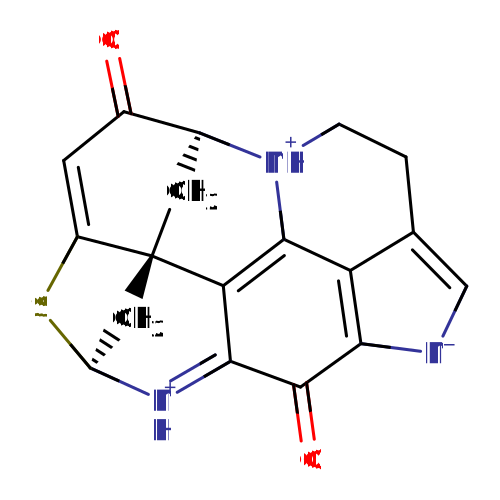
| Common Name | discorhabdin D |
|---|
| Provided By | JEOL Database |
|---|
| Description | discorhabdin D is found in Latrunculia bellae, Latrunculia brevis, Latrunculia sp., Prianos sp. and Strongylodesma algoaensis. discorhabdin D was first documented in 1988 (Perry, N. B., et al.). |
|---|
| Structure | [H]N1C([H])=C2C3=C1C(=O)C1=C4C3=[N+](C([H])([H])C2([H])[H])[C@]2([H])C(=O)C([H])=C3S[C@]([H])(N1[H])C([H])([H])[C@]43C2([H])[H] InChI=1S/C18H13N3O2S/c22-9-3-10-18-4-8(9)21-2-1-7-6-19-14-12(7)16(21)13(18)15(17(14)23)20-11(5-18)24-10/h3,6,8,11H,1-2,4-5H2,(H,19,20,23)/p+1/t8-,11-,18-/m0/s1 |
|---|
| Synonyms | Not Available |
|---|
| Chemical Formula | C18H14N3O2S |
|---|
| Average Mass | 336.3900 Da |
|---|
| Monoisotopic Mass | 336.08012 Da |
|---|
| IUPAC Name | (3R,5S,10S)-6,13-dioxo-9-thia-11,15,20lambda5-triazaheptacyclo[12.6.1.1^{3,10}.0^{2,12}.0^{3,8}.0^{5,20}.0^{17,21}]docosa-1(20),2(12),7,14(21),16-pentaen-20-ylium |
|---|
| Traditional Name | (3R,5S,10S)-6,13-dioxo-9-thia-11,15,20lambda5-triazaheptacyclo[12.6.1.1^{3,10}.0^{2,12}.0^{3,8}.0^{5,20}.0^{17,21}]docosa-1(20),2(12),7,14(21),16-pentaen-20-ylium |
|---|
| CAS Registry Number | Not Available |
|---|
| SMILES | [H]N1C([H])=C2C3=C1C(=O)C1=C4C3=[N+](C([H])([H])C2([H])[H])[C@]2([H])C(=O)C([H])=C3S[C@]([H])(N1[H])C([H])([H])[C@]43C2([H])[H] |
|---|
| InChI Identifier | InChI=1S/C18H13N3O2S/c22-9-3-10-18-4-8(9)21-2-1-7-6-19-14-12(7)16(21)13(18)15(17(14)23)20-11(5-18)24-10/h3,6,8,11H,1-2,4-5H2,(H,19,20,23)/p+1/t8-,11-,18-/m0/s1 |
|---|
| InChI Key | QYJUINXANIOBKV-XYVASLDOSA-O |
|---|
| Experimental Spectra |
|---|
|
| | Spectrum Type | Description | Depositor Email | Depositor Organization | Depositor | Deposition Date | View |
|---|
| 1D NMR | 13C NMR Spectrum (1D, 300 MHz, CD3OD (H) / DMSO-d6 (C), simulated) | Wishart Lab | Wishart Lab | David Wishart | 2021-06-20 | View Spectrum | | 1D NMR | 1H NMR Spectrum (1D, 300 MHz, CD3OD (H) / DMSO-d6 (C), simulated) | Wishart Lab | Wishart Lab | David Wishart | 2021-06-20 | View Spectrum | | 1D NMR | 13C NMR Spectrum (1D, 100 MHz, CD3OD (H) / DMSO-d6 (C), simulated) | Wishart Lab | Wishart Lab | David Wishart | 2021-06-20 | View Spectrum | | 1D NMR | 1H NMR Spectrum (1D, 100 MHz, CD3OD (H) / DMSO-d6 (C), simulated) | Wishart Lab | Wishart Lab | David Wishart | 2021-06-20 | View Spectrum | | 1D NMR | 13C NMR Spectrum (1D, 200 MHz, CD3OD (H) / DMSO-d6 (C), simulated) | Wishart Lab | Wishart Lab | David Wishart | 2021-06-20 | View Spectrum | | 1D NMR | 1H NMR Spectrum (1D, 200 MHz, CD3OD (H) / DMSO-d6 (C), simulated) | Wishart Lab | Wishart Lab | David Wishart | 2021-06-20 | View Spectrum | | 1D NMR | 13C NMR Spectrum (1D, 400 MHz, CD3OD (H) / DMSO-d6 (C), simulated) | Wishart Lab | Wishart Lab | David Wishart | 2021-06-20 | View Spectrum | | 1D NMR | 1H NMR Spectrum (1D, 400 MHz, CD3OD (H) / DMSO-d6 (C), simulated) | Wishart Lab | Wishart Lab | David Wishart | 2021-06-20 | View Spectrum | | 1D NMR | 13C NMR Spectrum (1D, 500 MHz, CD3OD (H) / DMSO-d6 (C), simulated) | Wishart Lab | Wishart Lab | David Wishart | 2021-06-20 | View Spectrum | | 1D NMR | 1H NMR Spectrum (1D, 500 MHz, CD3OD (H) / DMSO-d6 (C), simulated) | Wishart Lab | Wishart Lab | David Wishart | 2021-06-20 | View Spectrum | | 1D NMR | 13C NMR Spectrum (1D, 600 MHz, CD3OD (H) / DMSO-d6 (C), simulated) | Wishart Lab | Wishart Lab | David Wishart | 2021-06-20 | View Spectrum | | 1D NMR | 1H NMR Spectrum (1D, 600 MHz, CD3OD (H) / DMSO-d6 (C), simulated) | Wishart Lab | Wishart Lab | David Wishart | 2021-06-20 | View Spectrum | | 1D NMR | 13C NMR Spectrum (1D, 700 MHz, CD3OD (H) / DMSO-d6 (C), simulated) | Wishart Lab | Wishart Lab | David Wishart | 2021-06-20 | View Spectrum | | 1D NMR | 1H NMR Spectrum (1D, 700 MHz, CD3OD (H) / DMSO-d6 (C), simulated) | Wishart Lab | Wishart Lab | David Wishart | 2021-06-20 | View Spectrum | | 1D NMR | 13C NMR Spectrum (1D, 800 MHz, CD3OD (H) / DMSO-d6 (C), simulated) | Wishart Lab | Wishart Lab | David Wishart | 2021-06-20 | View Spectrum | | 1D NMR | 1H NMR Spectrum (1D, 800 MHz, CD3OD (H) / DMSO-d6 (C), simulated) | Wishart Lab | Wishart Lab | David Wishart | 2021-06-20 | View Spectrum | | 1D NMR | 13C NMR Spectrum (1D, 900 MHz, CD3OD (H) / DMSO-d6 (C), simulated) | Wishart Lab | Wishart Lab | David Wishart | 2021-06-20 | View Spectrum | | 1D NMR | 1H NMR Spectrum (1D, 900 MHz, CD3OD (H) / DMSO-d6 (C), simulated) | Wishart Lab | Wishart Lab | David Wishart | 2021-06-20 | View Spectrum | | 1D NMR | 13C NMR Spectrum (1D, 1000 MHz, CD3OD (H) / DMSO-d6 (C), simulated) | Wishart Lab | Wishart Lab | David Wishart | 2021-06-20 | View Spectrum | | 1D NMR | 1H NMR Spectrum (1D, 1000 MHz, CD3OD (H) / DMSO-d6 (C), simulated) | Wishart Lab | Wishart Lab | David Wishart | 2021-06-20 | View Spectrum |
| | Predicted Spectra |
|---|
|
| Not Available | | Chemical Shift Submissions |
|---|
|
| Not Available | | Species |
|---|
| Species of Origin | | Species Name | Source | Reference |
|---|
| Latrunculia bellae | - | | | Latrunculia brevis | JEOL database | - Perry, N. B., et al, J. Org. Chem. 53, 4127 (1988)
| | Latrunculia sp. | - | | | Prianos sp. | JEOL database | - Perry, N. B., et al, J. Org. Chem. 53, 4127 (1988)
| | Strongylodesma algoaensis | - | |
|
|---|
| Chemical Taxonomy |
|---|
| Description | Belongs to the class of organic compounds known as phenanthrolines. These are aromatic polycyclic compounds containing the phenanthroline skeleton, which is a derivative of phenanthrene, and consists of two pyridine rings non-linearly joined by a benzene ring. |
|---|
| Kingdom | Organic compounds |
|---|
| Super Class | Organoheterocyclic compounds |
|---|
| Class | Phenanthrolines |
|---|
| Sub Class | Not Available |
|---|
| Direct Parent | Phenanthrolines |
|---|
| Alternative Parents | |
|---|
| Substituents | - 1,7-phenanthroline
- Pyrrolo[4,3,2-de]quinoline
- Pyrroloquinoline
- Naphthyridine
- Indole or derivatives
- Aryl ketone
- Cyclohexenone
- Tetrahydropyridine
- Vinylogous thioester
- Heteroaromatic compound
- Thiolane
- Pyrrole
- Thioenolether
- Ketone
- Azacycle
- Hemithioaminal
- Enamine
- Carbonyl group
- Hydrocarbon derivative
- Organic oxide
- Organooxygen compound
- Organonitrogen compound
- Organic oxygen compound
- Amine
- Organic nitrogen compound
- Organic cation
- Aromatic heteropolycyclic compound
|
|---|
| Molecular Framework | Aromatic heteropolycyclic compounds |
|---|
| External Descriptors | Not Available |
|---|
| Physical Properties |
|---|
| State | Not Available |
|---|
| Experimental Properties | | Property | Value | Reference |
|---|
| Melting Point | Not Available | Not Available | | Boiling Point | Not Available | Not Available | | Water Solubility | Not Available | Not Available | | LogP | Not Available | Not Available |
|
|---|
| Predicted Properties | |
|---|