| Record Information |
|---|
| Version | 2.0 |
|---|
| Created at | 2021-06-20 19:13:57 UTC |
|---|
| Updated at | 2021-08-20 00:00:32 UTC |
|---|
| NP-MRD ID | NP0035920 |
|---|
| Secondary Accession Numbers | None |
|---|
| Natural Product Identification |
|---|
| Common Name | gamma-mangostin |
|---|
| Provided By | JEOL Database |
|---|
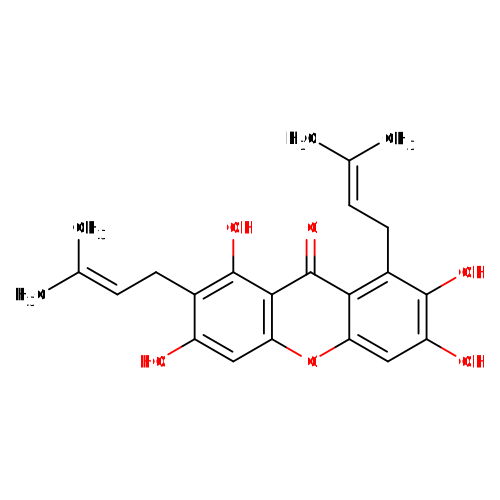
| Description | Gamma-Mangostin, also known as γ-mangostin, belongs to the class of organic compounds known as 8-prenylated xanthones. These are organic compounds containing a C5-isoprenoid group linked to a xanthone moiety at the 8-position. Xanthone is a tricyclic compound made up of two benzene rings linearly fused to each other through a pyran ring that carries a ketone group. Gamma-Mangostin has been detected, but not quantified in, fruits and purple mangosteens (Garcinia mangostana). This could make gamma-mangostin a potential biomarker for the consumption of these foods. Gamma-Mangostin is a secondary metabolite. Secondary metabolites are metabolically or physiologically non-essential metabolites that may serve a role as defense or signalling molecules. In some cases they are simply molecules that arise from the incomplete metabolism of other secondary metabolites. gamma-mangostin is found in Cratoxylum cochinchinense, Garcina xipshuanbannaensis, Garcinia costata, Hypericum androsaemum, Hypericum patulum and Hypericum perforatum. gamma-mangostin was first documented in 1992 (PMID: 1368866). Based on a literature review a small amount of articles have been published on gamma-Mangostin (PMID: 15322259) (PMID: 22759914) (PMID: 23513467). |
|---|
| Structure | [H]OC1=C([H])C2=C(C(=O)C3=C(O[H])C(=C(O[H])C([H])=C3O2)C([H])([H])C([H])=C(C([H])([H])[H])C([H])([H])[H])C(=C1O[H])C([H])([H])C([H])=C(C([H])([H])[H])C([H])([H])[H] InChI=1S/C23H24O6/c1-11(2)5-7-13-15(24)9-18-20(22(13)27)23(28)19-14(8-6-12(3)4)21(26)16(25)10-17(19)29-18/h5-6,9-10,24-27H,7-8H2,1-4H3 |
|---|
| Synonyms | | Value | Source |
|---|
| g-Mangostin | Generator | | Γ-mangostin | Generator | | 1,3,6,7-Tetrahydroxy-2,8-bis(3-methyl-2-butenyl)-9H-xanthen-9-one, 9ci | HMDB | | Normangostin | HMDB | | 1,3,6,7-Tetrahydroxy-2,5-bis(3-methyl-2-butenyl)-9H-xanthen-9-one | HMDB |
|
|---|
| Chemical Formula | C23H24O6 |
|---|
| Average Mass | 396.4331 Da |
|---|
| Monoisotopic Mass | 396.15729 Da |
|---|
| IUPAC Name | 1,3,6,7-tetrahydroxy-2,8-bis(3-methylbut-2-en-1-yl)-9H-xanthen-9-one |
|---|
| Traditional Name | 1,3,6,7-tetrahydroxy-2,8-bis(3-methylbut-2-en-1-yl)xanthen-9-one |
|---|
| CAS Registry Number | Not Available |
|---|
| SMILES | [H]OC1=C([H])C2=C(C(=O)C3=C(O[H])C(=C(O[H])C([H])=C3O2)C([H])([H])C([H])=C(C([H])([H])[H])C([H])([H])[H])C(=C1O[H])C([H])([H])C([H])=C(C([H])([H])[H])C([H])([H])[H] |
|---|
| InChI Identifier | InChI=1S/C23H24O6/c1-11(2)5-7-13-15(24)9-18-20(22(13)27)23(28)19-14(8-6-12(3)4)21(26)16(25)10-17(19)29-18/h5-6,9-10,24-27H,7-8H2,1-4H3 |
|---|
| InChI Key | VEZXFTKZUMARDU-UHFFFAOYSA-N |
|---|
| Experimental Spectra |
|---|
|
| | Spectrum Type | Description | Depositor Email | Depositor Organization | Depositor | Deposition Date | View |
|---|
| 1D NMR | 13C NMR Spectrum (1D, 400 MHz, acetone-d6, simulated) | Wishart Lab | Wishart Lab | David Wishart | 2021-06-20 | View Spectrum | | 1D NMR | 1H NMR Spectrum (1D, 400 MHz, acetone-d6, simulated) | Wishart Lab | Wishart Lab | David Wishart | 2021-06-20 | View Spectrum | | 1D NMR | 13C NMR Spectrum (1D, 100 MHz, acetone-d6, simulated) | Wishart Lab | Wishart Lab | David Wishart | 2021-06-20 | View Spectrum | | 1D NMR | 1H NMR Spectrum (1D, 100 MHz, acetone-d6, simulated) | Wishart Lab | Wishart Lab | David Wishart | 2021-06-20 | View Spectrum | | 1D NMR | 13C NMR Spectrum (1D, 200 MHz, acetone-d6, simulated) | Wishart Lab | Wishart Lab | David Wishart | 2021-06-20 | View Spectrum | | 1D NMR | 1H NMR Spectrum (1D, 200 MHz, acetone-d6, simulated) | Wishart Lab | Wishart Lab | David Wishart | 2021-06-20 | View Spectrum | | 1D NMR | 13C NMR Spectrum (1D, 300 MHz, acetone-d6, simulated) | Wishart Lab | Wishart Lab | David Wishart | 2021-06-20 | View Spectrum | | 1D NMR | 1H NMR Spectrum (1D, 300 MHz, acetone-d6, simulated) | Wishart Lab | Wishart Lab | David Wishart | 2021-06-20 | View Spectrum | | 1D NMR | 13C NMR Spectrum (1D, 500 MHz, acetone-d6, simulated) | Wishart Lab | Wishart Lab | David Wishart | 2021-06-20 | View Spectrum | | 1D NMR | 1H NMR Spectrum (1D, 500 MHz, acetone-d6, simulated) | Wishart Lab | Wishart Lab | David Wishart | 2021-06-20 | View Spectrum | | 1D NMR | 13C NMR Spectrum (1D, 600 MHz, acetone-d6, simulated) | Wishart Lab | Wishart Lab | David Wishart | 2021-06-20 | View Spectrum | | 1D NMR | 1H NMR Spectrum (1D, 600 MHz, acetone-d6, simulated) | Wishart Lab | Wishart Lab | David Wishart | 2021-06-20 | View Spectrum | | 1D NMR | 13C NMR Spectrum (1D, 700 MHz, acetone-d6, simulated) | Wishart Lab | Wishart Lab | David Wishart | 2021-06-20 | View Spectrum | | 1D NMR | 1H NMR Spectrum (1D, 700 MHz, acetone-d6, simulated) | Wishart Lab | Wishart Lab | David Wishart | 2021-06-20 | View Spectrum | | 1D NMR | 13C NMR Spectrum (1D, 800 MHz, acetone-d6, simulated) | Wishart Lab | Wishart Lab | David Wishart | 2021-06-20 | View Spectrum | | 1D NMR | 1H NMR Spectrum (1D, 800 MHz, acetone-d6, simulated) | Wishart Lab | Wishart Lab | David Wishart | 2021-06-20 | View Spectrum | | 1D NMR | 13C NMR Spectrum (1D, 900 MHz, acetone-d6, simulated) | Wishart Lab | Wishart Lab | David Wishart | 2021-06-20 | View Spectrum | | 1D NMR | 1H NMR Spectrum (1D, 900 MHz, acetone-d6, simulated) | Wishart Lab | Wishart Lab | David Wishart | 2021-06-20 | View Spectrum | | 1D NMR | 13C NMR Spectrum (1D, 1000 MHz, acetone-d6, simulated) | Wishart Lab | Wishart Lab | David Wishart | 2021-06-20 | View Spectrum | | 1D NMR | 1H NMR Spectrum (1D, 1000 MHz, acetone-d6, simulated) | Wishart Lab | Wishart Lab | David Wishart | 2021-06-20 | View Spectrum |
| | Predicted Spectra |
|---|
|
| Not Available | | Chemical Shift Submissions |
|---|
|
| Not Available | | Species |
|---|
| Species of Origin | |
|---|
| Chemical Taxonomy |
|---|
| Description | Belongs to the class of organic compounds known as 8-prenylated xanthones. These are organic compounds containing a C5-isoprenoid group linked to a xanthone moiety at the 8-position. Xanthone is a tricyclic compound made up of two benzene rings linearly fused to each other through a pyran ring that carries a ketone group. |
|---|
| Kingdom | Organic compounds |
|---|
| Super Class | Organoheterocyclic compounds |
|---|
| Class | Benzopyrans |
|---|
| Sub Class | 1-benzopyrans |
|---|
| Direct Parent | 8-prenylated xanthones |
|---|
| Alternative Parents | |
|---|
| Substituents | - 2-prenylated xanthone
- 8-prenylated xanthone
- Chromone
- 1-hydroxy-4-unsubstituted benzenoid
- 1-hydroxy-2-unsubstituted benzenoid
- Pyranone
- Pyran
- Benzenoid
- Heteroaromatic compound
- Vinylogous acid
- Polyol
- Oxacycle
- Organic oxygen compound
- Hydrocarbon derivative
- Organic oxide
- Organooxygen compound
- Aromatic heteropolycyclic compound
|
|---|
| Molecular Framework | Aromatic heteropolycyclic compounds |
|---|
| External Descriptors | |
|---|
| Physical Properties |
|---|
| State | Not Available |
|---|
| Experimental Properties | |
|---|
| Predicted Properties | |
|---|
| General References | - Jinsart W, Ternai B, Buddhasukh D, Polya GM: Inhibition of wheat embryo calcium-dependent protein kinase and other kinases by mangostin and gamma-mangostin. Phytochemistry. 1992 Nov;31(11):3711-3. doi: 10.1016/s0031-9422(00)97514-9. [PubMed:1368866 ]
- Nakatani K, Yamakuni T, Kondo N, Arakawa T, Oosawa K, Shimura S, Inoue H, Ohizumi Y: gamma-Mangostin inhibits inhibitor-kappaB kinase activity and decreases lipopolysaccharide-induced cyclooxygenase-2 gene expression in C6 rat glioma cells. Mol Pharmacol. 2004 Sep;66(3):667-74. doi: 10.1124/mol.104.002626. [PubMed:15322259 ]
- Chang HF, Yang LL: Gamma-mangostin, a micronutrient of mangosteen fruit, induces apoptosis in human colon cancer cells. Molecules. 2012 Jul 3;17(7):8010-21. doi: 10.3390/molecules17078010. [PubMed:22759914 ]
- Tep-Areenan P, Suksamrarn S: Mechanisms of vasorelaxation to gamma-mangostin in the rat aorta. J Med Assoc Thai. 2012 Dec;95 Suppl 12:S63-8. [PubMed:23513467 ]
- Ren, Y., et al. (2011). Ren, Y., et al, J. Nat. Prod. 74, 1117 (2011). J. Nat. Prod..
|
|---|