| Record Information |
|---|
| Version | 2.0 |
|---|
| Created at | 2021-06-19 22:41:54 UTC |
|---|
| Updated at | 2021-06-30 00:00:25 UTC |
|---|
| NP-MRD ID | NP0031683 |
|---|
| Secondary Accession Numbers | None |
|---|
| Natural Product Identification |
|---|
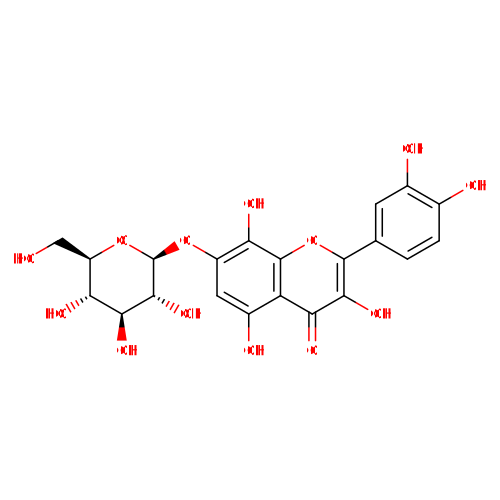
| Common Name | gossypitrin |
|---|
| Provided By | JEOL Database |
|---|
| Description | Gossypitrin belongs to the class of organic compounds known as flavonoid-7-o-glycosides. These are phenolic compounds containing a flavonoid moiety which is O-glycosidically linked to carbohydrate moiety at the C7-position. gossypitrin is found in Abutilon indicum , Restio tetraphyllus, Calorophus lateriflorus, Calorophus minor, Chrysanthemum segetum , Dacrydium spp., Drosera rotundifolia, Equisetum arvense, Equisetum spp., Equisetum telmateia, Hibiscus sabdariffa, Hibiscus spp., Leucanthemopsis flaveola, Millettia zechiana, Papaver nudicaule and Restio complanatus. gossypitrin was first documented in 2002 (PMID: 11933852). Based on a literature review a small amount of articles have been published on Gossypitrin (PMID: 30853999) (PMID: 23831703) (PMID: 16376394) (PMID: 14599345). |
|---|
| Structure | [H]OC1=C([H])C([H])=C(C([H])=C1O[H])C1=C(O[H])C(=O)C2=C(O1)C(O[H])=C(O[C@]1([H])O[C@]([H])(C([H])([H])O[H])[C@@]([H])(O[H])[C@]([H])(O[H])[C@@]1([H])O[H])C([H])=C2O[H] InChI=1S/C21H20O13/c22-5-11-13(26)16(29)18(31)21(33-11)32-10-4-9(25)12-15(28)17(30)19(34-20(12)14(10)27)6-1-2-7(23)8(24)3-6/h1-4,11,13,16,18,21-27,29-31H,5H2/t11-,13-,16+,18-,21-/m1/s1 |
|---|
| Synonyms | Not Available |
|---|
| Chemical Formula | C21H20O13 |
|---|
| Average Mass | 480.3780 Da |
|---|
| Monoisotopic Mass | 480.09039 Da |
|---|
| IUPAC Name | 2-(3,4-dihydroxyphenyl)-3,5,8-trihydroxy-7-{[(2S,3R,4S,5S,6R)-3,4,5-trihydroxy-6-(hydroxymethyl)oxan-2-yl]oxy}-4H-chromen-4-one |
|---|
| Traditional Name | 2-(3,4-dihydroxyphenyl)-3,5,8-trihydroxy-7-{[(2S,3R,4S,5S,6R)-3,4,5-trihydroxy-6-(hydroxymethyl)oxan-2-yl]oxy}chromen-4-one |
|---|
| CAS Registry Number | Not Available |
|---|
| SMILES | [H]OC1=C([H])C([H])=C(C([H])=C1O[H])C1=C(O[H])C(=O)C2=C(O1)C(O[H])=C(O[C@]1([H])O[C@]([H])(C([H])([H])O[H])[C@@]([H])(O[H])[C@]([H])(O[H])[C@@]1([H])O[H])C([H])=C2O[H] |
|---|
| InChI Identifier | InChI=1S/C21H20O13/c22-5-11-13(26)16(29)18(31)21(33-11)32-10-4-9(25)12-15(28)17(30)19(34-20(12)14(10)27)6-1-2-7(23)8(24)3-6/h1-4,11,13,16,18,21-27,29-31H,5H2/t11-,13-,16+,18-,21-/m1/s1 |
|---|
| InChI Key | ATRBFJXIWFCIMW-ZGNDCXKCSA-N |
|---|
| Experimental Spectra |
|---|
|
| | Spectrum Type | Description | Depositor Email | Depositor Organization | Depositor | Deposition Date | View |
|---|
| 1D NMR | 13C NMR Spectrum (1D, 500 MHz, DMSO-d6, simulated) | Wishart Lab | Wishart Lab | David Wishart | 2021-06-20 | View Spectrum | | 1D NMR | 1H NMR Spectrum (1D, 500 MHz, DMSO-d6, simulated) | Wishart Lab | Wishart Lab | David Wishart | 2021-06-20 | View Spectrum | | 1D NMR | 13C NMR Spectrum (1D, 100 MHz, DMSO-d6, simulated) | Wishart Lab | Wishart Lab | David Wishart | 2021-06-20 | View Spectrum | | 1D NMR | 1H NMR Spectrum (1D, 100 MHz, DMSO-d6, simulated) | Wishart Lab | Wishart Lab | David Wishart | 2021-06-20 | View Spectrum | | 1D NMR | 13C NMR Spectrum (1D, 200 MHz, DMSO-d6, simulated) | Wishart Lab | Wishart Lab | David Wishart | 2021-06-20 | View Spectrum | | 1D NMR | 1H NMR Spectrum (1D, 200 MHz, DMSO-d6, simulated) | Wishart Lab | Wishart Lab | David Wishart | 2021-06-20 | View Spectrum | | 1D NMR | 13C NMR Spectrum (1D, 300 MHz, DMSO-d6, simulated) | Wishart Lab | Wishart Lab | David Wishart | 2021-06-20 | View Spectrum | | 1D NMR | 1H NMR Spectrum (1D, 300 MHz, DMSO-d6, simulated) | Wishart Lab | Wishart Lab | David Wishart | 2021-06-20 | View Spectrum | | 1D NMR | 13C NMR Spectrum (1D, 400 MHz, DMSO-d6, simulated) | Wishart Lab | Wishart Lab | David Wishart | 2021-06-20 | View Spectrum | | 1D NMR | 1H NMR Spectrum (1D, 400 MHz, DMSO-d6, simulated) | Wishart Lab | Wishart Lab | David Wishart | 2021-06-20 | View Spectrum | | 1D NMR | 13C NMR Spectrum (1D, 600 MHz, DMSO-d6, simulated) | Wishart Lab | Wishart Lab | David Wishart | 2021-06-20 | View Spectrum | | 1D NMR | 1H NMR Spectrum (1D, 600 MHz, DMSO-d6, simulated) | Wishart Lab | Wishart Lab | David Wishart | 2021-06-20 | View Spectrum | | 1D NMR | 13C NMR Spectrum (1D, 700 MHz, DMSO-d6, simulated) | Wishart Lab | Wishart Lab | David Wishart | 2021-06-20 | View Spectrum | | 1D NMR | 1H NMR Spectrum (1D, 700 MHz, DMSO-d6, simulated) | Wishart Lab | Wishart Lab | David Wishart | 2021-06-20 | View Spectrum | | 1D NMR | 13C NMR Spectrum (1D, 800 MHz, DMSO-d6, simulated) | Wishart Lab | Wishart Lab | David Wishart | 2021-06-20 | View Spectrum | | 1D NMR | 1H NMR Spectrum (1D, 800 MHz, DMSO-d6, simulated) | Wishart Lab | Wishart Lab | David Wishart | 2021-06-20 | View Spectrum | | 1D NMR | 13C NMR Spectrum (1D, 900 MHz, DMSO-d6, simulated) | Wishart Lab | Wishart Lab | David Wishart | 2021-06-20 | View Spectrum | | 1D NMR | 1H NMR Spectrum (1D, 900 MHz, DMSO-d6, simulated) | Wishart Lab | Wishart Lab | David Wishart | 2021-06-20 | View Spectrum | | 1D NMR | 13C NMR Spectrum (1D, 1000 MHz, DMSO-d6, simulated) | Wishart Lab | Wishart Lab | David Wishart | 2021-06-20 | View Spectrum | | 1D NMR | 1H NMR Spectrum (1D, 1000 MHz, DMSO-d6, simulated) | Wishart Lab | Wishart Lab | David Wishart | 2021-06-20 | View Spectrum |
| | Predicted Spectra |
|---|
|
| Not Available | | Chemical Shift Submissions |
|---|
|
| Not Available | | Species |
|---|
| Species of Origin | |
|---|
| Chemical Taxonomy |
|---|
| Description | Belongs to the class of organic compounds known as flavonoid-7-o-glycosides. These are phenolic compounds containing a flavonoid moiety which is O-glycosidically linked to carbohydrate moiety at the C7-position. |
|---|
| Kingdom | Organic compounds |
|---|
| Super Class | Phenylpropanoids and polyketides |
|---|
| Class | Flavonoids |
|---|
| Sub Class | Flavonoid glycosides |
|---|
| Direct Parent | Flavonoid-7-O-glycosides |
|---|
| Alternative Parents | |
|---|
| Substituents | - Flavonoid-7-o-glycoside
- 3-hydroxyflavone
- Hydroxyflavonoid
- 3'-hydroxyflavonoid
- 3-hydroxyflavonoid
- 4'-hydroxyflavonoid
- 5-hydroxyflavonoid
- 8-hydroxyflavonoid
- Flavone
- Phenolic glycoside
- Hexose monosaccharide
- O-glycosyl compound
- Glycosyl compound
- Chromone
- Benzopyran
- 1-benzopyran
- Catechol
- Pyranone
- 1-hydroxy-4-unsubstituted benzenoid
- 1-hydroxy-2-unsubstituted benzenoid
- Phenol
- Monocyclic benzene moiety
- Benzenoid
- Pyran
- Oxane
- Monosaccharide
- Vinylogous acid
- Heteroaromatic compound
- Secondary alcohol
- Organoheterocyclic compound
- Acetal
- Polyol
- Oxacycle
- Hydrocarbon derivative
- Organic oxide
- Organic oxygen compound
- Alcohol
- Primary alcohol
- Organooxygen compound
- Aromatic heteropolycyclic compound
|
|---|
| Molecular Framework | Aromatic heteropolycyclic compounds |
|---|
| External Descriptors | Not Available |
|---|
| Physical Properties |
|---|
| State | Not Available |
|---|
| Experimental Properties | | Property | Value | Reference |
|---|
| Melting Point | Not Available | Not Available | | Boiling Point | Not Available | Not Available | | Water Solubility | Not Available | Not Available | | LogP | Not Available | Not Available |
|
|---|
| Predicted Properties | |
|---|
| General References | - Ay E, Hunyadi A, Mezei M, Minarovits J, Hohmann J: Flavonol 7-O-Glucoside Herbacitrin Inhibits HIV-1 Replication through Simultaneous Integrase and Reverse Transcriptase Inhibition. Evid Based Complement Alternat Med. 2019 Feb 3;2019:1064793. doi: 10.1155/2019/1064793. eCollection 2019. [PubMed:30853999 ]
- Braunberger C, Zehl M, Conrad J, Fischer S, Adhami HR, Beifuss U, Krenn L: LC-NMR, NMR, and LC-MS identification and LC-DAD quantification of flavonoids and ellagic acid derivatives in Drosera peltata. J Chromatogr B Analyt Technol Biomed Life Sci. 2013 Aug 1;932:111-6. doi: 10.1016/j.jchromb.2013.06.015. Epub 2013 Jun 17. [PubMed:23831703 ]
- Schliemann W, Schneider B, Wray V, Schmidt J, Nimtz M, Porzel A, Bohm H: Flavonols and an indole alkaloid skeleton bearing identical acylated glycosidic groups from yellow petals of Papaver nudicaule. Phytochemistry. 2006 Jan;67(2):191-201. doi: 10.1016/j.phytochem.2005.11.002. Epub 2005 Dec 22. [PubMed:16376394 ]
- Perez-Trueba G, Ramos-Guanche C, Martinez-Sanchez B, Marquez-Hernandez I, Giuliani A, Martinez-Sanchez G: Protective effect of gossypitrin on carbon tetrachloride-induced in vivo hepatotoxicity. Redox Rep. 2003;8(4):215-21. doi: 10.1179/135100003225002718. [PubMed:14599345 ]
- Kolodziej H, Pertz HH, Humke A: Main constituents of a commercial Drosera fluid extract and their antagonist activity at muscarinic M3 receptors in guinea-pig ileum. Pharmazie. 2002 Mar;57(3):201-3. [PubMed:11933852 ]
- Schliemann, W., et al. (2006). Schliemann, W., et al, Phytochemistry 67, 191 (2006) . Phytochem..
|
|---|