| Record Information |
|---|
| Version | 2.0 |
|---|
| Created at | 2021-06-19 22:20:45 UTC |
|---|
| Updated at | 2021-06-29 23:59:37 UTC |
|---|
| NP-MRD ID | NP0031191 |
|---|
| Secondary Accession Numbers | None |
|---|
| Natural Product Identification |
|---|
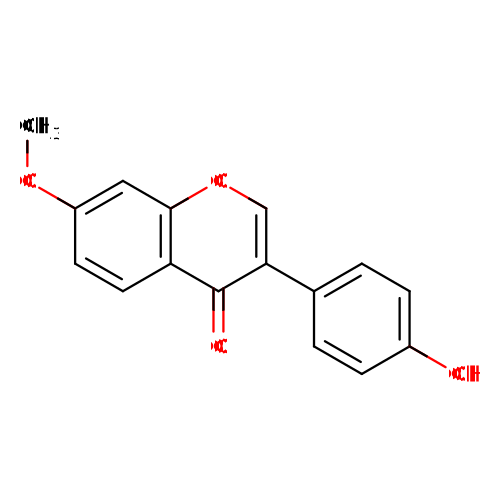
| Common Name | 7-O-methyldaidzein. Isoformononetin |
|---|
| Provided By | JEOL Database |
|---|
| Description | Isoformononetin belongs to the class of organic compounds known as 7-o-methylisoflavones. These are isoflavones with methoxy groups attached to the C7 atom of the isoflavone backbone. Thus, isoformononetin is considered to be a flavonoid. Isoformononetin has been detected, but not quantified in, pulses and soy beans (Glycine max). This could make isoformononetin a potential biomarker for the consumption of these foods. Isoformononetin is a primary metabolite. Primary metabolites are metabolically or physiologically essential metabolites. They are directly involved in an organism’s growth, development or reproduction. 7-O-methyldaidzein. Isoformononetin is found in Butea monosperma, Hedysarum sikkimense, Nocardia species, Ormosia henryi, Oxytropis falcata, Pueraria montana and Taxus yunnanensis. 7-O-methyldaidzein. Isoformononetin was first documented in 2000 (PMID: 11006341). Based on a literature review a small amount of articles have been published on Isoformononetin (PMID: 17707445) (PMID: 11129614) (PMID: 15896369) (PMID: 19598169). |
|---|
| Structure | [H]OC1=C([H])C([H])=C(C([H])=C1[H])C1=C([H])OC2=C([H])C(OC([H])([H])[H])=C([H])C([H])=C2C1=O InChI=1S/C16H12O4/c1-19-12-6-7-13-15(8-12)20-9-14(16(13)18)10-2-4-11(17)5-3-10/h2-9,17H,1H3 |
|---|
| Synonyms | | Value | Source |
|---|
| 4'-Hydroxy-7-methoxyisoflavone | ChEBI | | 7-O-Methyldaidzein | ChEBI |
|
|---|
| Chemical Formula | C16H12O4 |
|---|
| Average Mass | 268.2641 Da |
|---|
| Monoisotopic Mass | 268.07356 Da |
|---|
| IUPAC Name | 3-(4-hydroxyphenyl)-7-methoxy-4H-chromen-4-one |
|---|
| Traditional Name | isoformononetin |
|---|
| CAS Registry Number | Not Available |
|---|
| SMILES | [H]OC1=C([H])C([H])=C(C([H])=C1[H])C1=C([H])OC2=C([H])C(OC([H])([H])[H])=C([H])C([H])=C2C1=O |
|---|
| InChI Identifier | InChI=1S/C16H12O4/c1-19-12-6-7-13-15(8-12)20-9-14(16(13)18)10-2-4-11(17)5-3-10/h2-9,17H,1H3 |
|---|
| InChI Key | LNIQZRIHAMVRJA-UHFFFAOYSA-N |
|---|
| Experimental Spectra |
|---|
|
| | Spectrum Type | Description | Depositor Email | Depositor Organization | Depositor | Deposition Date | View |
|---|
| 1D NMR | 13C NMR Spectrum (1D, 400 MHz, DMSO-d6, simulated) | Wishart Lab | Wishart Lab | David Wishart | 2021-06-20 | View Spectrum | | 1D NMR | 1H NMR Spectrum (1D, 400 MHz, DMSO-d6, simulated) | Wishart Lab | Wishart Lab | David Wishart | 2021-06-20 | View Spectrum | | 1D NMR | 13C NMR Spectrum (1D, 100 MHz, DMSO-d6, simulated) | Wishart Lab | Wishart Lab | David Wishart | 2021-06-20 | View Spectrum | | 1D NMR | 1H NMR Spectrum (1D, 100 MHz, DMSO-d6, simulated) | Wishart Lab | Wishart Lab | David Wishart | 2021-06-20 | View Spectrum | | 1D NMR | 13C NMR Spectrum (1D, 200 MHz, DMSO-d6, simulated) | Wishart Lab | Wishart Lab | David Wishart | 2021-06-20 | View Spectrum | | 1D NMR | 1H NMR Spectrum (1D, 200 MHz, DMSO-d6, simulated) | Wishart Lab | Wishart Lab | David Wishart | 2021-06-20 | View Spectrum | | 1D NMR | 13C NMR Spectrum (1D, 300 MHz, DMSO-d6, simulated) | Wishart Lab | Wishart Lab | David Wishart | 2021-06-20 | View Spectrum | | 1D NMR | 1H NMR Spectrum (1D, 300 MHz, DMSO-d6, simulated) | Wishart Lab | Wishart Lab | David Wishart | 2021-06-20 | View Spectrum | | 1D NMR | 13C NMR Spectrum (1D, 500 MHz, DMSO-d6, simulated) | Wishart Lab | Wishart Lab | David Wishart | 2021-06-20 | View Spectrum | | 1D NMR | 1H NMR Spectrum (1D, 500 MHz, DMSO-d6, simulated) | Wishart Lab | Wishart Lab | David Wishart | 2021-06-20 | View Spectrum | | 1D NMR | 13C NMR Spectrum (1D, 600 MHz, DMSO-d6, simulated) | Wishart Lab | Wishart Lab | David Wishart | 2021-06-20 | View Spectrum | | 1D NMR | 1H NMR Spectrum (1D, 600 MHz, DMSO-d6, simulated) | Wishart Lab | Wishart Lab | David Wishart | 2021-06-20 | View Spectrum | | 1D NMR | 13C NMR Spectrum (1D, 700 MHz, DMSO-d6, simulated) | Wishart Lab | Wishart Lab | David Wishart | 2021-06-20 | View Spectrum | | 1D NMR | 1H NMR Spectrum (1D, 700 MHz, DMSO-d6, simulated) | Wishart Lab | Wishart Lab | David Wishart | 2021-06-20 | View Spectrum | | 1D NMR | 13C NMR Spectrum (1D, 800 MHz, DMSO-d6, simulated) | Wishart Lab | Wishart Lab | David Wishart | 2021-06-20 | View Spectrum | | 1D NMR | 1H NMR Spectrum (1D, 800 MHz, DMSO-d6, simulated) | Wishart Lab | Wishart Lab | David Wishart | 2021-06-20 | View Spectrum | | 1D NMR | 13C NMR Spectrum (1D, 900 MHz, DMSO-d6, simulated) | Wishart Lab | Wishart Lab | David Wishart | 2021-06-20 | View Spectrum | | 1D NMR | 1H NMR Spectrum (1D, 900 MHz, DMSO-d6, simulated) | Wishart Lab | Wishart Lab | David Wishart | 2021-06-20 | View Spectrum | | 1D NMR | 13C NMR Spectrum (1D, 1000 MHz, DMSO-d6, simulated) | Wishart Lab | Wishart Lab | David Wishart | 2021-06-20 | View Spectrum | | 1D NMR | 1H NMR Spectrum (1D, 1000 MHz, DMSO-d6, simulated) | Wishart Lab | Wishart Lab | David Wishart | 2021-06-20 | View Spectrum |
| | Predicted Spectra |
|---|
|
| Not Available | | Chemical Shift Submissions |
|---|
|
| Not Available | | Species |
|---|
| Species of Origin | |
|---|
| Chemical Taxonomy |
|---|
| Description | Belongs to the class of organic compounds known as 7-o-methylisoflavones. These are isoflavones with methoxy groups attached to the C7 atom of the isoflavone backbone. |
|---|
| Kingdom | Organic compounds |
|---|
| Super Class | Phenylpropanoids and polyketides |
|---|
| Class | Isoflavonoids |
|---|
| Sub Class | O-methylated isoflavonoids |
|---|
| Direct Parent | 7-O-methylisoflavones |
|---|
| Alternative Parents | |
|---|
| Substituents | - 7-o-methylisoflavone
- Isoflavone
- Chromone
- Benzopyran
- 1-benzopyran
- Anisole
- 1-hydroxy-2-unsubstituted benzenoid
- Alkyl aryl ether
- Phenol
- Pyranone
- Monocyclic benzene moiety
- Pyran
- Benzenoid
- Heteroaromatic compound
- Ether
- Oxacycle
- Organoheterocyclic compound
- Organic oxygen compound
- Organooxygen compound
- Hydrocarbon derivative
- Organic oxide
- Aromatic heteropolycyclic compound
|
|---|
| Molecular Framework | Aromatic heteropolycyclic compounds |
|---|
| External Descriptors | |
|---|
| Physical Properties |
|---|
| State | Not Available |
|---|
| Experimental Properties | | Property | Value | Reference |
|---|
| Melting Point | Not Available | Not Available | | Boiling Point | Not Available | Not Available | | Water Solubility | Not Available | Not Available | | LogP | Not Available | Not Available |
|
|---|
| Predicted Properties | |
|---|
| General References | - Kaimoyo E, VanEtten HD: Inactivation of pea genes by RNAi supports the involvement of two similar O-methyltransferases in the biosynthesis of (+)-pisatin and of chiral intermediates with a configuration opposite that found in (+)-pisatin. Phytochemistry. 2008 Jan;69(1):76-87. doi: 10.1016/j.phytochem.2007.06.013. Epub 2007 Aug 17. [PubMed:17707445 ]
- He XZ, Dixon RA: Genetic manipulation of isoflavone 7-O-methyltransferase enhances biosynthesis of 4'-O-methylated isoflavonoid phytoalexins and disease resistance in alfalfa. Plant Cell. 2000 Sep;12(9):1689-702. doi: 10.1105/tpc.12.9.1689. [PubMed:11006341 ]
- Akashi T, Sawada Y, Aoki T, Ayabe S: New scheme of the biosynthesis of formononetin involving 2,7,4'-trihydroxyisoflavanone but not daidzein as the methyl acceptor. Biosci Biotechnol Biochem. 2000 Oct;64(10):2276-9. doi: 10.1271/bbb.64.2276. [PubMed:11129614 ]
- Maatooq GT, Rosazza JP: Metabolism of daidzein by Nocardia species NRRL 5646 and Mortierella isabellina ATCC 38063. Phytochemistry. 2005 May;66(9):1007-11. doi: 10.1016/j.phytochem.2005.03.013. [PubMed:15896369 ]
- Bhargavan B, Gautam AK, Singh D, Kumar A, Chaurasia S, Tyagi AM, Yadav DK, Mishra JS, Singh AB, Sanyal S, Goel A, Maurya R, Chattopadhyay N: Methoxylated isoflavones, cajanin and isoformononetin, have non-estrogenic bone forming effect via differential mitogen activated protein kinase (MAPK) signaling. J Cell Biochem. 2009 Oct 1;108(2):388-99. doi: 10.1002/jcb.22264. [PubMed:19598169 ]
- Maatooq, G. T., et al. (2005). Maatooq, G. T., et al, Phytochemistry 66, 1007 (2005) . Phytochem..
|
|---|