| Record Information |
|---|
| Version | 2.0 |
|---|
| Created at | 2021-06-19 22:18:31 UTC |
|---|
| Updated at | 2021-08-20 00:00:23 UTC |
|---|
| NP-MRD ID | NP0031143 |
|---|
| Secondary Accession Numbers | None |
|---|
| Natural Product Identification |
|---|
| Common Name | epigallocatechin-3-O-gallate |
|---|
| Provided By | JEOL Database |
|---|
| Description | Epigallocatechin gallate, also known as EGCG or catechin deriv., Belongs to the class of organic compounds known as catechin gallates. These are organic compounds containing a gallate moiety glycosidically linked to a catechin. Epigallocatechin gallate has been detected, but not quantified in, black tea and green tea. This could make epigallocatechin gallate a potential biomarker for the consumption of these foods. Epigallocatechin gallate is a primary metabolite. Primary metabolites are metabolically or physiologically essential metabolites. They are directly involved in an organism’s growth, development or reproduction. epigallocatechin-3-O-gallate is found in Senegalia polyacantha, Alhagi sparsifolia, Alnus sieboldiana, Averrhoa carambola L., Camellia crassicolumna, Camellia taliensis, Coccoloba mollis, Cucurbita pepo, Diospyros kaki, Eschweilera coriacea, Eugenia myrcianthes, Eugenia selloi, Euphorbia hirta, Fagopyrum megacarpum, Hibiscus cannabinus, Hippophae rhamnoides, Limoniastrum guyonianum, Limonium gmelinii, Limonium sinense, Lotus corniculatus, Matricaria chamomilla, Myrica esculenta, Myrica rubra, Morus alba, Myrtus communis, Parapiptadenia rigida, Parkia biglobosa, Phyllanthus niruri, Platycarya strobilacea, Polygonum panjutinii, Dasiphora fruticosa, Prunus dulcis, Pteroxygonum giraldii, Quercus robur, Rhodiola crenulata, Rhodiola heterodonta, Rhodiola kirilowii, Rhodiola sacra, Rhodiola semenovii, Rhododendron ponticum, Rosa rugosa, Sclerocarya birrea, Sedum crassularia, Sempervivum tectorum, Sideroxylon inerme, Terminalia catappa, Theobroma cacao, Trifolium pratense, Turnera ulmifolia, Uncaria guianensis, Vitellaria paradoxa, Vitis vinifera and Ziziphus jujuba. epigallocatechin-3-O-gallate was first documented in 1992 (PMID: 1731169). Based on a literature review a small amount of articles have been published on Epigallocatechin gallate (PMID: 16772446) (PMID: 12832052) (PMID: 16054165) (PMID: 16403950). |
|---|
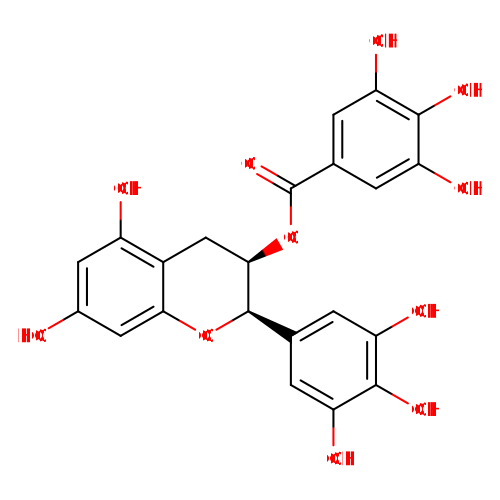
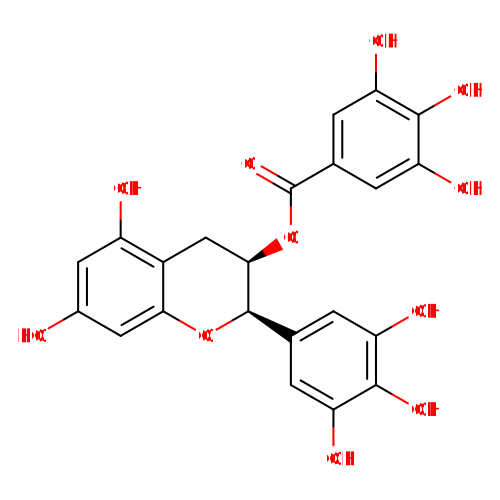
| Structure | [H]OC1=C([H])C(O[H])=C2C(O[C@]([H])(C3=C([H])C(O[H])=C(O[H])C(O[H])=C3[H])[C@]([H])(OC(=O)C3=C([H])C(O[H])=C(O[H])C(O[H])=C3[H])C2([H])[H])=C1[H] InChI=1S/C22H18O11/c23-10-5-12(24)11-7-18(33-22(31)9-3-15(27)20(30)16(28)4-9)21(32-17(11)6-10)8-1-13(25)19(29)14(26)2-8/h1-6,18,21,23-30H,7H2/t18-,21-/m1/s1 |
|---|
| Synonyms | | Value | Source |
|---|
| (-)-Epigallocatechin-3-O-gallate | ChEBI | | [(2R,3R)-5,7-Dihydroxy-2-(3,4,5-trihydroxyphenyl)-3,4-dihydro-2H-chromen-3-yl] 3,4,5-trihydroxybenzoate | ChEBI | | EGCG | ChEBI | | Epigallocatechin 3-gallate | ChEBI | | (-)-Epigallocatechin-3-O-gallic acid | Generator | | [(2R,3R)-5,7-Dihydroxy-2-(3,4,5-trihydroxyphenyl)-3,4-dihydro-2H-chromen-3-yl] 3,4,5-trihydroxybenzoic acid | Generator | | Epigallocatechin 3-gallic acid | Generator | | Epigallocatechin gallic acid | Generator | | (-)-Epigallocatechin gallat | HMDB | | (-)-Epigallocatechin gallate | HMDB | | (-)-Epigallocatechol gallate | HMDB | | (-)-Epigallocatehin gallate | HMDB | | Catechin deriv. | HMDB | | Epigallocatcchin gallate | HMDB | | Epigallocate | HMDB | | Epigallocic acid | HMDB | | Galloyl-L-epigallocatechol | HMDB | | Tea catechin | HMDB | | Epigallo-catechin gallate | HMDB | | Epigallocatechin-3-gallate | HMDB | | Sunphenon | HMDB | | EGCG CPD | HMDB | | Epigallocatechin-3-O-gallate | HMDB |
|
|---|
| Chemical Formula | C22H18O11 |
|---|
| Average Mass | 458.3717 Da |
|---|
| Monoisotopic Mass | 458.08491 Da |
|---|
| IUPAC Name | (2R,3R)-5,7-dihydroxy-2-(3,4,5-trihydroxyphenyl)-3,4-dihydro-2H-1-benzopyran-3-yl 3,4,5-trihydroxybenzoate |
|---|
| Traditional Name | (-)-epigallocatechin gallate |
|---|
| CAS Registry Number | Not Available |
|---|
| SMILES | [H]OC1=C([H])C(O[H])=C2C(O[C@]([H])(C3=C([H])C(O[H])=C(O[H])C(O[H])=C3[H])[C@]([H])(OC(=O)C3=C([H])C(O[H])=C(O[H])C(O[H])=C3[H])C2([H])[H])=C1[H] |
|---|
| InChI Identifier | InChI=1S/C22H18O11/c23-10-5-12(24)11-7-18(33-22(31)9-3-15(27)20(30)16(28)4-9)21(32-17(11)6-10)8-1-13(25)19(29)14(26)2-8/h1-6,18,21,23-30H,7H2/t18-,21-/m1/s1 |
|---|
| InChI Key | WMBWREPUVVBILR-WIYYLYMNSA-N |
|---|
| Experimental Spectra |
|---|
|
| | Spectrum Type | Description | Depositor Email | Depositor Organization | Depositor | Deposition Date | View |
|---|
| 1D NMR | 13C NMR Spectrum (1D, 400 MHz, acetone-d6 at 303K, simulated) | Wishart Lab | Wishart Lab | David Wishart | 2021-06-20 | View Spectrum | | 1D NMR | 1H NMR Spectrum (1D, 400 MHz, acetone-d6 at 303K, simulated) | Wishart Lab | Wishart Lab | David Wishart | 2021-06-20 | View Spectrum | | 1D NMR | 13C NMR Spectrum (1D, 100 MHz, acetone-d6 at 303K, simulated) | Wishart Lab | Wishart Lab | David Wishart | 2021-06-20 | View Spectrum | | 1D NMR | 1H NMR Spectrum (1D, 100 MHz, acetone-d6 at 303K, simulated) | Wishart Lab | Wishart Lab | David Wishart | 2021-06-20 | View Spectrum | | 1D NMR | 13C NMR Spectrum (1D, 200 MHz, acetone-d6 at 303K, simulated) | Wishart Lab | Wishart Lab | David Wishart | 2021-06-20 | View Spectrum | | 1D NMR | 1H NMR Spectrum (1D, 200 MHz, acetone-d6 at 303K, simulated) | Wishart Lab | Wishart Lab | David Wishart | 2021-06-20 | View Spectrum | | 1D NMR | 13C NMR Spectrum (1D, 300 MHz, acetone-d6 at 303K, simulated) | Wishart Lab | Wishart Lab | David Wishart | 2021-06-20 | View Spectrum | | 1D NMR | 1H NMR Spectrum (1D, 300 MHz, acetone-d6 at 303K, simulated) | Wishart Lab | Wishart Lab | David Wishart | 2021-06-20 | View Spectrum | | 1D NMR | 13C NMR Spectrum (1D, 500 MHz, acetone-d6 at 303K, simulated) | Wishart Lab | Wishart Lab | David Wishart | 2021-06-20 | View Spectrum | | 1D NMR | 1H NMR Spectrum (1D, 500 MHz, acetone-d6 at 303K, simulated) | Wishart Lab | Wishart Lab | David Wishart | 2021-06-20 | View Spectrum | | 1D NMR | 13C NMR Spectrum (1D, 600 MHz, acetone-d6 at 303K, simulated) | Wishart Lab | Wishart Lab | David Wishart | 2021-06-20 | View Spectrum | | 1D NMR | 1H NMR Spectrum (1D, 600 MHz, acetone-d6 at 303K, simulated) | Wishart Lab | Wishart Lab | David Wishart | 2021-06-20 | View Spectrum | | 1D NMR | 13C NMR Spectrum (1D, 700 MHz, acetone-d6 at 303K, simulated) | Wishart Lab | Wishart Lab | David Wishart | 2021-06-20 | View Spectrum | | 1D NMR | 1H NMR Spectrum (1D, 700 MHz, acetone-d6 at 303K, simulated) | Wishart Lab | Wishart Lab | David Wishart | 2021-06-20 | View Spectrum | | 1D NMR | 13C NMR Spectrum (1D, 800 MHz, acetone-d6 at 303K, simulated) | Wishart Lab | Wishart Lab | David Wishart | 2021-06-20 | View Spectrum | | 1D NMR | 1H NMR Spectrum (1D, 800 MHz, acetone-d6 at 303K, simulated) | Wishart Lab | Wishart Lab | David Wishart | 2021-06-20 | View Spectrum | | 1D NMR | 13C NMR Spectrum (1D, 900 MHz, acetone-d6 at 303K, simulated) | Wishart Lab | Wishart Lab | David Wishart | 2021-06-20 | View Spectrum | | 1D NMR | 1H NMR Spectrum (1D, 900 MHz, acetone-d6 at 303K, simulated) | Wishart Lab | Wishart Lab | David Wishart | 2021-06-20 | View Spectrum | | 1D NMR | 13C NMR Spectrum (1D, 1000 MHz, acetone-d6 at 303K, simulated) | Wishart Lab | Wishart Lab | David Wishart | 2021-06-20 | View Spectrum | | 1D NMR | 1H NMR Spectrum (1D, 1000 MHz, acetone-d6 at 303K, simulated) | Wishart Lab | Wishart Lab | David Wishart | 2021-06-20 | View Spectrum |
| | Predicted Spectra |
|---|
|
| Not Available | | Chemical Shift Submissions |
|---|
|
| Not Available | | Species |
|---|
| Species of Origin | |
|---|
| Chemical Taxonomy |
|---|
| Description | Belongs to the class of organic compounds known as catechin gallates. These are organic compounds containing a gallate moiety glycosidically linked to a catechin. |
|---|
| Kingdom | Organic compounds |
|---|
| Super Class | Phenylpropanoids and polyketides |
|---|
| Class | Flavonoids |
|---|
| Sub Class | Flavans |
|---|
| Direct Parent | Catechin gallates |
|---|
| Alternative Parents | Not Available |
|---|
| Substituents | Not Available |
|---|
| Molecular Framework | Aromatic heteropolycyclic compounds |
|---|
| External Descriptors | Not Available |
|---|
| Physical Properties |
|---|
| State | Not Available |
|---|
| Experimental Properties | |
|---|
| Predicted Properties | |
|---|
| General References | - Henning SM, Aronson W, Niu Y, Conde F, Lee NH, Seeram NP, Lee RP, Lu J, Harris DM, Moro A, Hong J, Pak-Shan L, Barnard RJ, Ziaee HG, Csathy G, Go VL, Wang H, Heber D: Tea polyphenols and theaflavins are present in prostate tissue of humans and mice after green and black tea consumption. J Nutr. 2006 Jul;136(7):1839-43. [PubMed:16772446 ]
- Lill G, Voit S, Schror K, Weber AA: Complex effects of different green tea catechins on human platelets. FEBS Lett. 2003 Jul 10;546(2-3):265-70. [PubMed:12832052 ]
- Uchida S, Ozaki M, Suzuki K, Shikita M: Radioprotective effects of (-)-epigallocatechin 3-O-gallate (green-tea tannin) in mice. Life Sci. 1992;50(2):147-52. doi: 10.1016/0024-3205(92)90296-2. [PubMed:1731169 ]
- Dashwood WM, Carter O, Al-Fageeh M, Li Q, Dashwood RH: Lysosomal trafficking of beta-catenin induced by the tea polyphenol epigallocatechin-3-gallate. Mutat Res. 2005 Dec 11;591(1-2):161-72. doi: 10.1016/j.mrfmmm.2005.03.029. Epub 2005 Jul 27. [PubMed:16054165 ]
- Dorchies OM, Wagner S, Vuadens O, Waldhauser K, Buetler TM, Kucera P, Ruegg UT: Green tea extract and its major polyphenol (-)-epigallocatechin gallate improve muscle function in a mouse model for Duchenne muscular dystrophy. Am J Physiol Cell Physiol. 2006 Feb;290(2):C616-25. doi: 10.1152/ajpcell.00425.2005. [PubMed:16403950 ]
- Davis, A. L., et al. (1996). Davis, A. L., et al, Magn. Reson. Chem. 34, 887 (1996). Mag. Reson. Chem..
|
|---|