| Record Information |
|---|
| Version | 2.0 |
|---|
| Created at | 2021-06-19 16:54:36 UTC |
|---|
| Updated at | 2021-06-29 23:48:58 UTC |
|---|
| NP-MRD ID | NP0024559 |
|---|
| Secondary Accession Numbers | None |
|---|
| Natural Product Identification |
|---|
| Common Name | Mangostenol |
|---|
| Provided By | JEOL Database |
|---|
| Description | Mangostenol belongs to the class of organic compounds known as 8-prenylated xanthones. These are organic compounds containing a C5-isoprenoid group linked to a xanthone moiety at the 8-position. Xanthone is a tricyclic compound made up of two benzene rings linearly fused to each other through a pyran ring that carries a ketone group. Mangostenol is found in Garcinia dulcis and Garcinia mangostana. Mangostenol was first documented in 2002 (PMID: 12027762). Based on a literature review a small amount of articles have been published on Mangostenol (PMID: 33094642) (PMID: 24901833). |
|---|
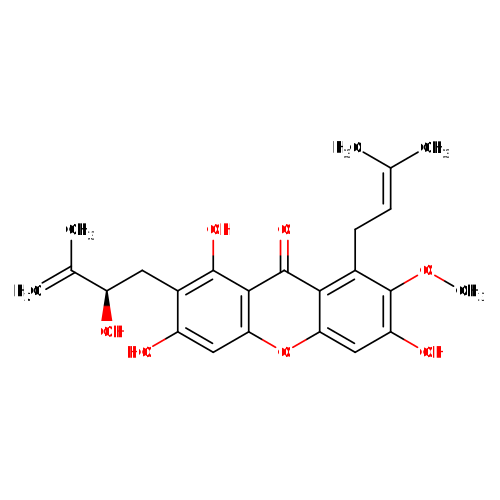
| Structure | [H]OC1=C(OC([H])([H])[H])C(=C2C(=O)C3=C(O[H])C(=C(O[H])C([H])=C3OC2=C1[H])C([H])([H])[C@@]([H])(O[H])C(=C([H])[H])C([H])([H])[H])C([H])([H])C([H])=C(C([H])([H])[H])C([H])([H])[H] InChI=1S/C24H26O7/c1-11(2)6-7-13-20-18(10-17(27)24(13)30-5)31-19-9-16(26)14(8-15(25)12(3)4)22(28)21(19)23(20)29/h6,9-10,15,25-28H,3,7-8H2,1-2,4-5H3/t15-/m1/s1 |
|---|
| Synonyms | Not Available |
|---|
| Chemical Formula | C24H26O7 |
|---|
| Average Mass | 426.4650 Da |
|---|
| Monoisotopic Mass | 426.16785 Da |
|---|
| IUPAC Name | 1,3,6-trihydroxy-2-[(2R)-2-hydroxy-3-methylbut-3-en-1-yl]-7-methoxy-8-(3-methylbut-2-en-1-yl)-9H-xanthen-9-one |
|---|
| Traditional Name | 1,3,6-trihydroxy-2-[(2R)-2-hydroxy-3-methylbut-3-en-1-yl]-7-methoxy-8-(3-methylbut-2-en-1-yl)xanthen-9-one |
|---|
| CAS Registry Number | Not Available |
|---|
| SMILES | [H]OC1=C(OC([H])([H])[H])C(=C2C(=O)C3=C(O[H])C(=C(O[H])C([H])=C3OC2=C1[H])C([H])([H])[C@@]([H])(O[H])C(=C([H])[H])C([H])([H])[H])C([H])([H])C([H])=C(C([H])([H])[H])C([H])([H])[H] |
|---|
| InChI Identifier | InChI=1S/C24H26O7/c1-11(2)6-7-13-20-18(10-17(27)24(13)30-5)31-19-9-16(26)14(8-15(25)12(3)4)22(28)21(19)23(20)29/h6,9-10,15,25-28H,3,7-8H2,1-2,4-5H3/t15-/m1/s1 |
|---|
| InChI Key | ATOPEAUOJODWMN-OAHLLOKOSA-N |
|---|
| Experimental Spectra |
|---|
|
| | Spectrum Type | Description | Depositor Email | Depositor Organization | Depositor | Deposition Date | View |
|---|
| 1D NMR | 13C NMR Spectrum (1D, 300 MHz, CDCl3 + CD3OD, simulated) | Wishart Lab | Wishart Lab | David Wishart | 2021-06-20 | View Spectrum | | 1D NMR | 1H NMR Spectrum (1D, 300 MHz, CDCl3 + CD3OD, simulated) | Wishart Lab | Wishart Lab | David Wishart | 2021-06-20 | View Spectrum | | 1D NMR | 13C NMR Spectrum (1D, 100 MHz, CDCl3 + CD3OD, simulated) | Wishart Lab | Wishart Lab | David Wishart | 2021-06-20 | View Spectrum | | 1D NMR | 1H NMR Spectrum (1D, 100 MHz, CDCl3 + CD3OD, simulated) | Wishart Lab | Wishart Lab | David Wishart | 2021-06-20 | View Spectrum | | 1D NMR | 13C NMR Spectrum (1D, 200 MHz, CDCl3 + CD3OD, simulated) | Wishart Lab | Wishart Lab | David Wishart | 2021-06-20 | View Spectrum | | 1D NMR | 1H NMR Spectrum (1D, 200 MHz, CDCl3 + CD3OD, simulated) | Wishart Lab | Wishart Lab | David Wishart | 2021-06-20 | View Spectrum | | 1D NMR | 13C NMR Spectrum (1D, 400 MHz, CDCl3 + CD3OD, simulated) | Wishart Lab | Wishart Lab | David Wishart | 2021-06-20 | View Spectrum | | 1D NMR | 1H NMR Spectrum (1D, 400 MHz, CDCl3 + CD3OD, simulated) | Wishart Lab | Wishart Lab | David Wishart | 2021-06-20 | View Spectrum | | 1D NMR | 13C NMR Spectrum (1D, 500 MHz, CDCl3 + CD3OD, simulated) | Wishart Lab | Wishart Lab | David Wishart | 2021-06-20 | View Spectrum | | 1D NMR | 1H NMR Spectrum (1D, 500 MHz, CDCl3 + CD3OD, simulated) | Wishart Lab | Wishart Lab | David Wishart | 2021-06-20 | View Spectrum | | 1D NMR | 13C NMR Spectrum (1D, 600 MHz, CDCl3 + CD3OD, simulated) | Wishart Lab | Wishart Lab | David Wishart | 2021-06-20 | View Spectrum | | 1D NMR | 1H NMR Spectrum (1D, 600 MHz, CDCl3 + CD3OD, simulated) | Wishart Lab | Wishart Lab | David Wishart | 2021-06-20 | View Spectrum | | 1D NMR | 13C NMR Spectrum (1D, 700 MHz, CDCl3 + CD3OD, simulated) | Wishart Lab | Wishart Lab | David Wishart | 2021-06-20 | View Spectrum | | 1D NMR | 1H NMR Spectrum (1D, 700 MHz, CDCl3 + CD3OD, simulated) | Wishart Lab | Wishart Lab | David Wishart | 2021-06-20 | View Spectrum | | 1D NMR | 13C NMR Spectrum (1D, 800 MHz, CDCl3 + CD3OD, simulated) | Wishart Lab | Wishart Lab | David Wishart | 2021-06-20 | View Spectrum | | 1D NMR | 1H NMR Spectrum (1D, 800 MHz, CDCl3 + CD3OD, simulated) | Wishart Lab | Wishart Lab | David Wishart | 2021-06-20 | View Spectrum | | 1D NMR | 13C NMR Spectrum (1D, 900 MHz, CDCl3 + CD3OD, simulated) | Wishart Lab | Wishart Lab | David Wishart | 2021-06-20 | View Spectrum | | 1D NMR | 1H NMR Spectrum (1D, 900 MHz, CDCl3 + CD3OD, simulated) | Wishart Lab | Wishart Lab | David Wishart | 2021-06-20 | View Spectrum | | 1D NMR | 13C NMR Spectrum (1D, 1000 MHz, CDCl3 + CD3OD, simulated) | Wishart Lab | Wishart Lab | David Wishart | 2021-06-20 | View Spectrum | | 1D NMR | 1H NMR Spectrum (1D, 1000 MHz, CDCl3 + CD3OD, simulated) | Wishart Lab | Wishart Lab | David Wishart | 2021-06-20 | View Spectrum |
| | Predicted Spectra |
|---|
|
| Not Available | | Chemical Shift Submissions |
|---|
|
| Not Available | | Species |
|---|
| Species of Origin | |
|---|
| Chemical Taxonomy |
|---|
| Description | Belongs to the class of organic compounds known as 8-prenylated xanthones. These are organic compounds containing a C5-isoprenoid group linked to a xanthone moiety at the 8-position. Xanthone is a tricyclic compound made up of two benzene rings linearly fused to each other through a pyran ring that carries a ketone group. |
|---|
| Kingdom | Organic compounds |
|---|
| Super Class | Organoheterocyclic compounds |
|---|
| Class | Benzopyrans |
|---|
| Sub Class | 1-benzopyrans |
|---|
| Direct Parent | 8-prenylated xanthones |
|---|
| Alternative Parents | Not Available |
|---|
| Substituents | Not Available |
|---|
| Molecular Framework | Aromatic heteropolycyclic compounds |
|---|
| External Descriptors | Not Available |
|---|
| Physical Properties |
|---|
| State | Not Available |
|---|
| Experimental Properties | | Property | Value | Reference |
|---|
| Melting Point | Not Available | Not Available | | Boiling Point | Not Available | Not Available | | Water Solubility | Not Available | Not Available | | LogP | Not Available | Not Available |
|
|---|
| Predicted Properties | |
|---|
| General References | - See I, Ee GCL, Jong VYM, Teh SS, Acuna CLC, Mah SH: Cytotoxic activity of phytochemicals from Garcinia mangostana L. and G. benthamiana (Planch. & Triana) Pipoly against breast cancer cells. Nat Prod Res. 2020 Oct 23:1-6. doi: 10.1080/14786419.2020.1836629. [PubMed:33094642 ]
- See I, Ee GC, Teh SS, Kadir AA, Daud S: Two new chemical constituents from the stem bark of Garcinia mangostana. Molecules. 2014 Jun 4;19(6):7308-16. doi: 10.3390/molecules19067308. [PubMed:24901833 ]
- Suksamrarn S, Suwannapoch N, Ratananukul P, Aroonlerk N, Suksamrarn A: Xanthones from the green fruit hulls of Garcinia mangostana. J Nat Prod. 2002 May;65(5):761-3. doi: 10.1021/np010566g. [PubMed:12027762 ]
- Suksamrarn, S., et al. (2002). Suksamrarn, S., et al, J. Nat. Prod. 65, 761 (2002). J. Nat. Prod..
|
|---|