| Record Information |
|---|
| Version | 2.0 |
|---|
| Created at | 2021-01-06 07:03:15 UTC |
|---|
| Updated at | 2021-07-15 17:37:17 UTC |
|---|
| NP-MRD ID | NP0021788 |
|---|
| Secondary Accession Numbers | None |
|---|
| Natural Product Identification |
|---|
| Common Name | Averantin |
|---|
| Provided By | NPAtlas |
|---|
| Description | Averantin is a secondary metabolite. Secondary metabolites are metabolically or physiologically non-essential metabolites that may serve a role as defense or signalling molecules. In some cases they are simply molecules that arise from the incomplete metabolism of other secondary metabolites. Averantin is found in Aspergillus parasiticus. Averantin was first documented in 1966 (PMID: 5948685). Based on a literature review a small amount of articles have been published on averantin (PMID: 25611347) (PMID: 33373758) (PMID: 25103412) (PMID: 25022791). |
|---|
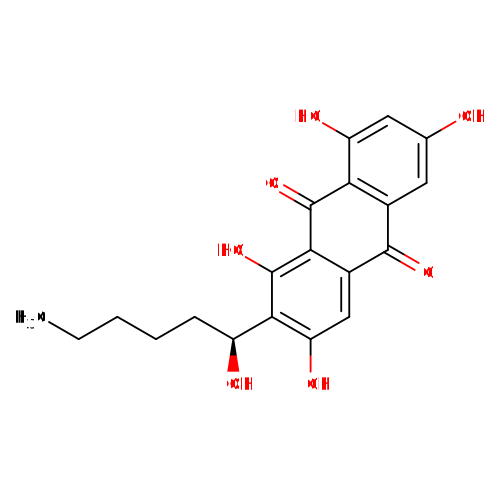
| Structure | [H]OC1=C([H])C(O[H])=C2C(=O)C3=C(O[H])C(=C(O[H])C([H])=C3C(=O)C2=C1[H])[C@@]([H])(O[H])C([H])([H])C([H])([H])C([H])([H])C([H])([H])C([H])([H])[H] InChI=1S/C20H20O7/c1-2-3-4-5-12(22)17-14(24)8-11-16(20(17)27)19(26)15-10(18(11)25)6-9(21)7-13(15)23/h6-8,12,21-24,27H,2-5H2,1H3/t12-/m0/s1 |
|---|
| Synonyms | | Value | Source |
|---|
| 1,3,6,8-Tetrahydroxy-2-(1-hydroxyhexyl)anthraquinone | ChEBI | | 2-(1-Hydroxyhexyl)-1,3,6,8-tetrahydroxyanthraquinone | ChEBI |
|
|---|
| Chemical Formula | C20H20O7 |
|---|
| Average Mass | 372.3730 Da |
|---|
| Monoisotopic Mass | 372.12090 Da |
|---|
| IUPAC Name | 1,3,6,8-tetrahydroxy-2-[(1S)-1-hydroxyhexyl]-9,10-dihydroanthracene-9,10-dione |
|---|
| Traditional Name | 1,3,6,8-tetrahydroxy-2-[(1S)-1-hydroxyhexyl]anthracene-9,10-dione |
|---|
| CAS Registry Number | Not Available |
|---|
| SMILES | CCCCCC(O)C1=C(O)C=C2C(=O)C3=CC(O)=CC(O)=C3C(=O)C2=C1O |
|---|
| InChI Identifier | InChI=1S/C20H20O7/c1-2-3-4-5-12(22)17-14(24)8-11-16(20(17)27)19(26)15-10(18(11)25)6-9(21)7-13(15)23/h6-8,12,21-24,27H,2-5H2,1H3 |
|---|
| InChI Key | WGPOPPKSQRZUTP-UHFFFAOYSA-N |
|---|
| Experimental Spectra |
|---|
|
| Not Available | | Predicted Spectra |
|---|
|
| | Spectrum Type | Description | Depositor ID | Depositor Organization | Depositor | Deposition Date | View |
|---|
| 1D NMR | 13C NMR Spectrum (1D, 25 MHz, D2O, predicted) | Wishart Lab | Wishart Lab | David Wishart | 2021-06-20 | View Spectrum | | 1D NMR | 1H NMR Spectrum (1D, 100 MHz, D2O, predicted) | Wishart Lab | Wishart Lab | David Wishart | 2021-06-20 | View Spectrum | | 1D NMR | 13C NMR Spectrum (1D, 252 MHz, D2O, predicted) | Wishart Lab | Wishart Lab | David Wishart | 2021-06-20 | View Spectrum | | 1D NMR | 1H NMR Spectrum (1D, 1000 MHz, D2O, predicted) | Wishart Lab | Wishart Lab | David Wishart | 2021-06-20 | View Spectrum | | 1D NMR | 13C NMR Spectrum (1D, 50 MHz, D2O, predicted) | Wishart Lab | Wishart Lab | David Wishart | 2021-06-20 | View Spectrum | | 1D NMR | 1H NMR Spectrum (1D, 200 MHz, D2O, predicted) | Wishart Lab | Wishart Lab | David Wishart | 2021-06-20 | View Spectrum | | 1D NMR | 13C NMR Spectrum (1D, 75 MHz, D2O, predicted) | Wishart Lab | Wishart Lab | David Wishart | 2021-06-20 | View Spectrum | | 1D NMR | 1H NMR Spectrum (1D, 300 MHz, D2O, predicted) | Wishart Lab | Wishart Lab | David Wishart | 2021-06-20 | View Spectrum | | 1D NMR | 13C NMR Spectrum (1D, 101 MHz, D2O, predicted) | Wishart Lab | Wishart Lab | David Wishart | 2021-06-20 | View Spectrum | | 1D NMR | 1H NMR Spectrum (1D, 400 MHz, D2O, predicted) | Wishart Lab | Wishart Lab | David Wishart | 2021-06-20 | View Spectrum | | 1D NMR | 13C NMR Spectrum (1D, 126 MHz, D2O, predicted) | Wishart Lab | Wishart Lab | David Wishart | 2021-06-20 | View Spectrum | | 1D NMR | 1H NMR Spectrum (1D, 500 MHz, D2O, predicted) | Wishart Lab | Wishart Lab | David Wishart | 2021-06-20 | View Spectrum | | 1D NMR | 13C NMR Spectrum (1D, 151 MHz, D2O, predicted) | Wishart Lab | Wishart Lab | David Wishart | 2021-06-20 | View Spectrum | | 1D NMR | 1H NMR Spectrum (1D, 600 MHz, D2O, predicted) | Wishart Lab | Wishart Lab | David Wishart | 2021-06-20 | View Spectrum | | 1D NMR | 13C NMR Spectrum (1D, 176 MHz, D2O, predicted) | Wishart Lab | Wishart Lab | David Wishart | 2021-06-20 | View Spectrum | | 1D NMR | 1H NMR Spectrum (1D, 700 MHz, D2O, predicted) | Wishart Lab | Wishart Lab | David Wishart | 2021-06-20 | View Spectrum | | 1D NMR | 13C NMR Spectrum (1D, 201 MHz, D2O, predicted) | Wishart Lab | Wishart Lab | David Wishart | 2021-06-20 | View Spectrum | | 1D NMR | 1H NMR Spectrum (1D, 800 MHz, D2O, predicted) | Wishart Lab | Wishart Lab | David Wishart | 2021-06-20 | View Spectrum | | 1D NMR | 13C NMR Spectrum (1D, 226 MHz, D2O, predicted) | Wishart Lab | Wishart Lab | David Wishart | 2021-06-20 | View Spectrum | | 1D NMR | 1H NMR Spectrum (1D, 900 MHz, D2O, predicted) | Wishart Lab | Wishart Lab | David Wishart | 2021-06-20 | View Spectrum |
| | Chemical Shift Submissions |
|---|
|
| Not Available | | Species |
|---|
| Species of Origin | |
|---|
| Chemical Taxonomy |
|---|
| Description | This compound belongs to the class of organic compounds known as hydroxyanthraquinones. These are compounds containing a hydroxyanthraquinone moiety, which consists of an anthracene bearing a quinone, and hydroxyl group. |
|---|
| Kingdom | Organic compounds |
|---|
| Super Class | Benzenoids |
|---|
| Class | Anthracenes |
|---|
| Sub Class | Anthraquinones |
|---|
| Direct Parent | Hydroxyanthraquinones |
|---|
| Alternative Parents | |
|---|
| Substituents | - Hydroxyanthraquinone
- Fatty alcohol
- Aryl ketone
- 1-hydroxy-4-unsubstituted benzenoid
- 1-hydroxy-2-unsubstituted benzenoid
- Fatty acyl
- Vinylogous acid
- Ketone
- Secondary alcohol
- Polyol
- Alcohol
- Aromatic alcohol
- Organooxygen compound
- Hydrocarbon derivative
- Organic oxide
- Organic oxygen compound
- Aromatic homopolycyclic compound
|
|---|
| Molecular Framework | Aromatic homopolycyclic compounds |
|---|
| External Descriptors | |
|---|
| Physical Properties |
|---|
| State | Not Available |
|---|
| Experimental Properties | | Property | Value | Reference |
|---|
| Melting Point | Not Available | Not Available | | Boiling Point | Not Available | Not Available | | Water Solubility | Not Available | Not Available | | LogP | Not Available | Not Available |
|
|---|
| Predicted Properties | |
|---|
| General References | - Tatsuda D, Momose I, Someno T, Sawa R, Kubota Y, Iijima M, Kunisada T, Watanabe T, Shibasaki M, Nomoto A: Quinofuracins A-E, produced by the fungus Staphylotrichum boninense PF1444, show p53-dependent growth suppression. J Nat Prod. 2015 Feb 27;78(2):188-95. doi: 10.1021/np500581m. Epub 2015 Jan 22. [PubMed:25611347 ]
- Birkinshaw JH, Roberts JC, Roffey P: Studies in mycological chemistry. XIX. "Product B" (averantin) [1,3,6,8-tetrahydroxy-2-(1-hydroxyhexyl)anthraquinone], a pigment from Aspergillus versicolor (Vuillemin) Tiraboschi. J Chem Soc Perkin 1. 1966;9:855-7. doi: 10.1039/j39660000855. [PubMed:5948685 ]
- Liang X, Huang ZH, Ma X, Zheng ZH, Zhang XX, Lu XH, Qi SH: Mycotoxins as inhibitors of protein tyrosine phosphatases from the deep-sea-derived fungus Aspergillus puniceus SCSIO z021. Bioorg Chem. 2021 Feb;107:104571. doi: 10.1016/j.bioorg.2020.104571. Epub 2020 Dec 19. [PubMed:33373758 ]
- Li H, Wei J, Pan SY, Gao JM, Tian JM: Antifungal, phytotoxic and toxic metabolites produced by Penicillium purpurogenum. Nat Prod Res. 2014;28(24):2358-61. doi: 10.1080/14786419.2014.940586. Epub 2014 Aug 7. [PubMed:25103412 ]
- Liu K, Zheng Y, Miao C, Xiong Z, Xu L, Guan H, Yang Y, Zhao L: The antifungal metabolites obtained from the rhizospheric Aspergillus sp. YIM PH30001 against pathogenic fungi of Panax notoginseng. Nat Prod Res. 2014;28(24):2334-7. doi: 10.1080/14786419.2014.935941. Epub 2014 Jul 15. [PubMed:25022791 ]
|
|---|