| Record Information |
|---|
| Version | 2.0 |
|---|
| Created at | 2021-01-06 06:59:50 UTC |
|---|
| Updated at | 2021-07-15 17:37:05 UTC |
|---|
| NP-MRD ID | NP0021720 |
|---|
| Secondary Accession Numbers | None |
|---|
| Natural Product Identification |
|---|
| Common Name | Baeocystin |
|---|
| Provided By | NPAtlas |
|---|
| Description | Baeocystin is a secondary metabolite. Secondary metabolites are metabolically or physiologically non-essential metabolites that may serve a role as defense or signalling molecules. In some cases they are simply molecules that arise from the incomplete metabolism of other secondary metabolites. Baeocystin is found in Gymnopilus purpuratus, Inocybe aeruginascens, Psilocybe baeocystis, Psilocybe cubensis, Psilocybe liniformans, Psilocybe samuiensis and Psilocybe semilanceata. Baeocystin was first documented in 1968 (PMID: 5684732). Based on a literature review a small amount of articles have been published on Baeocystin (PMID: 17269025) (PMID: 17269094) (PMID: 17342589) (PMID: 2614674). |
|---|
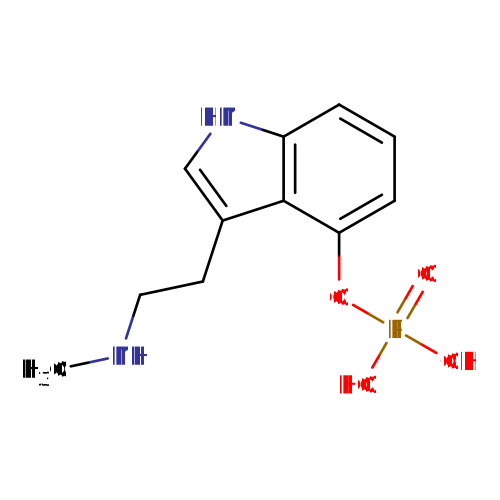
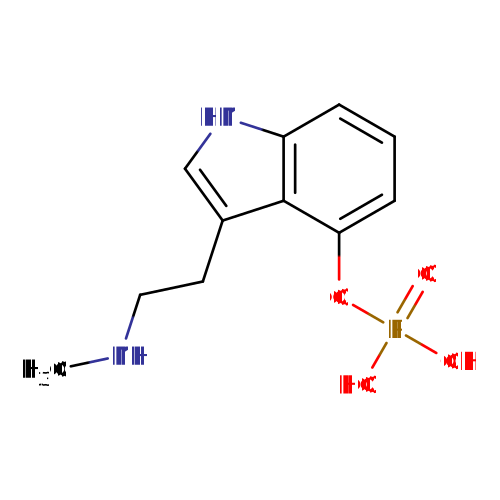
| Structure | [H]O[P](=O)(O[H])OC1=C2C(N([H])C([H])=C2C([H])([H])C([H])([H])N([H])C([H])([H])[H])=C([H])C([H])=C1[H] InChI=1S/C11H15N2O4P/c1-12-6-5-8-7-13-9-3-2-4-10(11(8)9)17-18(14,15)16/h2-4,7,12-13H,5-6H2,1H3,(H2,14,15,16) |
|---|
| Synonyms | | Value | Source |
|---|
| 4-Hydroxy-N-methyltryptamine 4-phosphate | ChEBI | | 4-Hydroxy-N-methyltryptamine phosphate | ChEBI | | N-Desmethylpsilocybin | ChEBI | | 4-Hydroxy-N-methyltryptamine 4-phosphoric acid | Generator | | 4-Hydroxy-N-methyltryptamine phosphoric acid | Generator |
|
|---|
| Chemical Formula | C11H15N2O4P |
|---|
| Average Mass | 270.2250 Da |
|---|
| Monoisotopic Mass | 270.07694 Da |
|---|
| IUPAC Name | ({3-[2-(methylamino)ethyl]-1H-indol-4-yl}oxy)phosphonic acid |
|---|
| Traditional Name | baeocystin |
|---|
| CAS Registry Number | Not Available |
|---|
| SMILES | CNCCC1=CNC2=C1C(OP(O)(O)=O)=CC=C2 |
|---|
| InChI Identifier | InChI=1S/C11H15N2O4P/c1-12-6-5-8-7-13-9-3-2-4-10(11(8)9)17-18(14,15)16/h2-4,7,12-13H,5-6H2,1H3,(H2,14,15,16) |
|---|
| InChI Key | WTPBXXCVZZZXKR-UHFFFAOYSA-N |
|---|
| Experimental Spectra |
|---|
|
| Not Available | | Predicted Spectra |
|---|
|
| | Spectrum Type | Description | Depositor ID | Depositor Organization | Depositor | Deposition Date | View |
|---|
| 1D NMR | 13C NMR Spectrum (1D, 25 MHz, D2O, predicted) | Wishart Lab | Wishart Lab | David Wishart | 2021-06-20 | View Spectrum | | 1D NMR | 1H NMR Spectrum (1D, 100 MHz, D2O, predicted) | Wishart Lab | Wishart Lab | David Wishart | 2021-06-20 | View Spectrum | | 1D NMR | 13C NMR Spectrum (1D, 252 MHz, D2O, predicted) | Wishart Lab | Wishart Lab | David Wishart | 2021-06-20 | View Spectrum | | 1D NMR | 1H NMR Spectrum (1D, 1000 MHz, D2O, predicted) | Wishart Lab | Wishart Lab | David Wishart | 2021-06-20 | View Spectrum | | 1D NMR | 13C NMR Spectrum (1D, 50 MHz, D2O, predicted) | Wishart Lab | Wishart Lab | David Wishart | 2021-06-20 | View Spectrum | | 1D NMR | 1H NMR Spectrum (1D, 200 MHz, D2O, predicted) | Wishart Lab | Wishart Lab | David Wishart | 2021-06-20 | View Spectrum | | 1D NMR | 13C NMR Spectrum (1D, 75 MHz, D2O, predicted) | Wishart Lab | Wishart Lab | David Wishart | 2021-06-20 | View Spectrum | | 1D NMR | 1H NMR Spectrum (1D, 300 MHz, D2O, predicted) | Wishart Lab | Wishart Lab | David Wishart | 2021-06-20 | View Spectrum | | 1D NMR | 13C NMR Spectrum (1D, 101 MHz, D2O, predicted) | Wishart Lab | Wishart Lab | David Wishart | 2021-06-20 | View Spectrum | | 1D NMR | 1H NMR Spectrum (1D, 400 MHz, D2O, predicted) | Wishart Lab | Wishart Lab | David Wishart | 2021-06-20 | View Spectrum | | 1D NMR | 13C NMR Spectrum (1D, 126 MHz, D2O, predicted) | Wishart Lab | Wishart Lab | David Wishart | 2021-06-20 | View Spectrum | | 1D NMR | 1H NMR Spectrum (1D, 500 MHz, D2O, predicted) | Wishart Lab | Wishart Lab | David Wishart | 2021-06-20 | View Spectrum | | 1D NMR | 13C NMR Spectrum (1D, 151 MHz, D2O, predicted) | Wishart Lab | Wishart Lab | David Wishart | 2021-06-20 | View Spectrum | | 1D NMR | 1H NMR Spectrum (1D, 600 MHz, D2O, predicted) | Wishart Lab | Wishart Lab | David Wishart | 2021-06-20 | View Spectrum | | 1D NMR | 13C NMR Spectrum (1D, 176 MHz, D2O, predicted) | Wishart Lab | Wishart Lab | David Wishart | 2021-06-20 | View Spectrum | | 1D NMR | 1H NMR Spectrum (1D, 700 MHz, D2O, predicted) | Wishart Lab | Wishart Lab | David Wishart | 2021-06-20 | View Spectrum | | 1D NMR | 13C NMR Spectrum (1D, 201 MHz, D2O, predicted) | Wishart Lab | Wishart Lab | David Wishart | 2021-06-20 | View Spectrum | | 1D NMR | 1H NMR Spectrum (1D, 800 MHz, D2O, predicted) | Wishart Lab | Wishart Lab | David Wishart | 2021-06-20 | View Spectrum | | 1D NMR | 13C NMR Spectrum (1D, 226 MHz, D2O, predicted) | Wishart Lab | Wishart Lab | David Wishart | 2021-06-20 | View Spectrum | | 1D NMR | 1H NMR Spectrum (1D, 900 MHz, D2O, predicted) | Wishart Lab | Wishart Lab | David Wishart | 2021-06-20 | View Spectrum |
| | Chemical Shift Submissions |
|---|
|
| Not Available | | Species |
|---|
| Species of Origin | |
|---|
| Species Where Detected | |
|---|
| Chemical Taxonomy |
|---|
| Description | This compound belongs to the class of organic compounds known as tryptamines and derivatives. These are compounds containing the tryptamine backbone, which is structurally characterized by an indole ring substituted at the 3-position by an ethanamine. |
|---|
| Kingdom | Organic compounds |
|---|
| Super Class | Organoheterocyclic compounds |
|---|
| Class | Indoles and derivatives |
|---|
| Sub Class | Tryptamines and derivatives |
|---|
| Direct Parent | Tryptamines and derivatives |
|---|
| Alternative Parents | |
|---|
| Substituents | - Tryptamine
- Aryl phosphate
- Aryl phosphomonoester
- 3-alkylindole
- Indole
- Aralkylamine
- Organic phosphoric acid derivative
- Phosphoric acid ester
- Benzenoid
- Substituted pyrrole
- Pyrrole
- Heteroaromatic compound
- Secondary aliphatic amine
- Azacycle
- Secondary amine
- Amine
- Hydrocarbon derivative
- Organic oxide
- Organooxygen compound
- Organonitrogen compound
- Organopnictogen compound
- Organic oxygen compound
- Organic nitrogen compound
- Aromatic heteropolycyclic compound
|
|---|
| Molecular Framework | Aromatic heteropolycyclic compounds |
|---|
| External Descriptors | Not Available |
|---|
| Physical Properties |
|---|
| State | Not Available |
|---|
| Experimental Properties | | Property | Value | Reference |
|---|
| Melting Point | Not Available | Not Available | | Boiling Point | Not Available | Not Available | | Water Solubility | Not Available | Not Available | | LogP | Not Available | Not Available |
|
|---|
| Predicted Properties | |
|---|