| Record Information |
|---|
| Version | 2.0 |
|---|
| Created at | 2021-01-06 06:46:40 UTC |
|---|
| Updated at | 2021-07-15 17:36:30 UTC |
|---|
| NP-MRD ID | NP0021496 |
|---|
| Secondary Accession Numbers | None |
|---|
| Natural Product Identification |
|---|
| Common Name | PSX 1 |
|---|
| Provided By | NPAtlas |
|---|
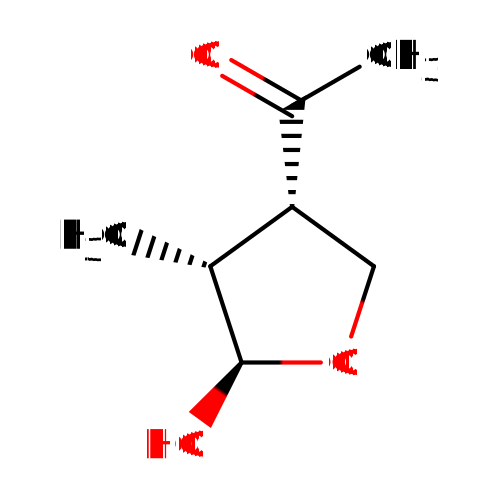
| Description | Botryodiplodin, also known as antibiotic PSX 1 or cytostipin, belongs to the class of organic compounds known as tetrahydrofurans. These are heterocyclic compounds containing a saturated, aliphatic, five-membered ring where a carbon is replaced by an oxygen. PSX 1 is found in Botryodiplodia theobromae, Macrophomina phaseolina, Penicillium, Penicillium carneoluteus, Penicillium roquefortii and Talaromyces stipitatus. PSX 1 was first documented in 2007 (PMID: 17628075). Based on a literature review very few articles have been published on Botryodiplodin (PMID: 24768282) (PMID: 26837531) (PMID: 33287215) (PMID: 32842542) (PMID: 31906290) (PMID: 31698804). |
|---|
| Structure | [H]O[C@]1([H])OC([H])([H])[C@@]([H])(C(=O)C([H])([H])[H])[C@@]1([H])C([H])([H])[H] InChI=1S/C7H12O3/c1-4-6(5(2)8)3-10-7(4)9/h4,6-7,9H,3H2,1-2H3/t4-,6-,7-/m1/s1 |
|---|
| Synonyms | | Value | Source |
|---|
| 1-(Tetrahydro-5-hydroxy-4-methyl-3-furanyl)-ethanone | HMDB | | 1-(Tetrahydro-5-hydroxy-4-methyl-3-furanyl)ethanone | HMDB | | 1-(Tetrahydro-5-hydroxy-4-methyl-3-furanyl)ethanone, 9ci | HMDB | | 2-Hydroxy-3-methyl-4-acetyltetrahydrofuran | HMDB | | 2-Hydroxy-3-methyl-4-acetyltetrahydrofurane | HMDB | | 4-Acetyl-2-hydroxy-3-methyltetrahydrofuran | HMDB | | Antibiotic PSX 1 | HMDB | | Botrydiplodin | HMDB | | Botryodiplodin (synthetic) | HMDB | | Botryodipolodin | HMDB | | Botyrodiplodin | HMDB | | Cytostipin | HMDB | | Ketone, methyl tetrahydro-5-hydroxy-4-methyl-3-furyl | HMDB | | Methyltetrahydro-5-hydroxy-4-methyl-3-furyl-ketone | HMDB | | PSX 1 | HMDB | | Botriodiplodin | HMDB | | PSX-1 | HMDB | | Botryodiplodin | MeSH |
|
|---|
| Chemical Formula | C7H12O3 |
|---|
| Average Mass | 144.1684 Da |
|---|
| Monoisotopic Mass | 144.07864 Da |
|---|
| IUPAC Name | 1-[(3S,4R,5R)-5-hydroxy-4-methyloxolan-3-yl]ethan-1-one |
|---|
| Traditional Name | 1-[(3S,4R,5R)-5-hydroxy-4-methyloxolan-3-yl]ethanone |
|---|
| CAS Registry Number | Not Available |
|---|
| SMILES | CC1C(O)OCC1C(C)=O |
|---|
| InChI Identifier | InChI=1S/C7H12O3/c1-4-6(5(2)8)3-10-7(4)9/h4,6-7,9H,3H2,1-2H3 |
|---|
| InChI Key | CLYSZQBIUYRLNX-UHFFFAOYSA-N |
|---|
| Experimental Spectra |
|---|
|
| Not Available | | Predicted Spectra |
|---|
|
| | Spectrum Type | Description | Depositor ID | Depositor Organization | Depositor | Deposition Date | View |
|---|
| 1D NMR | 13C NMR Spectrum (1D, 25 MHz, D2O, predicted) | Wishart Lab | Wishart Lab | David Wishart | 2021-06-20 | View Spectrum | | 1D NMR | 1H NMR Spectrum (1D, 100 MHz, D2O, predicted) | Wishart Lab | Wishart Lab | David Wishart | 2021-06-20 | View Spectrum | | 1D NMR | 13C NMR Spectrum (1D, 252 MHz, D2O, predicted) | Wishart Lab | Wishart Lab | David Wishart | 2021-06-20 | View Spectrum | | 1D NMR | 1H NMR Spectrum (1D, 1000 MHz, D2O, predicted) | Wishart Lab | Wishart Lab | David Wishart | 2021-06-20 | View Spectrum | | 1D NMR | 13C NMR Spectrum (1D, 50 MHz, D2O, predicted) | Wishart Lab | Wishart Lab | David Wishart | 2021-06-20 | View Spectrum | | 1D NMR | 1H NMR Spectrum (1D, 200 MHz, D2O, predicted) | Wishart Lab | Wishart Lab | David Wishart | 2021-06-20 | View Spectrum | | 1D NMR | 13C NMR Spectrum (1D, 75 MHz, D2O, predicted) | Wishart Lab | Wishart Lab | David Wishart | 2021-06-20 | View Spectrum | | 1D NMR | 1H NMR Spectrum (1D, 300 MHz, D2O, predicted) | Wishart Lab | Wishart Lab | David Wishart | 2021-06-20 | View Spectrum | | 1D NMR | 13C NMR Spectrum (1D, 101 MHz, D2O, predicted) | Wishart Lab | Wishart Lab | David Wishart | 2021-06-20 | View Spectrum | | 1D NMR | 1H NMR Spectrum (1D, 400 MHz, D2O, predicted) | Wishart Lab | Wishart Lab | David Wishart | 2021-06-20 | View Spectrum | | 1D NMR | 13C NMR Spectrum (1D, 126 MHz, D2O, predicted) | Wishart Lab | Wishart Lab | David Wishart | 2021-06-20 | View Spectrum | | 1D NMR | 1H NMR Spectrum (1D, 500 MHz, D2O, predicted) | Wishart Lab | Wishart Lab | David Wishart | 2021-06-20 | View Spectrum | | 1D NMR | 13C NMR Spectrum (1D, 151 MHz, D2O, predicted) | Wishart Lab | Wishart Lab | David Wishart | 2021-06-20 | View Spectrum | | 1D NMR | 1H NMR Spectrum (1D, 600 MHz, D2O, predicted) | Wishart Lab | Wishart Lab | David Wishart | 2021-06-20 | View Spectrum | | 1D NMR | 13C NMR Spectrum (1D, 176 MHz, D2O, predicted) | Wishart Lab | Wishart Lab | David Wishart | 2021-06-20 | View Spectrum | | 1D NMR | 1H NMR Spectrum (1D, 700 MHz, D2O, predicted) | Wishart Lab | Wishart Lab | David Wishart | 2021-06-20 | View Spectrum | | 1D NMR | 13C NMR Spectrum (1D, 201 MHz, D2O, predicted) | Wishart Lab | Wishart Lab | David Wishart | 2021-06-20 | View Spectrum | | 1D NMR | 1H NMR Spectrum (1D, 800 MHz, D2O, predicted) | Wishart Lab | Wishart Lab | David Wishart | 2021-06-20 | View Spectrum | | 1D NMR | 13C NMR Spectrum (1D, 226 MHz, D2O, predicted) | Wishart Lab | Wishart Lab | David Wishart | 2021-06-20 | View Spectrum | | 1D NMR | 1H NMR Spectrum (1D, 900 MHz, D2O, predicted) | Wishart Lab | Wishart Lab | David Wishart | 2021-06-20 | View Spectrum |
| | Chemical Shift Submissions |
|---|
|
| Not Available | | Species |
|---|
| Species of Origin | |
|---|
| Chemical Taxonomy |
|---|
| Description | Belongs to the class of organic compounds known as tetrahydrofurans. These are heterocyclic compounds containing a saturated, aliphatic, five-membered ring where a carbon is replaced by an oxygen. |
|---|
| Kingdom | Organic compounds |
|---|
| Super Class | Organoheterocyclic compounds |
|---|
| Class | Tetrahydrofurans |
|---|
| Sub Class | Not Available |
|---|
| Direct Parent | Tetrahydrofurans |
|---|
| Alternative Parents | |
|---|
| Substituents | - Tetrahydrofuran
- Ketone
- Hemiacetal
- Oxacycle
- Organic oxygen compound
- Organic oxide
- Hydrocarbon derivative
- Organooxygen compound
- Carbonyl group
- Aliphatic heteromonocyclic compound
|
|---|
| Molecular Framework | Aliphatic heteromonocyclic compounds |
|---|
| External Descriptors | Not Available |
|---|
| Physical Properties |
|---|
| State | Not Available |
|---|
| Experimental Properties | | Property | Value | Reference |
|---|
| Melting Point | Not Available | Not Available | | Boiling Point | Not Available | Not Available | | Water Solubility | Not Available | Not Available | | LogP | Not Available | Not Available |
|
|---|
| Predicted Properties | |
|---|
| General References | - Cabedo N, Lopez-Gresa MP, Primo J, Ciavatta ML, Gonzalez-Mas MC: Isolation and structural elucidation of eight new related analogues of the mycotoxin (-)-botryodiplodin from Penicillium coalescens. J Agric Food Chem. 2007 Aug 22;55(17):6977-83. doi: 10.1021/jf071568v. Epub 2007 Jul 12. [PubMed:17628075 ]
- Andolfi A, Maddau L, Cimmino A, Linaldeddu BT, Basso S, Deidda A, Serra S, Evidente A: Lasiojasmonates A-C, three jasmonic acid esters produced by Lasiodiplodia sp., a grapevine pathogen. Phytochemistry. 2014 Jul;103:145-153. doi: 10.1016/j.phytochem.2014.03.016. Epub 2014 Apr 23. [PubMed:24768282 ]
- Zang Y, Genta-Jouve G, Retailleau P, Escargueil A, Mann S, Nay B, Prado S: Talaroketals A and B, unusual bis(oxaphenalenone) spiro and fused ketals from the soil fungus Talaromyces stipitatus ATCC 10500. Org Biomol Chem. 2016 Mar 7;14(9):2691-7. doi: 10.1039/c5ob02657a. [PubMed:26837531 ]
- Khambhati VH, Abbas HK, Sulyok M, Tomaso-Peterson M, Shier WT: First Report of the Production of Mycotoxins and Other Secondary Metabolites by Macrophomina phaseolina (Tassi) Goid. Isolates from Soybeans (Glycine max L.) Symptomatic with Charcoal Rot Disease. J Fungi (Basel). 2020 Dec 3;6(4). pii: jof6040332. doi: 10.3390/jof6040332. [PubMed:33287215 ]
- Salvatore MM, Felix C, Lima F, Ferreira V, Duarte AS, Salvatore F, Alves A, Esteves AC, Andolfi A: Effect of gamma-Aminobutyric Acid (GABA) on the Metabolome of Two Strains of Lasiodiplodia theobromae Isolated from Grapevine. Molecules. 2020 Aug 23;25(17). pii: molecules25173833. doi: 10.3390/molecules25173833. [PubMed:32842542 ]
- Abbas HK, Bellaloui N, Butler AM, Nelson JL, Abou-Karam M, Shier WT: Phytotoxic Responses of Soybean (Glycine max L.) to Botryodiplodin, a Toxin Produced by the Charcoal Rot Disease Fungus, Macrophomina phaseolina. Toxins (Basel). 2020 Jan 1;12(1). pii: toxins12010025. doi: 10.3390/toxins12010025. [PubMed:31906290 ]
- Abbas HK, Bellaloui N, Accinelli C, Smith JR, Shier WT: Toxin Production in Soybean (Glycine max L.) Plants with Charcoal Rot Disease and by Macrophomina phaseolina, the Fungus that Causes the Disease. Toxins (Basel). 2019 Nov 6;11(11). pii: toxins11110645. doi: 10.3390/toxins11110645. [PubMed:31698804 ]
- Felix C, Salvatore MM, DellaGreca M, Ferreira V, Duarte AS, Salvatore F, Naviglio D, Gallo M, Alves A, Esteves AC, Andolfi A: Secondary metabolites produced by grapevine strains of Lasiodiplodia theobromae grown at two different temperatures. Mycologia. 2019 May-Jun;111(3):466-476. doi: 10.1080/00275514.2019.1600342. Epub 2019 Apr 26. [PubMed:31025901 ]
- Mioso R, Toledo Marante FJ, Herrera Bravo de Laguna I: Penicillium roqueforti: a multifunctional cell factory of high value-added molecules. J Appl Microbiol. 2015 Apr;118(4):781-91. doi: 10.1111/jam.12706. Epub 2014 Dec 29. [PubMed:25421646 ]
- Ramezani M, Shier WT, Abbas HK, Tonos JL, Baird RE, Sciumbato GL: Soybean charcoal rot disease fungus Macrophomina phaseolina in Mississippi produces the phytotoxin (-)-botryodiplodin but no detectable phaseolinone. J Nat Prod. 2007 Jan;70(1):128-9. doi: 10.1021/np060480t. [PubMed:17253865 ]
|
|---|