| Record Information |
|---|
| Version | 2.0 |
|---|
| Created at | 2005-11-16 15:48:42 UTC |
|---|
| Updated at | 2021-08-09 22:33:25 UTC |
|---|
| NP-MRD ID | NP0001222 |
|---|
| Secondary Accession Numbers | None |
|---|
| Natural Product Identification |
|---|
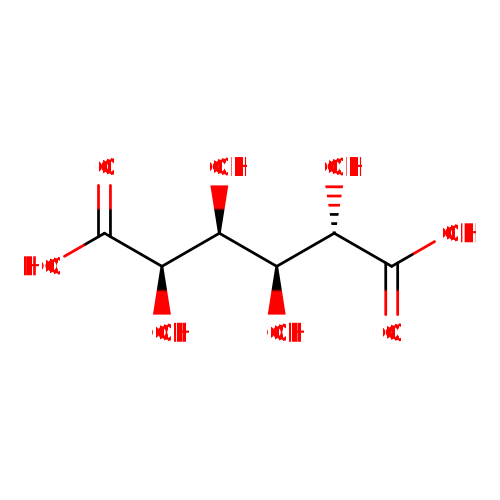
| Common Name | Glucaric acid |
|---|
| Description | Glucaric acid, also known as glucarate or D-saccharic acid, belongs to the class of organic compounds known as glucuronic acid derivatives. Glucuronic acid derivatives are compounds containing a glucuronic acid moiety (or a derivative), which consists of a glucose moiety with the C6 carbon oxidized to a carboxylic acid. Glucaric acid is a sugar acid derived from D-glucose in which both the aldehydic carbon atom and the carbon atom bearing the primary hydroxyl group are oxidized to carboxylic acid groups. D-glucaric acid is found in fruits, vegetables, and mammals. The highest concentrations of glucaric acid are found in grapefruits, apples, oranges, and cruciferous vegetables (PMID: 18772850 ). Glucaric acid is produced through the oxidation of glucose. Cytochrome P450 is thought to be responsible for the production of D-glucaric acid in vivo (PMID: 3779687 ). In mammals, D-glucaric acid and D-glucaro-l,4-lactone are also known end-products of the D-glucuronic acid pathway (PMID: 18772850 ). Glucaric is available as a dietary supplement in the form of calcium D-glucarate and has been studied for therapeutic purposes including cholesterol reduction and cancer chemotherapy (PMID: 9101079 ). D-Glucaric acid has a potential use as a building block for a number of polymers, including new nylons and hyperbranched polyesters. D-glucaric acid produced from D-glucose has been successfully utilized to produce a hydroxylated nylon. |
|---|
| Structure | O[C@@H]([C@H](O)[C@@H](O)C(O)=O)[C@H](O)C(O)=O InChI=1S/C6H10O8/c7-1(3(9)5(11)12)2(8)4(10)6(13)14/h1-4,7-10H,(H,11,12)(H,13,14)/t1-,2-,3-,4+/m0/s1 |
|---|
| Synonyms | | Value | Source |
|---|
| D-(+)-Saccharic acid | ChEBI | | D-Glucosaccharic acid | ChEBI | | D-Saccharic acid | ChEBI | | L-Gularic acid | ChEBI | | Saccharic acid | ChEBI | | D-Glucaric acid | Kegg | | Glucarate | Kegg | | D-(+)-Saccharate | Generator | | D-Glucosaccharate | Generator | | D-Saccharate | Generator | | L-Gularate | Generator | | Saccharate | Generator | | D-Glucarate | Generator | | (2R,3S,4S,5S)-2,3,4,5-Tetrahydroxyhexanedioate | HMDB | | (2R,3S,4S,5S)-2,3,4,5-Tetrahydroxyhexanedioic acid | HMDB | | D-Tetrahydroxyadipate | HMDB | | D-Tetrahydroxyadipic acid | HMDB | | DL-Glucaric acid | HMDB | | GKR | HMDB | | Glucosaccharic acid | HMDB | | Tetrahydroxyadipic acid | HMDB | | Acid, saccharic | HMDB | | Anhydrous calcium glucarate | HMDB | | Anhydrous calcium saccharate | HMDB | | Calcium saccharate | HMDB | | Glucarate, calcium | HMDB | | Levo gularic acid | HMDB | | Levo-gularic acid | HMDB | | Tetrahydrate, calcium saccharate | HMDB | | Calcium glucarate | HMDB | | Calcium glucarate, anhydrous | HMDB | | Calcium saccharate anhydrous | HMDB | | Calcium saccharate, anhydrous | HMDB | | D Glucaric acid | HMDB | | Saccharate tetrahydrate, calcium | HMDB | | Saccharate, calcium | HMDB | | Calcium saccharate tetrahydrate | HMDB | | D Saccharic acid | HMDB | | Glucarate, anhydrous calcium | HMDB | | L Gularic acid | HMDB | | Saccharate, anhydrous calcium | HMDB |
|
|---|
| Chemical Formula | C6H10O8 |
|---|
| Average Mass | 210.1388 Da |
|---|
| Monoisotopic Mass | 210.03757 Da |
|---|
| IUPAC Name | (2R,3S,4S,5S)-2,3,4,5-tetrahydroxyhexanedioic acid |
|---|
| Traditional Name | saccharic acid |
|---|
| CAS Registry Number | 25525-21-7 |
|---|
| SMILES | O[C@@H]([C@H](O)[C@@H](O)C(O)=O)[C@H](O)C(O)=O |
|---|
| InChI Identifier | InChI=1S/C6H10O8/c7-1(3(9)5(11)12)2(8)4(10)6(13)14/h1-4,7-10H,(H,11,12)(H,13,14)/t1-,2-,3-,4+/m0/s1 |
|---|
| InChI Key | DSLZVSRJTYRBFB-LLEIAEIESA-N |
|---|
| Experimental Spectra |
|---|
|
| | Spectrum Type | Description | Depositor Email | Depositor Organization | Depositor | Deposition Date | View |
|---|
| 1D NMR | 1H NMR Spectrum (1D, 600 MHz, 5%_DMSO, experimental) | Wishart Lab | Wishart Lab | David Wishart | 2021-06-20 | View Spectrum | | 2D NMR | [1H, 13C]-HSQC NMR Spectrum (2D, 600 MHz, 5%_DMSO, experimental) | Wishart Lab | Wishart Lab | David Wishart | 2021-06-20 | View Spectrum |
| | Predicted Spectra |
|---|
|
| Not Available | | Chemical Shift Submissions |
|---|
|
| Not Available | | Species |
|---|
| Species of Origin | |
|---|
| Species Where Detected | |
|---|
| Chemical Taxonomy |
|---|
| Description | Belongs to the class of organic compounds known as glucuronic acid derivatives. Glucuronic acid derivatives are compounds containing a glucuronic acid moiety (or a derivative), which consists of a glucose moiety with the C6 carbon oxidized to a carboxylic acid. |
|---|
| Kingdom | Organic compounds |
|---|
| Super Class | Organic oxygen compounds |
|---|
| Class | Organooxygen compounds |
|---|
| Sub Class | Carbohydrates and carbohydrate conjugates |
|---|
| Direct Parent | Glucuronic acid derivatives |
|---|
| Alternative Parents | |
|---|
| Substituents | - Glucuronic acid or derivatives
- Medium-chain hydroxy acid
- Medium-chain fatty acid
- Beta-hydroxy acid
- Hydroxy fatty acid
- Monosaccharide
- Hydroxy acid
- Dicarboxylic acid or derivatives
- Alpha-hydroxy acid
- Fatty acyl
- Fatty acid
- Secondary alcohol
- Polyol
- Carboxylic acid
- Carboxylic acid derivative
- Hydrocarbon derivative
- Organic oxide
- Carbonyl group
- Alcohol
- Aliphatic acyclic compound
|
|---|
| Molecular Framework | Aliphatic acyclic compounds |
|---|
| External Descriptors | |
|---|
| Physical Properties |
|---|
| State | Solid |
|---|
| Experimental Properties | | Property | Value | Reference |
|---|
| Melting Point | Not Available | Not Available | | Boiling Point | Not Available | Not Available | | Water Solubility | 912 mg/mL | Not Available | | LogP | Not Available | Not Available |
|
|---|
| Predicted Properties | |
|---|
| General References | - Matsushiro T, Suzuki N, Sato T, Maki T: Effects of diet on glucaric acid concentration in bile and the formation of calcium bilirubinate gallstones. Gastroenterology. 1977 Apr;72(4 Pt 1):630-3. [PubMed:320083 ]
- Roth B, Heimann G, Gladtke E: [Excretion of D-glucaric-acid in newborns with non-hemolytic hyperbilirubinemia after phenobarbital treatment (author's transl)]. Padiatr Padol. 1977;12(4):385-93. [PubMed:904946 ]
- Sorrell MF, Burnett DA, Tuma DJ, Barak AJ: Paradoxical urinary excretion of D-glucaric acid in acute viral hepatitis. Clin Pharmacol Ther. 1976 Sep;20(3):365-8. [PubMed:954355 ]
- Levy G, Khanna NN, Soda DM, Tsuzuki O, Stern L: Pharmacokinetics of acetaminophen in the human neonate: formation of acetaminophen glucuronide and sulfate in relation to plasma bilirubin concentration and D-glucaric acid excretion. Pediatrics. 1975 Jun;55(6):818-25. [PubMed:1134883 ]
- Traeger A, Horvath T, Rechenbach C, Javor T: Beta-adrenoceptor blocking drugs and cytochrome P-450: the influence of propranolol treatment on caffeine, antipyrine, D-glucaric acid and indocyanine green elimination in patients with hepatic disorders. Int J Clin Pharmacol Res. 1986;6(3):235-9. [PubMed:3744626 ]
- Herzberg M, Tenenbaum E, Fishel B, Wiener MH: D-Glucaric acid and gamma-glutamyltransferase as indices of hepatic enzyme induction in pregnancy. Clin Chem. 1977 Mar;23(3):596-8. [PubMed:13946 ]
- Zoltaszek R, Hanausek M, Kilianska ZM, Walaszek Z: [The biological role of D-glucaric acid and its derivatives: potential use in medicine]. Postepy Hig Med Dosw (Online). 2008 Sep 5;62:451-62. [PubMed:18772850 ]
- Marsh CA: Biosynthesis of D-glucaric acid in mammals: a free-radical mechanism? Carbohydr Res. 1986 Sep 15;153(1):119-31. doi: 10.1016/s0008-6215(00)90201-5. [PubMed:3779687 ]
- Walaszek Z, Szemraj J, Narog M, Adams AK, Kilgore J, Sherman U, Hanausek M: Metabolism, uptake, and excretion of a D-glucaric acid salt and its potential use in cancer prevention. Cancer Detect Prev. 1997;21(2):178-90. [PubMed:9101079 ]
|
|---|