| Record Information |
|---|
| Version | 2.0 |
|---|
| Created at | 2005-11-16 15:48:42 UTC |
|---|
| Updated at | 2025-02-11 15:41:26 UTC |
|---|
| NP-MRD ID | NP0000333 |
|---|
| Secondary Accession Numbers | None |
|---|
| Natural Product Identification |
|---|
| Common Name | Ureidosuccinic acid |
|---|
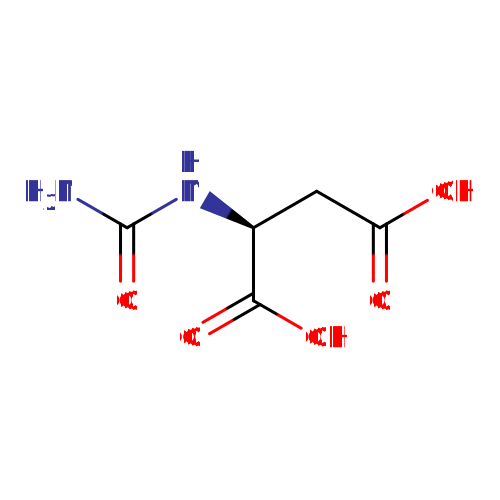
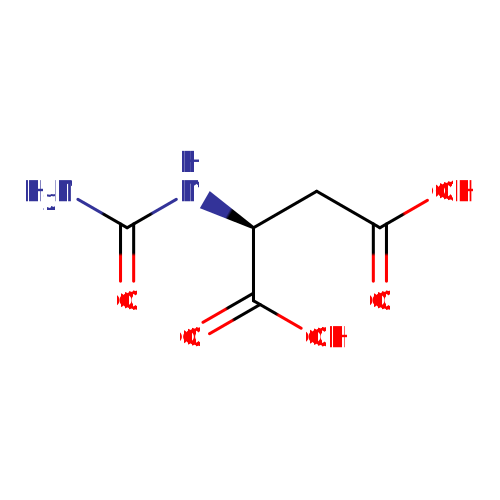
| Description | Ureidosuccinic acid, also known as L-ureidosuccinate or carbamyl-L-aspartate, belongs to the class of organic compounds known as aspartic acids and derivatives. Aspartic acids and derivatives are compounds containing an aspartic acid or a derivative thereof resulting from reaction of aspartic acid at the amino group or the carboxy group, or from the replacement of any hydrogen of glycine by a heteroatom. Ureidosuccinic acid is also classified as a carbamate derivative. It is a solid that is soluble in water. Ureidosuccinic acid exists in all living species, ranging from bacteria to plants to humans. Ureidosuccinic acid can be biosynthesized from carbamoyl phosphate and L-aspartic acid through the action of the enzyme known as aspartate carbamoyltransferase (ACTase) and serves as an intermediate in pyrimidine biosynthesis. In humans, a drop in the level of urinary ureidosuccinic acid is associated with bladder cancer (PMID: 25562196 ). It is also involved in the metabolic disorder called Canavan disease. |
|---|
| Structure | NC(=O)N[C@@H](CC(O)=O)C(O)=O InChI=1S/C5H8N2O5/c6-5(12)7-2(4(10)11)1-3(8)9/h2H,1H2,(H,8,9)(H,10,11)(H3,6,7,12)/t2-/m0/s1 |
|---|
| Synonyms | | Value | Source |
|---|
| Carbamyl-L-aspartic acid | ChEBI | | L-Ureidosuccinic acid | ChEBI | | N-(Aminocarbonyl)-L-aspartic acid | ChEBI | | N-Carbamoyl-L-aspartate | ChEBI | | N-Carbamoyl-S-aspartic acid | ChEBI | | Carbamyl-L-aspartate | Generator | | L-Ureidosuccinate | Generator | | N-(Aminocarbonyl)-L-aspartate | Generator | | N-Carbamoyl-L-aspartic acid | Generator | | N-Carbamoyl-S-aspartate | Generator | | Ureidosuccinate | Generator | | 2-Ureidobutanedioate | HMDB | | 2-Ureidobutanedioic acid | HMDB | | Carbamoylaspartic acid | HMDB | | Carbamylaspartic acid | HMDB | | L-N-Carbamoylaspartic acid | HMDB | | N-Carbamoylaspartate | HMDB | | N-Carbamoylaspartic acid | HMDB | | NCD | HMDB | | Carbamyl-DL-aspartate | HMDB | | Ureidosuccinic acid, (D)-isomer | HMDB | | Ureidosuccinic acid, maganeese (+2), (1:1) salt | HMDB | | Ureidosuccinic acid, zinc (1:1) salt, (L)-isomer | HMDB | | N-Carbamoyl-D-aspartic acid | HMDB | | Ureidosuccinic acid, (L)-isomer | HMDB | | Ureidosuccinic acid, cobalt (+2), (1:1) salt,(L)-isomer | HMDB |
|
|---|
| Chemical Formula | C5H8N2O5 |
|---|
| Average Mass | 176.1274 Da |
|---|
| Monoisotopic Mass | 176.04332 Da |
|---|
| IUPAC Name | (2S)-2-(carbamoylamino)butanedioic acid |
|---|
| Traditional Name | carbamylaspartic acid |
|---|
| CAS Registry Number | 13184-27-5 |
|---|
| SMILES | NC(=O)N[C@@H](CC(O)=O)C(O)=O |
|---|
| InChI Identifier | InChI=1S/C5H8N2O5/c6-5(12)7-2(4(10)11)1-3(8)9/h2H,1H2,(H,8,9)(H,10,11)(H3,6,7,12)/t2-/m0/s1 |
|---|
| InChI Key | HLKXYZVTANABHZ-REOHCLBHSA-N |
|---|
| Experimental Spectra |
|---|
|
| | Spectrum Type | Description | Depositor Email | Depositor Organization | Depositor | Deposition Date | View |
|---|
| 1D NMR | 1H NMR Spectrum (1D, 600 MHz, H2O, simulated) | Varshavi.d26 | | | 2021-08-23 | View Spectrum | | 2D NMR | [1H, 13C]-HSQC NMR Spectrum (2D, 600 MHz, H2O, experimental) | Wishart Lab | Wishart Lab | David Wishart | 2021-06-20 | View Spectrum |
| | Predicted Spectra |
|---|
|
| Not Available | | Chemical Shift Submissions |
|---|
|
| | Spectrum Type | Description | Depositor Email | Depositor Organization | Depositor | Deposition Date | View |
|---|
| 1D NMR | 1H NMR Spectrum (1D, 600 MHz, H2O, simulated) | varshavi.d26@gmail.com | Not Available | Not Available | 2021-08-07 | View Spectrum |
| | Species |
|---|
| Species of Origin | |
|---|
| Species Where Detected | |
|---|
| Chemical Taxonomy |
|---|
| Description | Belongs to the class of organic compounds known as aspartic acid and derivatives. Aspartic acid and derivatives are compounds containing an aspartic acid or a derivative thereof resulting from reaction of aspartic acid at the amino group or the carboxy group, or from the replacement of any hydrogen of glycine by a heteroatom. |
|---|
| Kingdom | Organic compounds |
|---|
| Super Class | Organic acids and derivatives |
|---|
| Class | Carboxylic acids and derivatives |
|---|
| Sub Class | Amino acids, peptides, and analogues |
|---|
| Direct Parent | Aspartic acid and derivatives |
|---|
| Alternative Parents | |
|---|
| Substituents | - Aspartic acid or derivatives
- Dicarboxylic acid or derivatives
- Fatty acid
- Isourea
- Carboximidamide
- Carboxylic acid
- Carboximidic acid derivative
- Organic oxide
- Organic nitrogen compound
- Hydrocarbon derivative
- Carbonyl group
- Organooxygen compound
- Organonitrogen compound
- Imine
- Organopnictogen compound
- Organic oxygen compound
- Aliphatic acyclic compound
|
|---|
| Molecular Framework | Aliphatic acyclic compounds |
|---|
| External Descriptors | |
|---|
| Physical Properties |
|---|
| State | Solid |
|---|
| Experimental Properties | | Property | Value | Reference |
|---|
| Melting Point | 174 - 175 °C | Not Available | | Boiling Point | Not Available | Not Available | | Water Solubility | 3.7 mg/mL | Not Available | | LogP | Not Available | Not Available |
|
|---|
| Predicted Properties | |
|---|
| General References | - Shen C, Sun Z, Chen D, Su X, Jiang J, Li G, Lin B, Yan J: Developing urinary metabolomic signatures as early bladder cancer diagnostic markers. OMICS. 2015 Jan;19(1):1-11. doi: 10.1089/omi.2014.0116. [PubMed:25562196 ]
|
|---|