| Record Information |
|---|
| Version | 2.0 |
|---|
| Created at | 2005-11-16 15:48:42 UTC |
|---|
| Updated at | 2021-08-19 20:22:32 UTC |
|---|
| NP-MRD ID | NP0000070 |
|---|
| Secondary Accession Numbers | None |
|---|
| Natural Product Identification |
|---|
| Common Name | Senecioic acid |
|---|
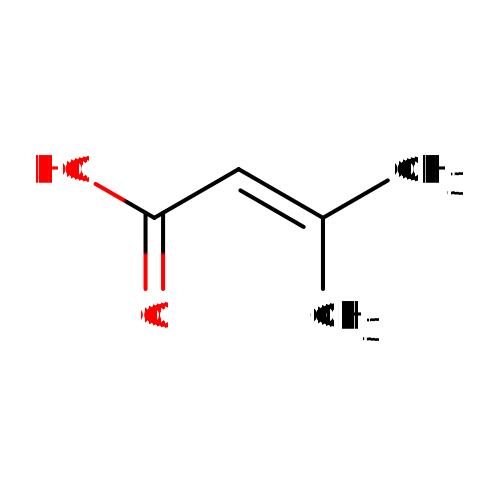
| Description | Senecioic acid, also known as 3-methylcrotonate, 3-methylcrotonic acid or 3,3-dimethylacrylic acid, belongs to the class of organic compounds known as methyl-branched fatty acids. These are fatty acids with an acyl chain that has a methyl branch. Usually, they are saturated (however senecioic acid is unsaturated) and contain only one or more methyl group. However, branches other than methyl may be present. Senecioic acid is a methyl-branched fatty acid that has a but-2-enoic acid skeleton bearing a methyl substituent at position 3. Senecioic acid is an unsaturated fatty acid found in the pheromones of mealybug species, the Madeira cockroach and the Southern long-nosed bat. It also appears in the urine of patients with 3-Methylcrotonic aciduria caused by 3-hydroxy-3-methylglutaryl-CoA lyase deficiency (PMID: 6157502 ) And those with 3-Hydroxy-3-methylglutaric aciduria (PMID: 947633 ). The appearance of 3-methylcrotonic acid in urine indicates a blockage in the sixth step of leucine catabolism, which is the cleavage of 3-hydroxy-3-methylglutaryl-CoA to acetoacetic acid and acetyl-CoA. |
|---|
| Structure | InChI=1S/C5H8O2/c1-4(2)3-5(6)7/h3H,1-2H3,(H,6,7) |
|---|
| Synonyms | | Value | Source |
|---|
| 3,3-Dimethylacrylic acid | ChEBI | | 3-Methyl-2-butenoic acid | ChEBI | | 3-Methylcrotonic acid | ChEBI | | beta,beta-Dimethacrylic acid | ChEBI | | beta,beta-Dimethylacrylic acid | ChEBI | | beta-Methylcrotonic acid | ChEBI | | SENECIC ACID | ChEBI | | 3,3-Dimethylacrylate | Generator | | 3-Methyl-2-butenoate | Generator | | 3-Methylcrotonate | Generator | | b,b-Dimethacrylate | Generator | | b,b-Dimethacrylic acid | Generator | | beta,beta-Dimethacrylate | Generator | | Β,β-dimethacrylate | Generator | | Β,β-dimethacrylic acid | Generator | | b,b-Dimethylacrylate | Generator | | b,b-Dimethylacrylic acid | Generator | | beta,beta-Dimethylacrylate | Generator | | Β,β-dimethylacrylate | Generator | | Β,β-dimethylacrylic acid | Generator | | b-Methylcrotonate | Generator | | b-Methylcrotonic acid | Generator | | beta-Methylcrotonate | Generator | | Β-methylcrotonate | Generator | | Β-methylcrotonic acid | Generator | | SENECate | Generator | | Senecioate | Generator | | 3-Methyl-crotonate | HMDB | | 3-Methyl-crotonic acid | HMDB | | 3-Methylbut-2-enoate | HMDB | | 3-Methylbut-2-enoic acid | HMDB | | b,b-Dimethyl acrylate | HMDB | | b,b-Dimethyl acrylic acid | HMDB | | beta,beta-Dimethyl acrylate | HMDB | | Β,β-dimethyl acrylate | HMDB | | Β,β-dimethyl acrylic acid | HMDB | | Senecioic acid | ChEBI |
|
|---|
| Chemical Formula | C5H8O2 |
|---|
| Average Mass | 100.1158 Da |
|---|
| Monoisotopic Mass | 100.05243 Da |
|---|
| IUPAC Name | 3-methylbut-2-enoic acid |
|---|
| Traditional Name | β,β-dimethacrylate |
|---|
| CAS Registry Number | 541-47-9 |
|---|
| SMILES | CC(C)=CC(O)=O |
|---|
| InChI Identifier | InChI=1S/C5H8O2/c1-4(2)3-5(6)7/h3H,1-2H3,(H,6,7) |
|---|
| InChI Key | YYPNJNDODFVZLE-UHFFFAOYSA-N |
|---|
| Experimental Spectra |
|---|
|
| | Spectrum Type | Description | Depositor Email | Depositor Organization | Depositor | Deposition Date | View |
|---|
| 1D NMR | 1H NMR Spectrum (1D, 600 MHz, H2O, experimental) | Wishart Lab | Wishart Lab | David Wishart | 2021-06-20 | View Spectrum | | 2D NMR | [1H, 13C]-HSQC NMR Spectrum (2D, 600 MHz, H2O, experimental) | Wishart Lab | Wishart Lab | David Wishart | 2021-06-20 | View Spectrum |
| | Predicted Spectra |
|---|
|
| Not Available | | Chemical Shift Submissions |
|---|
|
| Not Available | | Species |
|---|
| Species of Origin | |
|---|
| Chemical Taxonomy |
|---|
| Description | Belongs to the class of organic compounds known as methyl-branched fatty acids. These are fatty acids with an acyl chain that has a methyl branch. Usually, they are saturated and contain only one or more methyl group. However, branches other than methyl may be present. |
|---|
| Kingdom | Organic compounds |
|---|
| Super Class | Lipids and lipid-like molecules |
|---|
| Class | Fatty Acyls |
|---|
| Sub Class | Fatty acids and conjugates |
|---|
| Direct Parent | Methyl-branched fatty acids |
|---|
| Alternative Parents | |
|---|
| Substituents | - Methyl-branched fatty acid
- Unsaturated fatty acid
- Monocarboxylic acid or derivatives
- Carboxylic acid
- Carboxylic acid derivative
- Organic oxygen compound
- Organic oxide
- Hydrocarbon derivative
- Organooxygen compound
- Carbonyl group
- Aliphatic acyclic compound
|
|---|
| Molecular Framework | Aliphatic acyclic compounds |
|---|
| External Descriptors | |
|---|
| Physical Properties |
|---|
| State | Solid |
|---|
| Experimental Properties | |
|---|
| Predicted Properties | |
|---|
| General References | - Wysocki SJ, Wilkinson SP, Hahnel R, Wong CY, Panegyres PK: 3-Hydroxy-3-methylglutaric aciduria, combined with 3-methylglutaconic aciduria. Clin Chim Acta. 1976 Aug 2;70(3):399-406. [PubMed:947633 ]
- Duran M, Ketting D, Wadman SK, Jakobs C, Schutgens RB, Veder HA: Organic acid excretion in a patient with 3-hydroxy-3-methylglutaryl-CoA lyase deficiency: facts and artefacts. Clin Chim Acta. 1978 Dec 1;90(2):187-93. [PubMed:719902 ]
- Roth K, Cohn R, Yandrasitz J, Preti G, Dodd P, Segal S: Beta-methylcrotonic aciduria associated with lactic acidosis. J Pediatr. 1976 Feb;88(2):229-35. [PubMed:1249684 ]
- Farine JP, Sirugue D, Abed-Vieillard D, Everaerts C, Le Quere JL, Bonnard O, Brossut R: The male abdominal glands of Leucophaea maderae: chemical identification of the volatile secretion and sex pheromone function. J Chem Ecol. 2007 Feb;33(2):405-15. doi: 10.1007/s10886-006-9224-7. Epub 2007 Jan 3. [PubMed:17200891 ]
- Joglekar SS, Dhavlikar RS: Microbial transformation of terpenoids. I. Identification of metabolites produced by a pseudomonad from citronellal and citral. Appl Microbiol. 1969 Dec;18(6):1084-7. doi: 10.1128/am.18.6.1084-1087.1969. [PubMed:5370660 ]
|
|---|