| Record Information |
|---|
| Version | 2.0 |
|---|
| Created at | 2006-02-22 11:10:26 UTC |
|---|
| Updated at | 2021-06-29 00:47:13 UTC |
|---|
| NP-MRD ID | NP0000047 |
|---|
| Secondary Accession Numbers | None |
|---|
| Natural Product Identification |
|---|
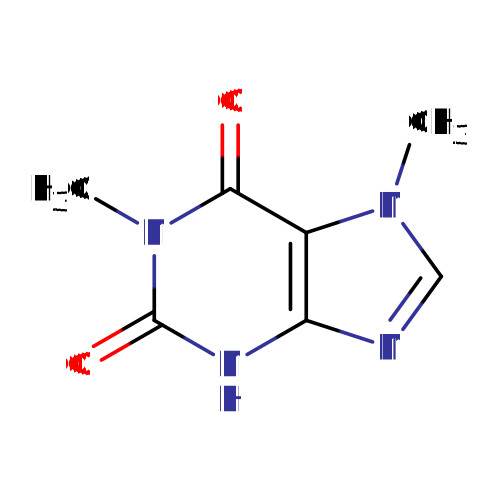
| Common Name | Paraxanthine |
|---|
| Description | Paraxanthine, also known as p-xanthine, belongs to the class of organic compounds known as xanthines. These are purine derivatives with a ketone group conjugated at carbons 2 and 6 of the purine moiety. Paraxanthine exists in all living organisms, ranging from bacteria to humans. Within humans, paraxanthine participates in a number of enzymatic reactions. In particular, paraxanthine and formaldehyde can be biosynthesized from caffeine; which is catalyzed by the enzyme cytochrome P450 1A2. In addition, paraxanthine and acetyl-CoA can be converted into 5-acetylamino-6-formylamino-3-methyluracil through its interaction with the enzyme arylamine N-acetyltransferase 2. In humans, paraxanthine is involved in caffeine metabolism. |
|---|
| Structure | CN1C=NC2=C1C(=O)N(C)C(=O)N2 InChI=1S/C7H8N4O2/c1-10-3-8-5-4(10)6(12)11(2)7(13)9-5/h3H,1-2H3,(H,9,13) |
|---|
| Synonyms | | Value | Source |
|---|
| 3,7-Dihydro-1,7-dimethyl-1H-purine-2,6-dione | ChEBI | | p-Xanthine | ChEBI | | 1,7-Dimethyl-xanthine | HMDB | | 1,7-Dimethylxanthine | HMDB |
|
|---|
| Chemical Formula | C7H8N4O2 |
|---|
| Average Mass | 180.1640 Da |
|---|
| Monoisotopic Mass | 180.06473 Da |
|---|
| IUPAC Name | 1,7-dimethyl-2,3,6,7-tetrahydro-1H-purine-2,6-dione |
|---|
| Traditional Name | paraxanthine |
|---|
| CAS Registry Number | 611-59-6 |
|---|
| SMILES | CN1C=NC2=C1C(=O)N(C)C(O)=N2 |
|---|
| InChI Identifier | InChI=1S/C7H8N4O2/c1-10-3-8-5-4(10)6(12)11(2)7(13)9-5/h3H,1-2H3,(H,9,13) |
|---|
| InChI Key | QUNWUDVFRNGTCO-UHFFFAOYSA-N |
|---|
| Experimental Spectra |
|---|
|
| | Spectrum Type | Description | Depositor Email | Depositor Organization | Depositor | Deposition Date | View |
|---|
| 1D NMR | 1H NMR Spectrum (1D, 500 MHz, H2O, experimental) | Wishart Lab | Wishart Lab | David Wishart | 2021-06-20 | View Spectrum | | 2D NMR | [1H, 13C]-HSQC NMR Spectrum (2D, 600 MHz, H2O, experimental) | Wishart Lab | Wishart Lab | David Wishart | 2021-06-20 | View Spectrum |
| | Predicted Spectra |
|---|
|
| Not Available | | Chemical Shift Submissions |
|---|
|
| Not Available | | Species |
|---|
| Species of Origin | |
|---|
| Chemical Taxonomy |
|---|
| Description | Belongs to the class of organic compounds known as xanthines. These are purine derivatives with a ketone group conjugated at carbons 2 and 6 of the purine moiety. |
|---|
| Kingdom | Organic compounds |
|---|
| Super Class | Organoheterocyclic compounds |
|---|
| Class | Imidazopyrimidines |
|---|
| Sub Class | Purines and purine derivatives |
|---|
| Direct Parent | Xanthines |
|---|
| Alternative Parents | |
|---|
| Substituents | - Xanthine
- 6-oxopurine
- Purinone
- Alkaloid or derivatives
- Pyrimidone
- Hydroxypyrimidine
- N-substituted imidazole
- Pyrimidine
- Imidazole
- Azole
- Heteroaromatic compound
- Lactam
- Azacycle
- Hydrocarbon derivative
- Organic oxide
- Organopnictogen compound
- Organic oxygen compound
- Organooxygen compound
- Organonitrogen compound
- Organic nitrogen compound
- Aromatic heteropolycyclic compound
|
|---|
| Molecular Framework | Aromatic heteropolycyclic compounds |
|---|
| External Descriptors | |
|---|
| Physical Properties |
|---|
| State | Solid |
|---|
| Experimental Properties | | Property | Value | Reference |
|---|
| Melting Point | 351 - 352 °C | Not Available | | Boiling Point | Not Available | Not Available | | Water Solubility | Not Available | Not Available | | LogP | Not Available | Not Available |
|
|---|
| Predicted Properties | |
|---|
| General References | - Christensen M, Andersson K, Dalen P, Mirghani RA, Muirhead GJ, Nordmark A, Tybring G, Wahlberg A, Yasar U, Bertilsson L: The Karolinska cocktail for phenotyping of five human cytochrome P450 enzymes. Clin Pharmacol Ther. 2003 Jun;73(6):517-28. [PubMed:12811361 ]
- Fuhr U, Rost KL: Simple and reliable CYP1A2 phenotyping by the paraxanthine/caffeine ratio in plasma and in saliva. Pharmacogenetics. 1994 Jun;4(3):109-16. [PubMed:7920690 ]
- Tanaka E: Simultaneous determination of caffeine and its primary demethylated metabolites in human plasma by high-performance liquid chromatography. J Chromatogr. 1992 Mar 27;575(2):311-4. [PubMed:1629311 ]
- Horrigan LA, Kelly JP, Connor TJ: Immunomodulatory effects of caffeine: friend or foe? Pharmacol Ther. 2006 Sep;111(3):877-92. Epub 2006 Mar 15. [PubMed:16540173 ]
- Holstege A, Kurz M, Weinbeck M, Gerok W: Excretion of caffeine and its primary degradation products into bile. J Hepatol. 1993 Jan;17(1):67-73. [PubMed:8445222 ]
- Granfors MT, Backman JT, Laitila J, Neuvonen PJ: Oral contraceptives containing ethinyl estradiol and gestodene markedly increase plasma concentrations and effects of tizanidine by inhibiting cytochrome P450 1A2. Clin Pharmacol Ther. 2005 Oct;78(4):400-11. [PubMed:16198659 ]
- Blanchard J, Weber CW, Shearer LE: HPLC analysis of methylxanthines in human breast milk. J Chromatogr Sci. 1990 Dec;28(12):640-2. [PubMed:2292610 ]
- Delahunty T, Schoendorfer D: Caffeine demethylation monitoring using a transdermal sweat patch. J Anal Toxicol. 1998 Nov-Dec;22(7):596-600. [PubMed:9847011 ]
- Holland DT, Godfredsen KA, Page T, Connor JD: Simple high-performance liquid chromatography method for the simultaneous determination of serum caffeine and paraxanthine following rapid sample preparation. J Chromatogr B Biomed Sci Appl. 1998 Apr 10;707(1-2):105-10. [PubMed:9613939 ]
- Fuhr U, Rost KL, Engelhardt R, Sachs M, Liermann D, Belloc C, Beaune P, Janezic S, Grant D, Meyer UA, Staib AH: Evaluation of caffeine as a test drug for CYP1A2, NAT2 and CYP2E1 phenotyping in man by in vivo versus in vitro correlations. Pharmacogenetics. 1996 Apr;6(2):159-76. [PubMed:9156694 ]
- Zaigler M, Rietbrock S, Szymanski J, Dericks-Tan JS, Staib AH, Fuhr U: Variation of CYP1A2-dependent caffeine metabolism during menstrual cycle in healthy women. Int J Clin Pharmacol Ther. 2000 May;38(5):235-44. [PubMed:10839467 ]
- Blanchard J, Weber CW, Shearer LE: Methylxanthine levels in breast milk of lactating women of different ethnic and socioeconomic classes. Biopharm Drug Dispos. 1992 Apr;13(3):187-96. [PubMed:1576327 ]
- Wahllander A, Renner E, Karlaganis G: High-performance liquid chromatographic determination of dimethylxanthine metabolites of caffeine in human plasma. J Chromatogr. 1985 Mar 22;338(2):369-75. [PubMed:3998024 ]
- Koch JP, ten Tusscher GW, Koppe JG, Guchelaar HJ: Validation of a high-performance liquid chromatography assay for quantification of caffeine and paraxanthine in human serum in the context of CYP1A2 phenotyping. Biomed Chromatogr. 1999 Jun;13(4):309-14. [PubMed:10416066 ]
- Sachse C, Ruschen S, Dettling M, Schley J, Bauer S, Muller-Oerlinghausen B, Roots I, Brockmoller J: Flavin monooxygenase 3 (FMO3) polymorphism in a white population: allele frequencies, mutation linkage, and functional effects on clozapine and caffeine metabolism. Clin Pharmacol Ther. 1999 Oct;66(4):431-8. [PubMed:10546928 ]
|
|---|