| Record Information |
|---|
| Version | 2.0 |
|---|
| Created at | 2022-09-08 16:46:32 UTC |
|---|
| Updated at | 2022-09-08 16:46:33 UTC |
|---|
| NP-MRD ID | NP0270729 |
|---|
| Secondary Accession Numbers | None |
|---|
| Natural Product Identification |
|---|
| Common Name | hexenal |
|---|
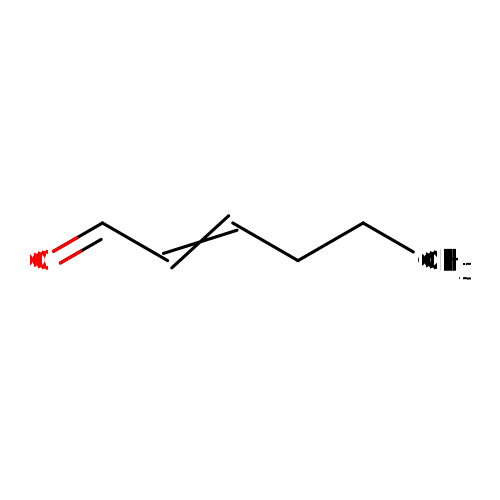
| Description | 2-Hexenal, also known as 2-hexenaldehyde or 3-propyl-acrolein, belongs to the class of organic compounds known as medium-chain aldehydes. These are an aldehyde with a chain length containing between 6 and 12 carbon atoms. 2-Hexenal is an extremely weak basic (essentially neutral) compound (based on its pKa). 2-Hexenal is a sweet, almond, and apple tasting compound. Outside of the human body, 2-Hexenal has been detected, but not quantified in, several different foods, such as sweet cherries, asparagus, blackcurrants, black elderberries, and cucumbers. This could make 2-hexenal a potential biomarker for the consumption of these foods. 2-Hexenal is a potentially toxic compound. Uremic toxins tend to accumulate in the blood either through dietary excess or through poor filtration by the kidneys. This seems to be mediated by the direct binding or inhibition by uremic toxins of the enzyme NADPH oxidase (especially NOX4 which is abundant in the kidneys and heart) (A7868). Shortness of breath from fluid buildup in the space between the lungs and the chest wall (pleural effusion) can also be present. Increased levels of uremic toxins can stimulate the production of reactive oxygen species. Abnormal bleeding, such as bleeding spontaneously or profusely from a very minor injury can also occur. It can also cause changes in mental status, such as confusion, reduced awareness, agitation, psychosis, seizures, and coma. hexenal is found in Aethus indicus, Ageratum conyzoides, Arctium lappa, Aristolochia debilis, Basella alba, Capillipedium parviflorum, Capparis spinosa, Clinopodium serpyllifolium, Echinophora tenuifolia, Euploea sylvester, Farfugium japonicum, Gonioctena viminalis, Medicago sativa, Origanum sipyleum, Peristeria elata, Pimenta racemosa, Quercus agrifolia, Riptortus pedestris, Robinia pseudoacacia, Salvia sclarea and Tripleurospermum maritimum. hexenal was first documented in 2010 (PMID: 20936263). Chronic exposure to uremic toxins can lead to a number of conditions including renal damage, chronic kidney disease and cardiovascular disease (PMID: 26475511). |
|---|
| Structure | InChI=1S/C6H10O/c1-2-3-4-5-6-7/h4-6H,2-3H2,1H3 |
|---|
| Synonyms | | Value | Source |
|---|
| 2-Hexenaldehyde | ChEBI | | 3-Propyl-acrolein | ChEBI | | alpha,beta-Hexylenaldehyde | ChEBI | | Alpha.beta-hexylenaldehyd | ChEBI | | beta-Propylacrolein | ChEBI | | Hexen-2-al | ChEBI | | Hexen-2-en-1-al | ChEBI | | Hexylenic aldehyde | ChEBI | | Leaf aldehyde | ChEBI | | a,b-Hexylenaldehyde | Generator | | Α,β-hexylenaldehyde | Generator | | b-Propylacrolein | Generator | | Β-propylacrolein | Generator | | 2-Hexen-1-al | HMDB | | 3-Propyl acrolein | HMDB | | 3-Propylacrolein | HMDB | | beta-Propyl acrolein | HMDB | | FEMA 2560 | HMDB | | Hex-2-en-1-al | HMDB | | Hex-2-enal | HMDB | | Hexenal | HMDB | | Evipan | MeSH | | Hexobarbital | MeSH | | Hexobarbital, sodium | MeSH | | Hexobarbitone | MeSH | | Sodium hexobarbital | MeSH |
|
|---|
| Chemical Formula | C6H10O |
|---|
| Average Mass | 98.1430 Da |
|---|
| Monoisotopic Mass | 98.07316 Da |
|---|
| IUPAC Name | hex-2-enal |
|---|
| Traditional Name | hexenal |
|---|
| CAS Registry Number | Not Available |
|---|
| SMILES | CCCC=CC=O |
|---|
| InChI Identifier | InChI=1S/C6H10O/c1-2-3-4-5-6-7/h4-6H,2-3H2,1H3 |
|---|
| InChI Key | MBDOYVRWFFCFHM-UHFFFAOYSA-N |
|---|
| Experimental Spectra |
|---|
|
| Not Available | | Predicted Spectra |
|---|
|
| | Spectrum Type | Description | Depositor ID | Depositor Organization | Depositor | Deposition Date | View |
|---|
| 1D NMR | 13C NMR Spectrum (1D, 25 MHz, H2O, predicted) | Wishart Lab | Wishart Lab | David Wishart | 2021-06-20 | View Spectrum | | 1D NMR | 1H NMR Spectrum (1D, 100 MHz, H2O, predicted) | Wishart Lab | Wishart Lab | David Wishart | 2021-06-20 | View Spectrum | | 1D NMR | 13C NMR Spectrum (1D, 252 MHz, H2O, predicted) | Wishart Lab | Wishart Lab | David Wishart | 2021-06-20 | View Spectrum | | 1D NMR | 1H NMR Spectrum (1D, 1000 MHz, H2O, predicted) | Wishart Lab | Wishart Lab | David Wishart | 2021-06-20 | View Spectrum | | 1D NMR | 13C NMR Spectrum (1D, 50 MHz, H2O, predicted) | Wishart Lab | Wishart Lab | David Wishart | 2021-06-20 | View Spectrum | | 1D NMR | 1H NMR Spectrum (1D, 200 MHz, H2O, predicted) | Wishart Lab | Wishart Lab | David Wishart | 2021-06-20 | View Spectrum | | 1D NMR | 13C NMR Spectrum (1D, 75 MHz, H2O, predicted) | Wishart Lab | Wishart Lab | David Wishart | 2021-06-20 | View Spectrum | | 1D NMR | 1H NMR Spectrum (1D, 300 MHz, H2O, predicted) | Wishart Lab | Wishart Lab | David Wishart | 2021-06-20 | View Spectrum | | 1D NMR | 13C NMR Spectrum (1D, 101 MHz, H2O, predicted) | Wishart Lab | Wishart Lab | David Wishart | 2021-06-20 | View Spectrum | | 1D NMR | 1H NMR Spectrum (1D, 400 MHz, H2O, predicted) | Wishart Lab | Wishart Lab | David Wishart | 2021-06-20 | View Spectrum | | 1D NMR | 13C NMR Spectrum (1D, 126 MHz, H2O, predicted) | Wishart Lab | Wishart Lab | David Wishart | 2021-06-20 | View Spectrum | | 1D NMR | 1H NMR Spectrum (1D, 500 MHz, H2O, predicted) | Wishart Lab | Wishart Lab | David Wishart | 2021-06-20 | View Spectrum | | 1D NMR | 13C NMR Spectrum (1D, 151 MHz, H2O, predicted) | Wishart Lab | Wishart Lab | David Wishart | 2021-06-20 | View Spectrum | | 1D NMR | 1H NMR Spectrum (1D, 600 MHz, H2O, predicted) | Wishart Lab | Wishart Lab | David Wishart | 2021-06-20 | View Spectrum | | 1D NMR | 13C NMR Spectrum (1D, 176 MHz, H2O, predicted) | Wishart Lab | Wishart Lab | David Wishart | 2021-06-20 | View Spectrum | | 1D NMR | 1H NMR Spectrum (1D, 700 MHz, H2O, predicted) | Wishart Lab | Wishart Lab | David Wishart | 2021-06-20 | View Spectrum | | 1D NMR | 13C NMR Spectrum (1D, 201 MHz, H2O, predicted) | Wishart Lab | Wishart Lab | David Wishart | 2021-06-20 | View Spectrum | | 1D NMR | 1H NMR Spectrum (1D, 800 MHz, H2O, predicted) | Wishart Lab | Wishart Lab | David Wishart | 2021-06-20 | View Spectrum | | 1D NMR | 13C NMR Spectrum (1D, 226 MHz, H2O, predicted) | Wishart Lab | Wishart Lab | David Wishart | 2021-06-20 | View Spectrum | | 1D NMR | 1H NMR Spectrum (1D, 900 MHz, H2O, predicted) | Wishart Lab | Wishart Lab | David Wishart | 2021-06-20 | View Spectrum |
| | Chemical Shift Submissions |
|---|
|
| Not Available | | Species |
|---|
| Species of Origin | |
|---|
| Chemical Taxonomy |
|---|
| Description | Belongs to the class of organic compounds known as medium-chain aldehydes. These are an aldehyde with a chain length containing between 6 and 12 carbon atoms. |
|---|
| Kingdom | Organic compounds |
|---|
| Super Class | Organic oxygen compounds |
|---|
| Class | Organooxygen compounds |
|---|
| Sub Class | Carbonyl compounds |
|---|
| Direct Parent | Medium-chain aldehydes |
|---|
| Alternative Parents | |
|---|
| Substituents | - Medium-chain aldehyde
- Enal
- Alpha,beta-unsaturated aldehyde
- Organic oxide
- Hydrocarbon derivative
- Aliphatic acyclic compound
|
|---|
| Molecular Framework | Aliphatic acyclic compounds |
|---|
| External Descriptors | |
|---|
| Physical Properties |
|---|
| State | Not Available |
|---|
| Experimental Properties | | Property | Value | Reference |
|---|
| Melting Point | Not Available | Not Available | | Boiling Point | Not Available | Not Available | | Water Solubility | Not Available | Not Available | | LogP | Not Available | Not Available |
|
|---|
| Predicted Properties | |
|---|