| Record Information |
|---|
| Version | 2.0 |
|---|
| Created at | 2022-04-28 18:00:35 UTC |
|---|
| Updated at | 2022-04-28 18:00:35 UTC |
|---|
| NP-MRD ID | NP0072701 |
|---|
| Secondary Accession Numbers | None |
|---|
| Natural Product Identification |
|---|
| Common Name | (+)-Acuminatin |
|---|
| Description | Acuminatin belongs to the class of organic compounds known as 2-arylbenzofuran flavonoids. These are phenylpropanoids containing the 2-phenylbenzofuran moiety. Acuminatin is a secondary metabolite. Secondary metabolites are metabolically or physiologically non-essential metabolites that may serve a role as defense or signalling molecules. In some cases they are simply molecules that arise from the incomplete metabolism of other secondary metabolites. (+)-Acuminatin is found in Epimedium pubescens, Juniperus sabina, Machilus thunbergii, Magnolia acuminata, Magnolia denudata , Magnolia ovata, Nectandra amazonum, Piper kadsura and Sesamum indicum. (+)-Acuminatin was first documented in 2002 (PMID: 12003531). Based on a literature review a significant number of articles have been published on acuminatin (PMID: 23157012) (PMID: 27452451) (PMID: 24066589) (PMID: 19658431) (PMID: 15554262) (PMID: 15256759). |
|---|
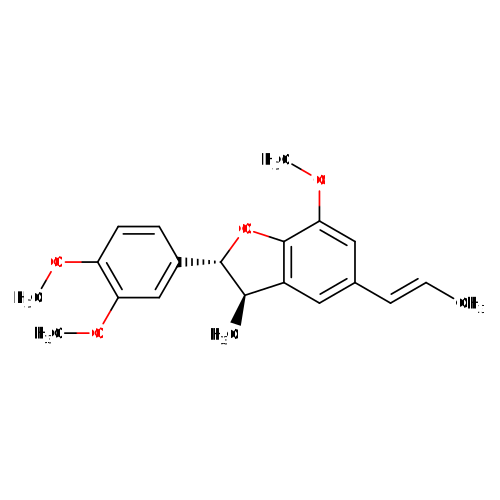
| Structure | COC1=C2O[C@H]([C@H](C)C2=CC(\C=C\C)=C1)C1=CC(OC)=C(OC)C=C1 InChI=1S/C21H24O4/c1-6-7-14-10-16-13(2)20(25-21(16)19(11-14)24-5)15-8-9-17(22-3)18(12-15)23-4/h6-13,20H,1-5H3/b7-6+/t13-,20-/m1/s1 |
|---|
| Synonyms | | Value | Source |
|---|
| (+)-Acuminatin | ChEBI |
|
|---|
| Chemical Formula | C21H24O4 |
|---|
| Average Mass | 340.4190 Da |
|---|
| Monoisotopic Mass | 340.16746 Da |
|---|
| IUPAC Name | (2R,3R)-2-(3,4-dimethoxyphenyl)-7-methoxy-3-methyl-5-[(1E)-prop-1-en-1-yl]-2,3-dihydro-1-benzofuran |
|---|
| Traditional Name | acuminatin |
|---|
| CAS Registry Number | Not Available |
|---|
| SMILES | COC1=C2O[C@H]([C@H](C)C2=CC(\C=C\C)=C1)C1=CC(OC)=C(OC)C=C1 |
|---|
| InChI Identifier | InChI=1S/C21H24O4/c1-6-7-14-10-16-13(2)20(25-21(16)19(11-14)24-5)15-8-9-17(22-3)18(12-15)23-4/h6-13,20H,1-5H3/b7-6+/t13-,20-/m1/s1 |
|---|
| InChI Key | ITFKWUHXYCXXFF-XSOBDOKWSA-N |
|---|
| Experimental Spectra |
|---|
|
| Not Available | | Predicted Spectra |
|---|
|
| | Spectrum Type | Description | Depositor ID | Depositor Organization | Depositor | Deposition Date | View |
|---|
| 1D NMR | 13C NMR Spectrum (1D, 25 MHz, D2O, predicted) | Wishart Lab | Wishart Lab | David Wishart | 2021-06-20 | View Spectrum | | 1D NMR | 1H NMR Spectrum (1D, 100 MHz, D2O, predicted) | Wishart Lab | Wishart Lab | David Wishart | 2021-06-20 | View Spectrum | | 1D NMR | 13C NMR Spectrum (1D, 252 MHz, D2O, predicted) | Wishart Lab | Wishart Lab | David Wishart | 2021-06-20 | View Spectrum | | 1D NMR | 1H NMR Spectrum (1D, 1000 MHz, D2O, predicted) | Wishart Lab | Wishart Lab | David Wishart | 2021-06-20 | View Spectrum | | 1D NMR | 13C NMR Spectrum (1D, 50 MHz, D2O, predicted) | Wishart Lab | Wishart Lab | David Wishart | 2021-06-20 | View Spectrum | | 1D NMR | 1H NMR Spectrum (1D, 200 MHz, D2O, predicted) | Wishart Lab | Wishart Lab | David Wishart | 2021-06-20 | View Spectrum | | 1D NMR | 13C NMR Spectrum (1D, 75 MHz, D2O, predicted) | Wishart Lab | Wishart Lab | David Wishart | 2021-06-20 | View Spectrum | | 1D NMR | 1H NMR Spectrum (1D, 300 MHz, D2O, predicted) | Wishart Lab | Wishart Lab | David Wishart | 2021-06-20 | View Spectrum | | 1D NMR | 13C NMR Spectrum (1D, 101 MHz, D2O, predicted) | Wishart Lab | Wishart Lab | David Wishart | 2021-06-20 | View Spectrum | | 1D NMR | 1H NMR Spectrum (1D, 400 MHz, D2O, predicted) | Wishart Lab | Wishart Lab | David Wishart | 2021-06-20 | View Spectrum | | 1D NMR | 13C NMR Spectrum (1D, 126 MHz, D2O, predicted) | Wishart Lab | Wishart Lab | David Wishart | 2021-06-20 | View Spectrum | | 1D NMR | 1H NMR Spectrum (1D, 500 MHz, D2O, predicted) | Wishart Lab | Wishart Lab | David Wishart | 2021-06-20 | View Spectrum | | 1D NMR | 13C NMR Spectrum (1D, 151 MHz, D2O, predicted) | Wishart Lab | Wishart Lab | David Wishart | 2021-06-20 | View Spectrum | | 1D NMR | 1H NMR Spectrum (1D, 600 MHz, D2O, predicted) | Wishart Lab | Wishart Lab | David Wishart | 2021-06-20 | View Spectrum | | 1D NMR | 13C NMR Spectrum (1D, 176 MHz, D2O, predicted) | Wishart Lab | Wishart Lab | David Wishart | 2021-06-20 | View Spectrum | | 1D NMR | 1H NMR Spectrum (1D, 700 MHz, D2O, predicted) | Wishart Lab | Wishart Lab | David Wishart | 2021-06-20 | View Spectrum | | 1D NMR | 13C NMR Spectrum (1D, 201 MHz, D2O, predicted) | Wishart Lab | Wishart Lab | David Wishart | 2021-06-20 | View Spectrum | | 1D NMR | 1H NMR Spectrum (1D, 800 MHz, D2O, predicted) | Wishart Lab | Wishart Lab | David Wishart | 2021-06-20 | View Spectrum | | 1D NMR | 13C NMR Spectrum (1D, 226 MHz, D2O, predicted) | Wishart Lab | Wishart Lab | David Wishart | 2021-06-20 | View Spectrum | | 1D NMR | 1H NMR Spectrum (1D, 900 MHz, D2O, predicted) | Wishart Lab | Wishart Lab | David Wishart | 2021-06-20 | View Spectrum |
| | Chemical Shift Submissions |
|---|
|
| Not Available | | Species |
|---|
| Species of Origin | |
|---|
| Chemical Taxonomy |
|---|
| Description | Belongs to the class of organic compounds known as 2-arylbenzofuran flavonoids. These are phenylpropanoids containing the 2-phenylbenzofuran moiety. |
|---|
| Kingdom | Organic compounds |
|---|
| Super Class | Phenylpropanoids and polyketides |
|---|
| Class | 2-arylbenzofuran flavonoids |
|---|
| Sub Class | Not Available |
|---|
| Direct Parent | 2-arylbenzofuran flavonoids |
|---|
| Alternative Parents | |
|---|
| Substituents | - 2-arylbenzofuran flavonoid
- Neolignan skeleton
- Dimethoxybenzene
- O-dimethoxybenzene
- Benzofuran
- Coumaran
- Anisole
- Phenoxy compound
- Phenol ether
- Styrene
- Methoxybenzene
- Alkyl aryl ether
- Monocyclic benzene moiety
- Benzenoid
- Ether
- Organoheterocyclic compound
- Oxacycle
- Organooxygen compound
- Organic oxygen compound
- Hydrocarbon derivative
- Aromatic heteropolycyclic compound
|
|---|
| Molecular Framework | Aromatic heteropolycyclic compounds |
|---|
| External Descriptors | Not Available |
|---|
| Physical Properties |
|---|
| State | Not Available |
|---|
| Experimental Properties | | Property | Value | Reference |
|---|
| Melting Point | Not Available | Not Available | | Boiling Point | Not Available | Not Available | | Water Solubility | Not Available | Not Available | | LogP | Not Available | Not Available |
|
|---|
| Predicted Properties | |
|---|
| General References | - Roy SC, Rana KK, Guin C: Short and stereoselective total synthesis of furano lignans (+/-)-dihydrosesamin, (+/-)-lariciresinol dimethyl ether, (+/-)-acuminatin methyl ether, (+/-)-sanshodiol methyl ether, (+/-)-lariciresinol, (+/-)-acuminatin, and (+/-)-lariciresinol monomethyl ether and furofuran lignans (+/-)-sesamin, (+/-)-eudesmin, (+/-)-piperitol methyl ether, (+/-)-pinoresinol, (+/-)-piperitol, and (+/-)-pinoresinol monomethyl ether by radical cyclization of epoxides using a transition-metal radical source. J Org Chem. 2002 May 17;67(10):3242-8. doi: 10.1021/jo010857u. [PubMed:12003531 ]
- Barros LF, Ehrenfried CA, Riva D, Barison A, de Mello-Silva R, Stefanello ME: Essential oil and other constituents from Magnolia ovata fruit. Nat Prod Commun. 2012 Oct;7(10):1365-7. [PubMed:23157012 ]
- Ding DD, Wang YH, Chen YH, Mei RQ, Yang J, Luo JF, Li Y, Long CL, Kong Y: Amides and neolignans from the aerial parts of Piper bonii. Phytochemistry. 2016 Sep;129:36-44. doi: 10.1016/j.phytochem.2016.07.004. Epub 2016 Jul 21. [PubMed:27452451 ]
- Zhang HF, Yan LH, Zhang QW, Wang ZM: [Flavonoids from leaves of Epimedium pubescens]. Zhongguo Zhong Yao Za Zhi. 2013 Jun;38(12):1942-6. [PubMed:24066589 ]
- Barros LF, Barison A, Salvador MJ, de Mello-Silva R, Cabral EC, Eberlin MN, Stefanello ME: Constituents of the leaves of Magnolia ovata. J Nat Prod. 2009 Aug;72(8):1529-32. doi: 10.1021/np900203y. [PubMed:19658431 ]
- Lee JS, Kim J, Yu YU, Kim YC: Inhibition of phospholipase Cgamma1 and cancer cell proliferation by lignans and flavans from Machilus thunbergii. Arch Pharm Res. 2004 Oct;27(10):1043-7. doi: 10.1007/BF02975429. [PubMed:15554262 ]
- Li G, Lee CS, Woo MH, Lee SH, Chang HW, Son JK: Lignans from the bark of Machilus thunbergii and their DNA topoisomerases I and II inhibition and cytotoxicity. Biol Pharm Bull. 2004 Jul;27(7):1147-50. doi: 10.1248/bpb.27.1147. [PubMed:15256759 ]
|
|---|