| Record Information |
|---|
| Version | 2.0 |
|---|
| Created at | 2022-03-17 21:08:42 UTC |
|---|
| Updated at | 2022-03-17 21:08:42 UTC |
|---|
| NP-MRD ID | NP0049201 |
|---|
| Secondary Accession Numbers | None |
|---|
| Natural Product Identification |
|---|
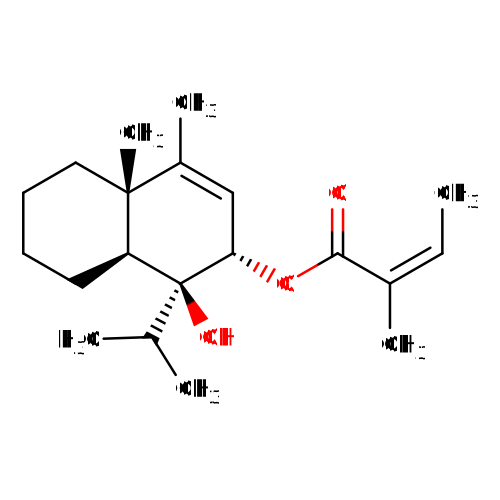
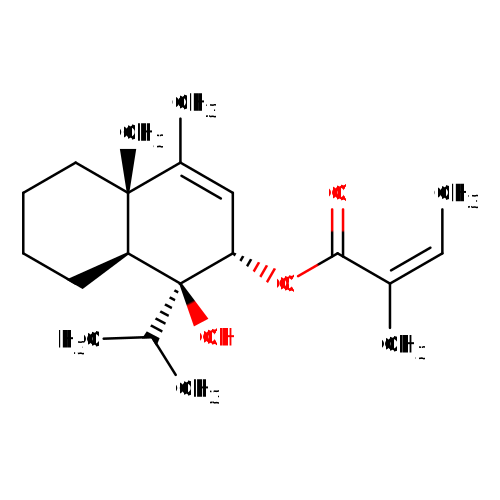
| Common Name | Crispane |
|---|
| Description | Crispane, also known as lasidiol angelate, belongs to the class of organic compounds known as bicyclic monoterpenoids. These are monoterpenoids containing exactly 2 rings, which are fused to each other. Crispane is an extremely weak basic (essentially neutral) compound (based on its pKa). Outside of the human body, Crispane has been detected, but not quantified in, herbs and spices and parsley. Crispane is found in Heliopsis helianthoides. Crispane was first documented in 1998 (PMID: 11711088). This could make crispane a potential biomarker for the consumption of these foods. |
|---|
| Structure | C\C=C(\C)C(=O)O[C@H]1C=C(C)[C@@]2(C)CCCC[C@]2([H])[C@@]1(O)C(C)C InChI=1S/C20H32O3/c1-7-14(4)18(21)23-17-12-15(5)19(6)11-9-8-10-16(19)20(17,22)13(2)3/h7,12-13,16-17,22H,8-11H2,1-6H3/b14-7-/t16-,17-,19+,20-/m0/s1 |
|---|
| Synonyms | | Value | Source |
|---|
| Lasidiol angelate | HMDB | | (1S,2S,4AS,8as)-1-hydroxy-4,4a-dimethyl-1-(propan-2-yl)-1,2,4a,5,6,7,8,8a-octahydronaphthalen-2-yl (2Z)-2-methylbut-2-enoic acid | Generator |
|
|---|
| Chemical Formula | C20H32O3 |
|---|
| Average Mass | 320.4663 Da |
|---|
| Monoisotopic Mass | 320.23514 Da |
|---|
| IUPAC Name | (1S,2S,4aS,8aS)-1-hydroxy-4,4a-dimethyl-1-(propan-2-yl)-1,2,4a,5,6,7,8,8a-octahydronaphthalen-2-yl (2Z)-2-methylbut-2-enoate |
|---|
| Traditional Name | (1S,2S,4aS,8aS)-1-hydroxy-1-isopropyl-4,4a-dimethyl-2,5,6,7,8,8a-hexahydronaphthalen-2-yl (2Z)-2-methylbut-2-enoate |
|---|
| CAS Registry Number | 79803-28-4 |
|---|
| SMILES | C\C=C(\C)C(=O)O[C@H]1C=C(C)[C@@]2(C)CCCC[C@]2([H])[C@@]1(O)C(C)C |
|---|
| InChI Identifier | InChI=1S/C20H32O3/c1-7-14(4)18(21)23-17-12-15(5)19(6)11-9-8-10-16(19)20(17,22)13(2)3/h7,12-13,16-17,22H,8-11H2,1-6H3/b14-7-/t16-,17-,19+,20-/m0/s1 |
|---|
| InChI Key | NXPBEWQMSGGADR-XUDYDAPFSA-N |
|---|
| Experimental Spectra |
|---|
|
| Not Available | | Predicted Spectra |
|---|
|
| Not Available | | Chemical Shift Submissions |
|---|
|
| Not Available | | Species |
|---|
| Species of Origin | |
|---|
| Chemical Taxonomy |
|---|
| Description | Belongs to the class of organic compounds known as bicyclic monoterpenoids. These are monoterpenoids containing exactly 2 rings, which are fused to each other. |
|---|
| Kingdom | Organic compounds |
|---|
| Super Class | Lipids and lipid-like molecules |
|---|
| Class | Prenol lipids |
|---|
| Sub Class | Monoterpenoids |
|---|
| Direct Parent | Bicyclic monoterpenoids |
|---|
| Alternative Parents | |
|---|
| Substituents | - Bicyclic monoterpenoid
- P-menthane monoterpenoid
- Fatty acid ester
- Fatty acyl
- Alpha,beta-unsaturated carboxylic ester
- Enoate ester
- Tertiary alcohol
- Carboxylic acid ester
- Carboxylic acid derivative
- Monocarboxylic acid or derivatives
- Hydrocarbon derivative
- Organic oxide
- Alcohol
- Carbonyl group
- Organic oxygen compound
- Organooxygen compound
- Aliphatic homopolycyclic compound
|
|---|
| Molecular Framework | Aliphatic homopolycyclic compounds |
|---|
| External Descriptors | Not Available |
|---|
| Physical Properties |
|---|
| State | Not Available |
|---|
| Experimental Properties | | Property | Value | Reference |
|---|
| Melting Point | Not Available | Not Available | | Boiling Point | Not Available | Not Available | | Water Solubility | Not Available | Not Available | | LogP | Not Available | Not Available |
|
|---|
| Predicted Properties | |
|---|